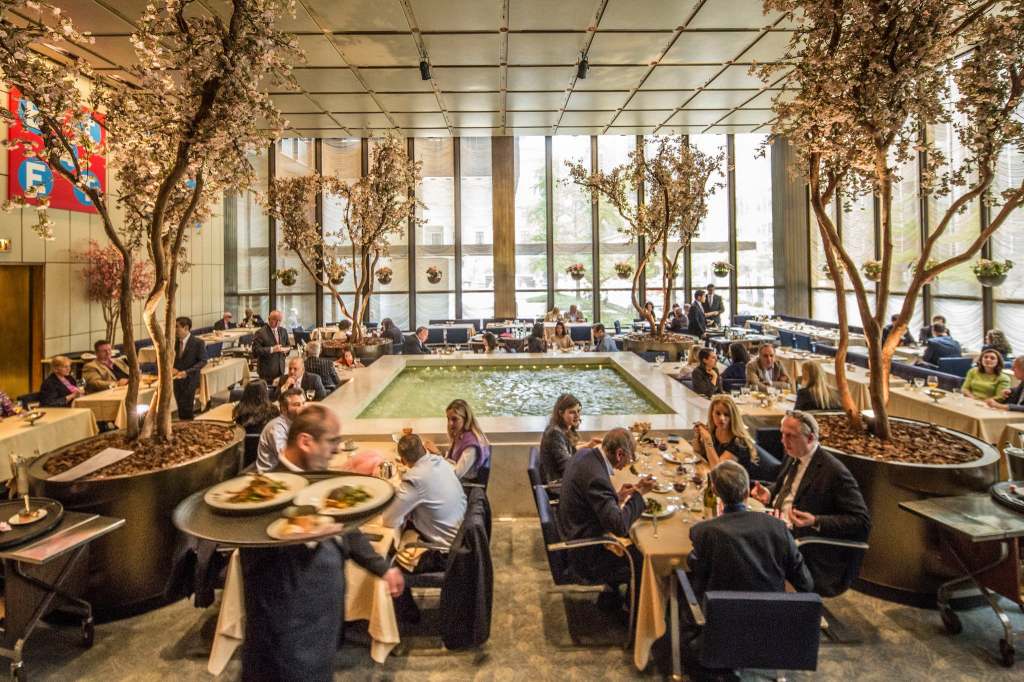
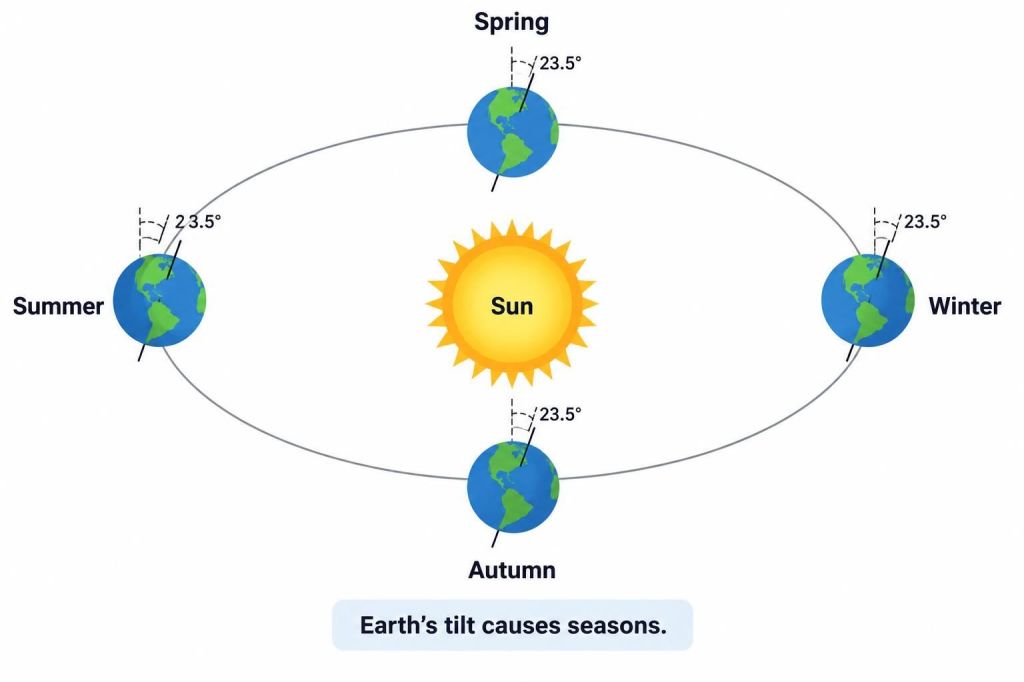
There are four seasons due to the Earth’s tilt which is approximately 23.5 degrees from the perpendicular to its orbital plane. Four seasons, not the restaurant, the one that served New American cuisine in Midtown Manhattan until 2019. I mean the other four, and we are in the midst of what is perhaps my favorite: autumn.
The fancy restaurant, not to be confused with the fancier planetary motion
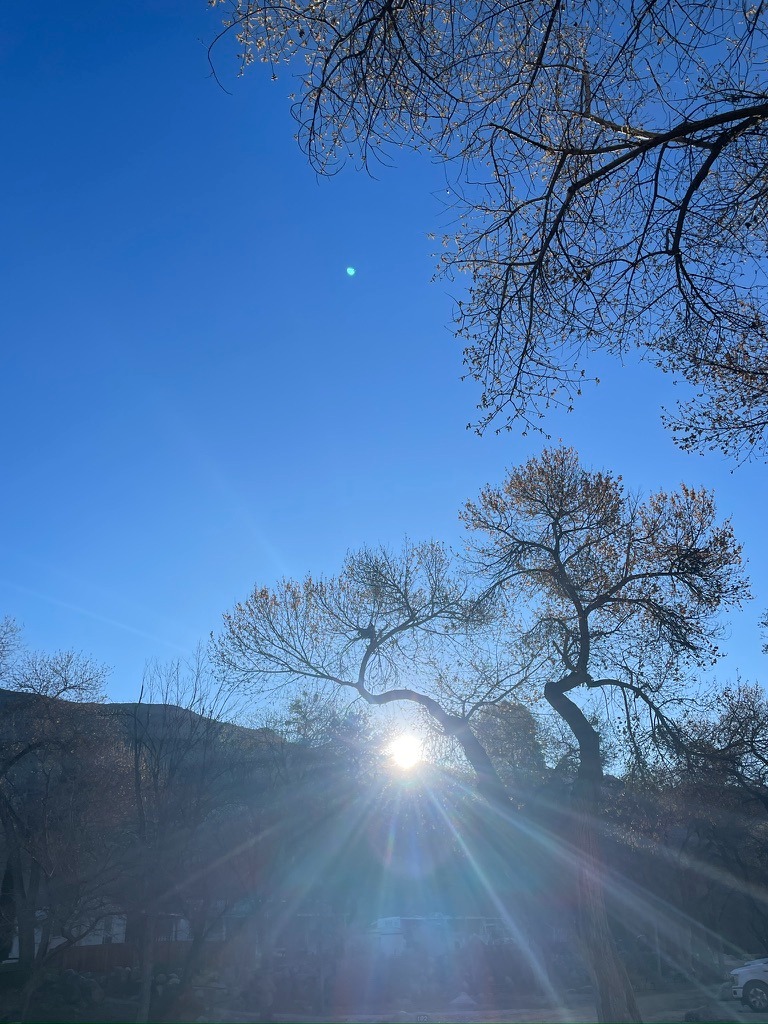
Say “autumn” and most people think of color. Shorter days tell the deciduous trees it’s time to shut down for winter, the chlorophyll fades, and the show begins. Oh, and the temperatures finally retreat from the intensely hot summer we experience in Central California where we live. There’s also, the World Series (Sorry Tampa Bay), the WNBA (Go Valkes!) football (Ya boy Niners), Halloween and brats (Don’t tell my cardiologist).
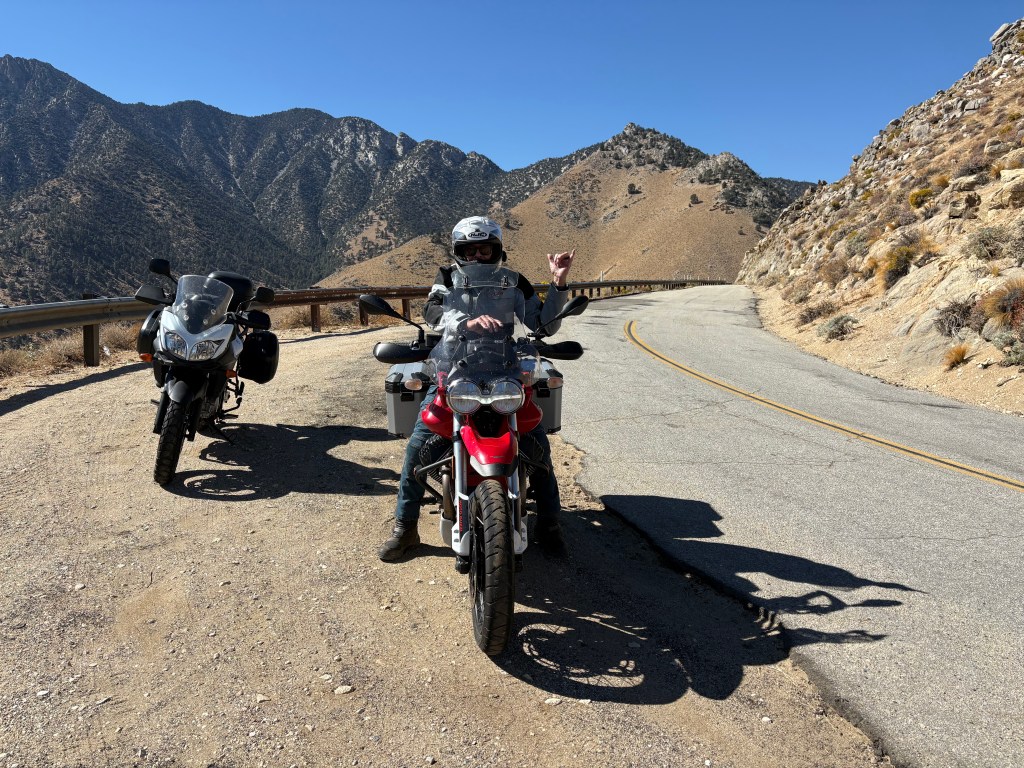
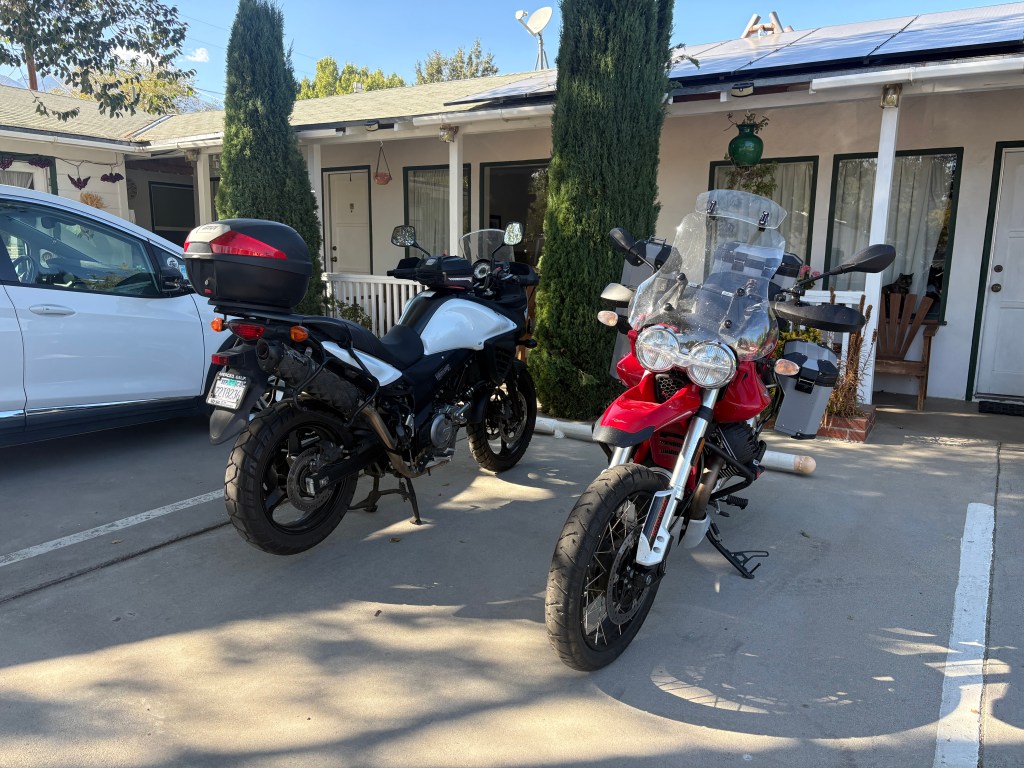
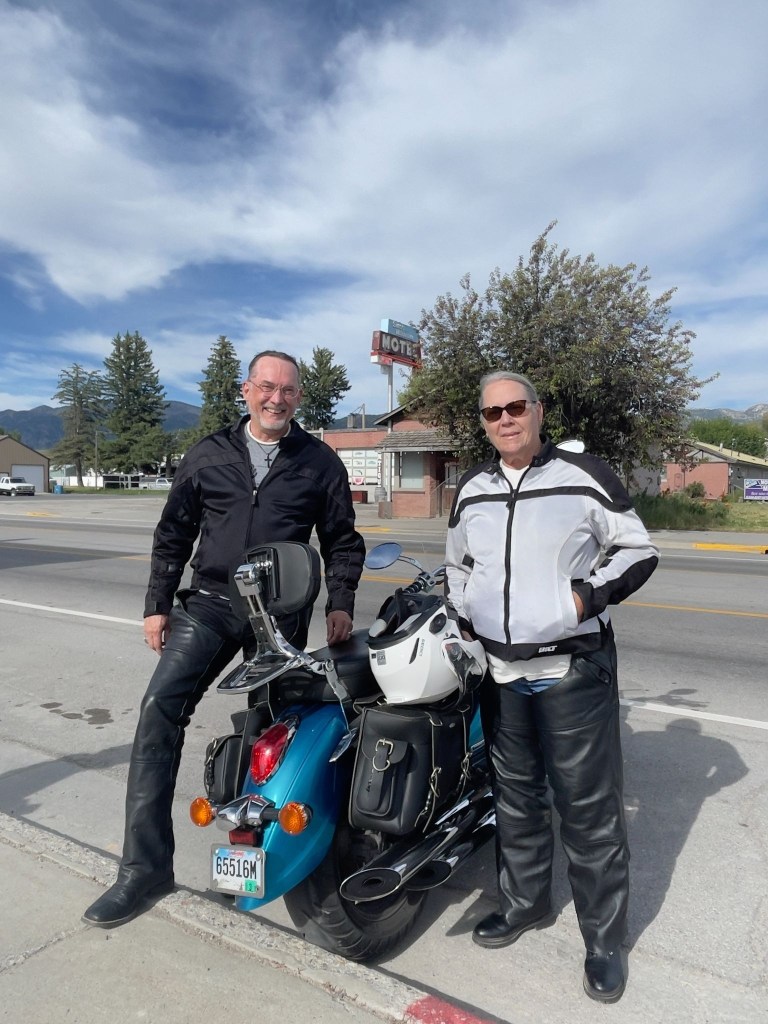
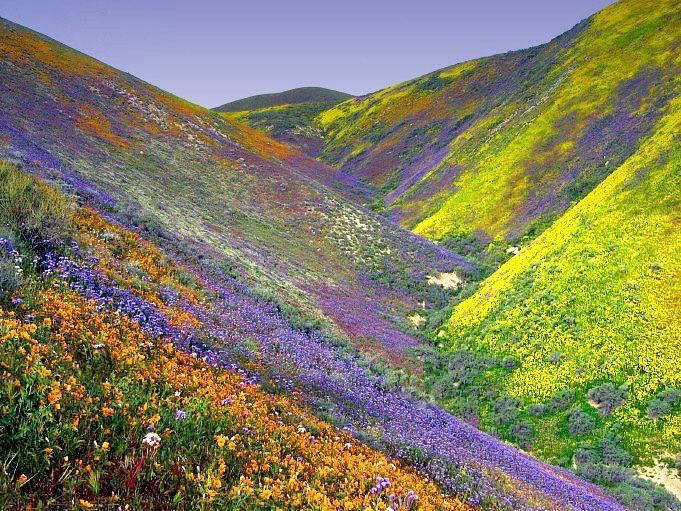
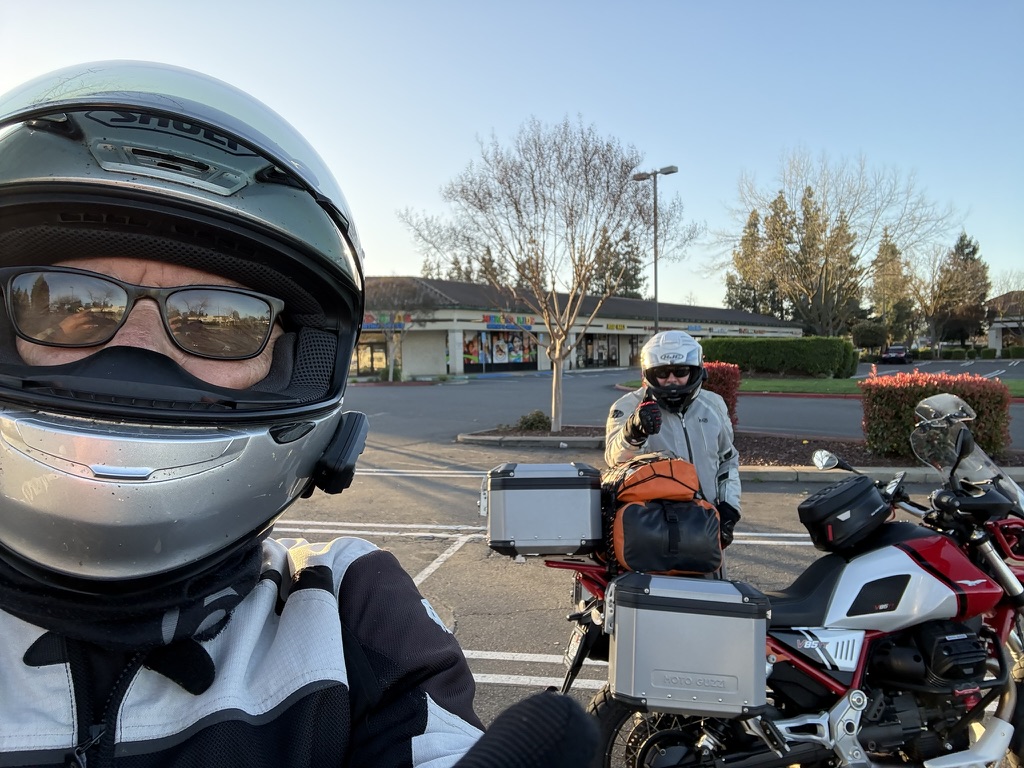
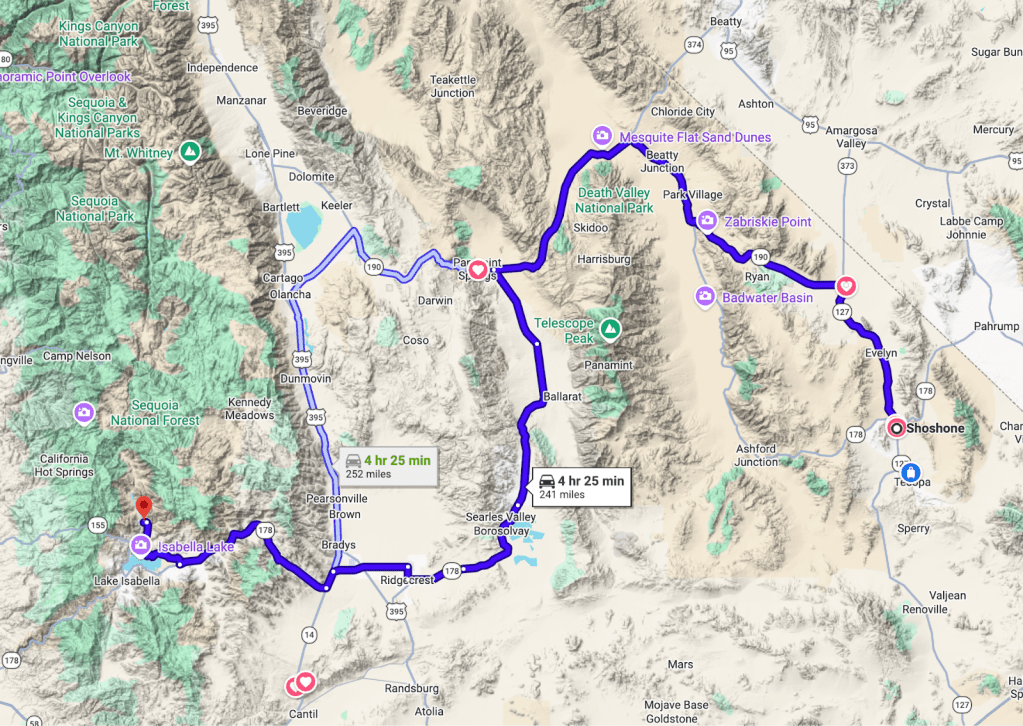
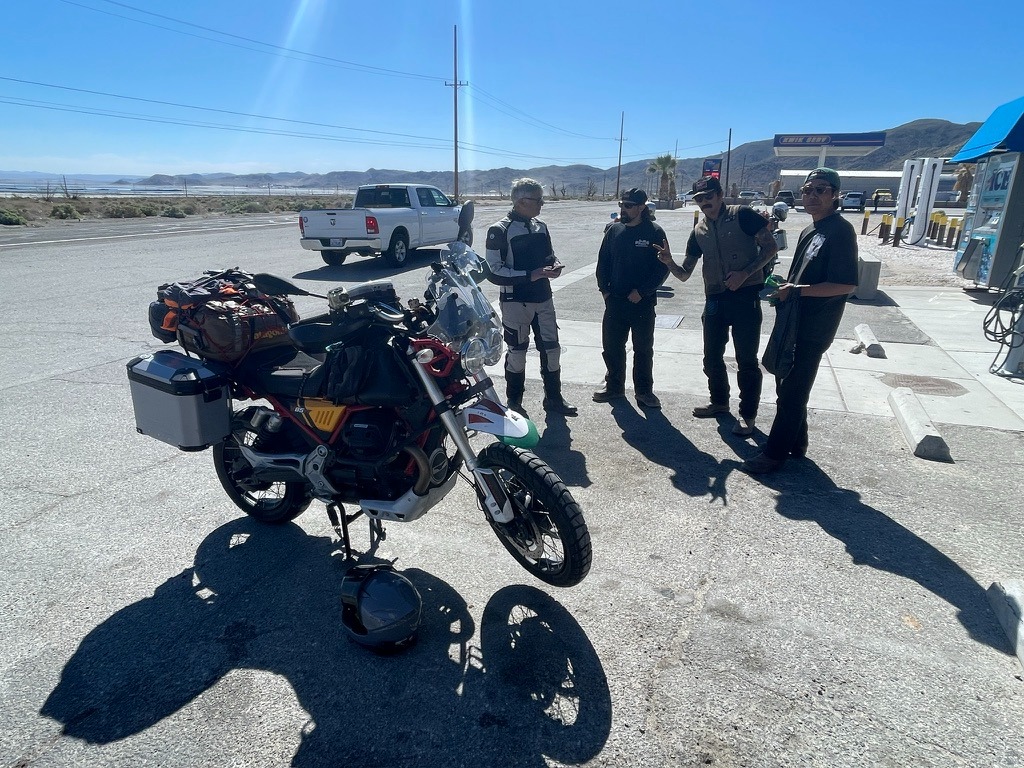
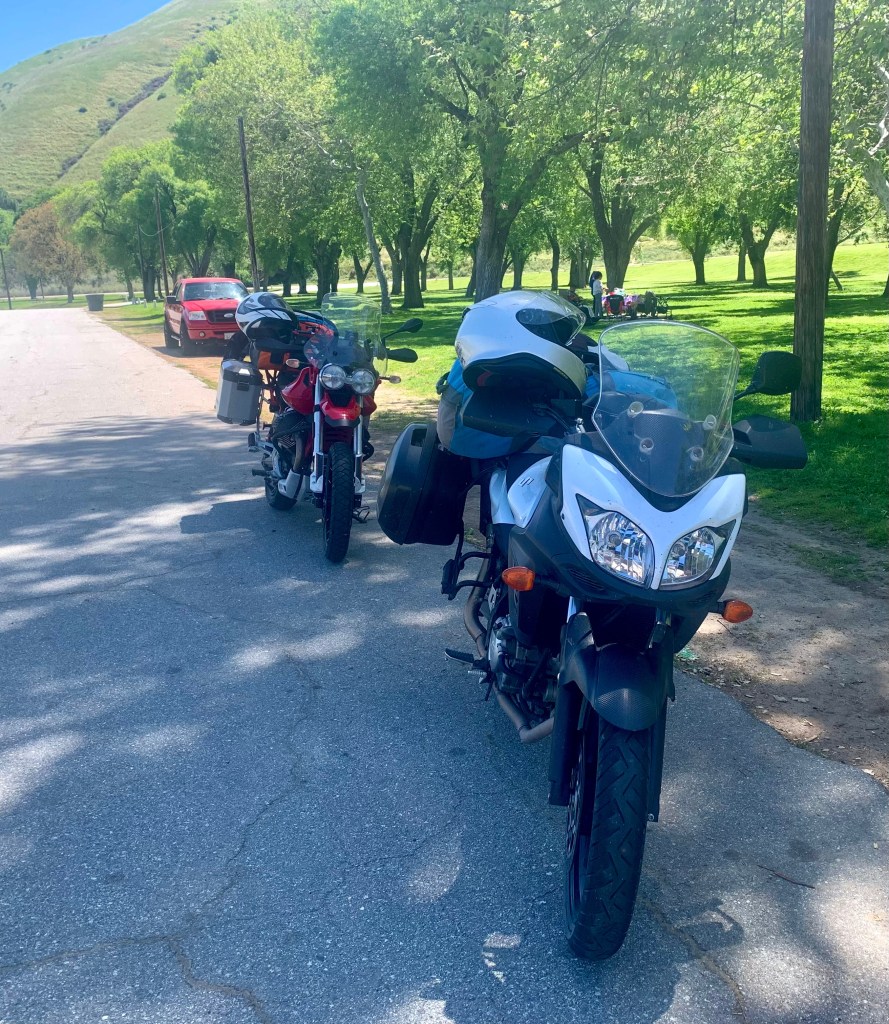
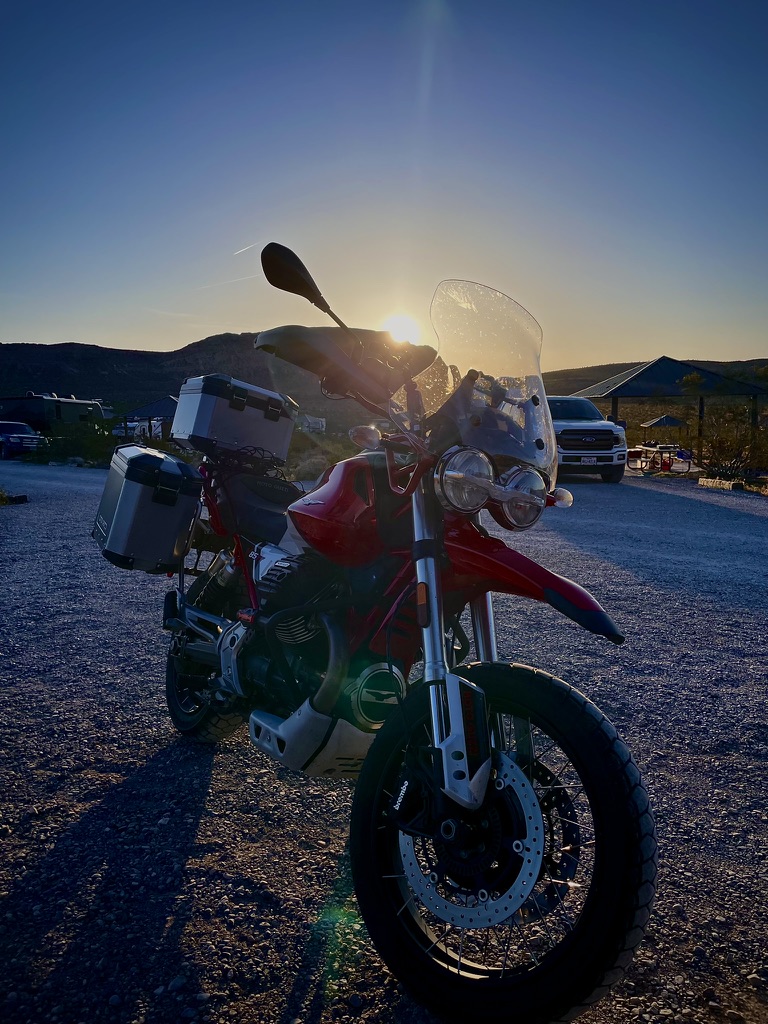
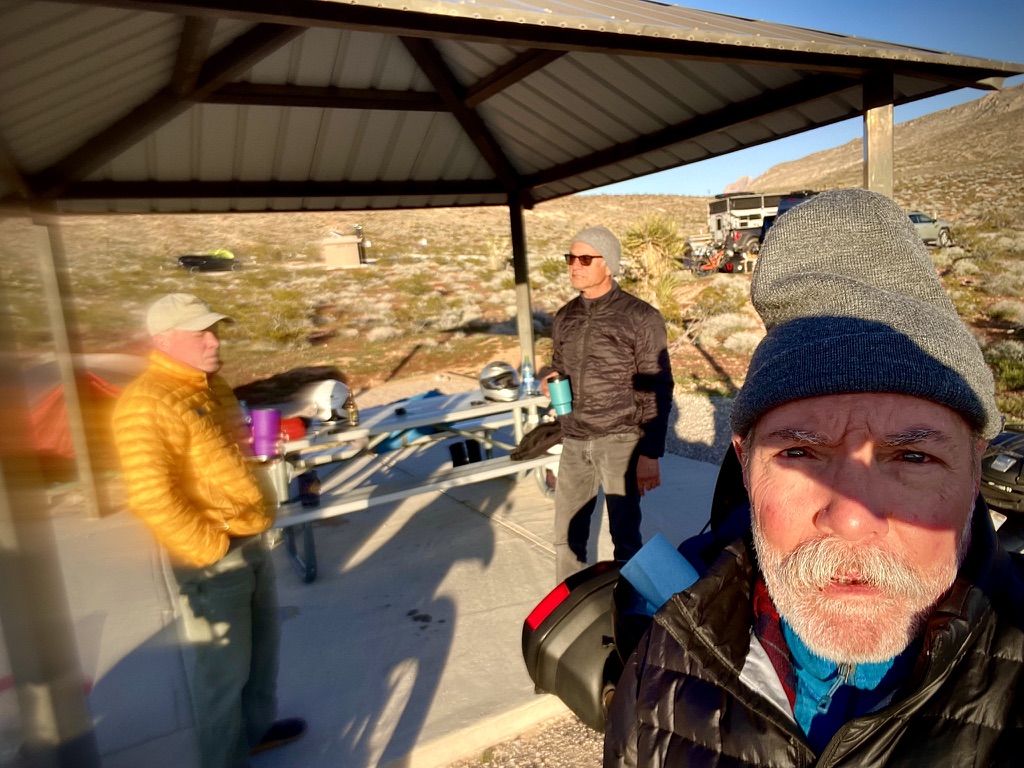
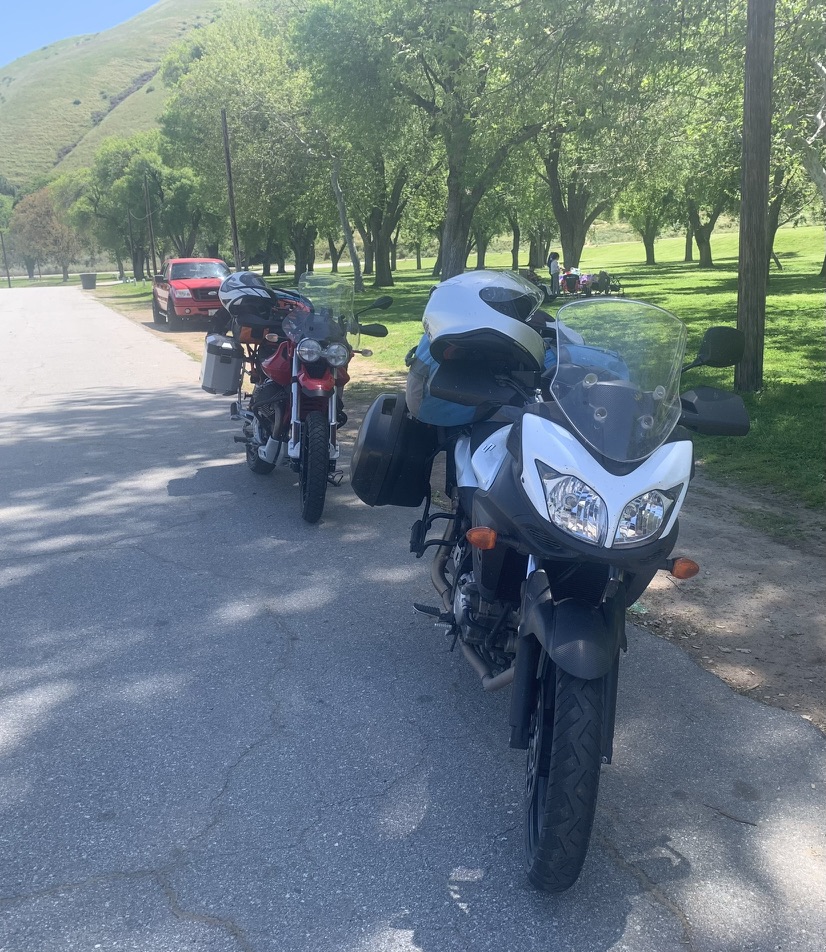
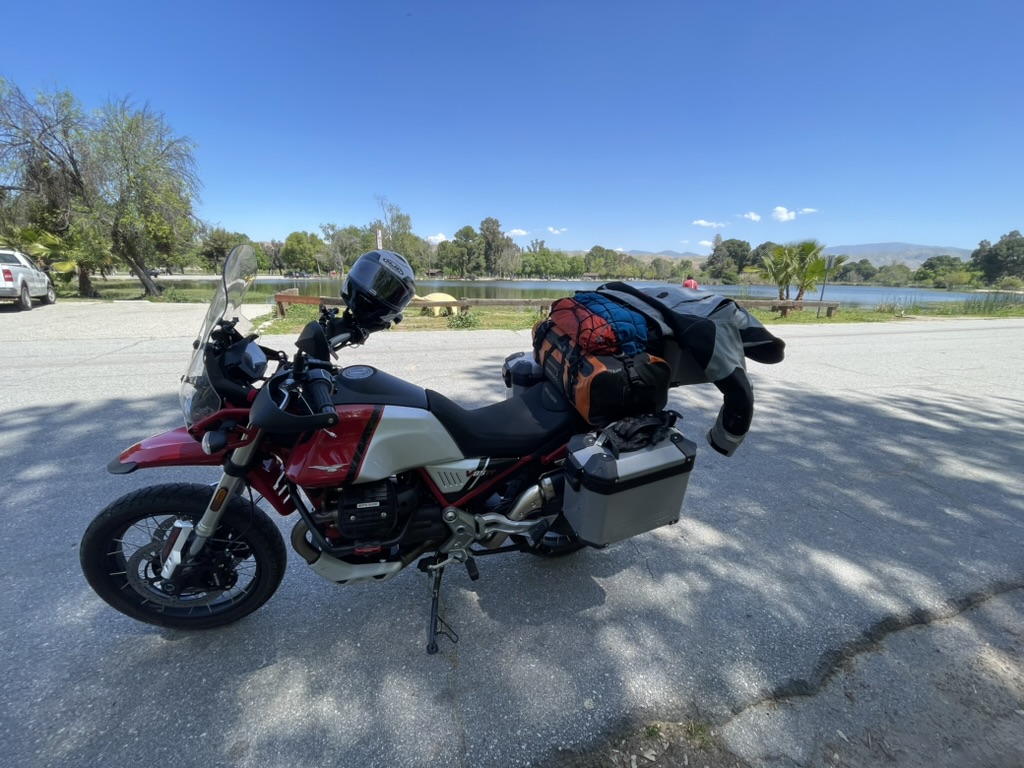
So we, Sisyphusdw7 and SMAP (Sisyphus’s Moto Associate Pete) climbed aboard the Moto Guzzi and the Suzuki respectively and pointed south and east of the Sierra, in search of fall color and the nifty little communities along the way.
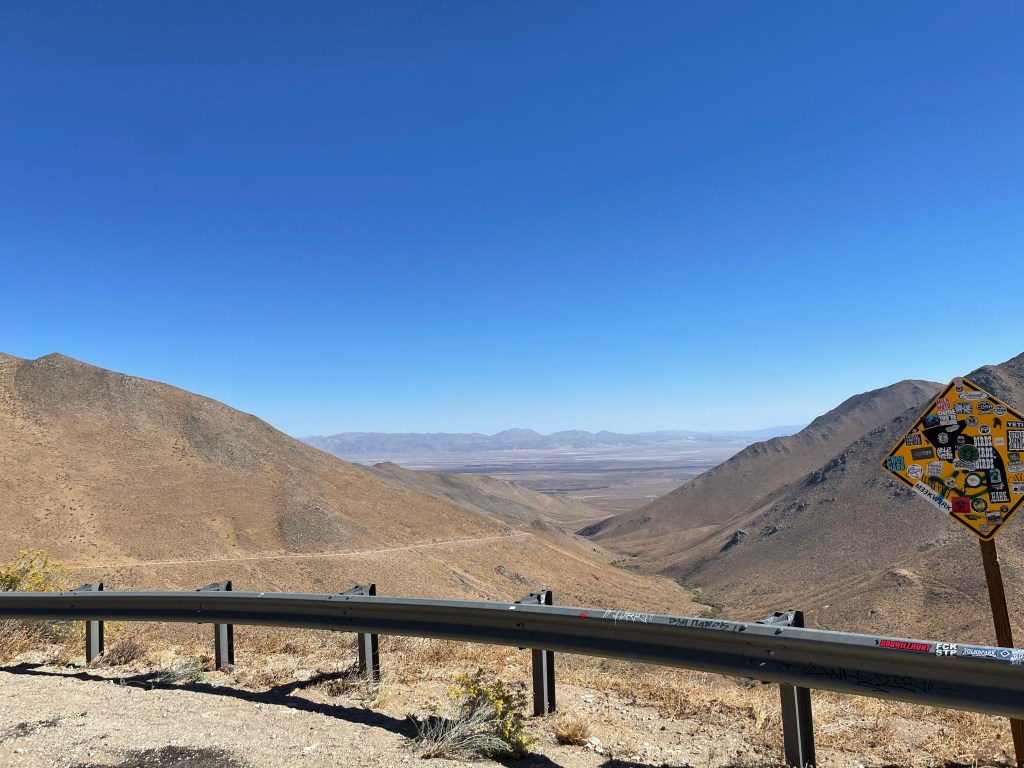
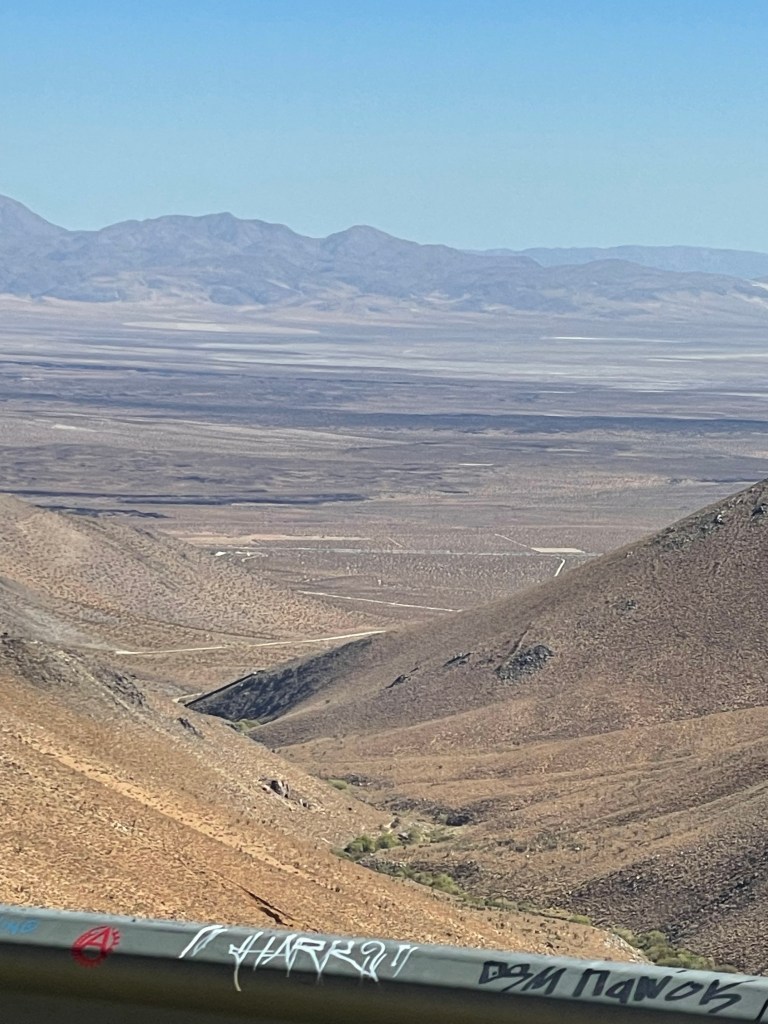
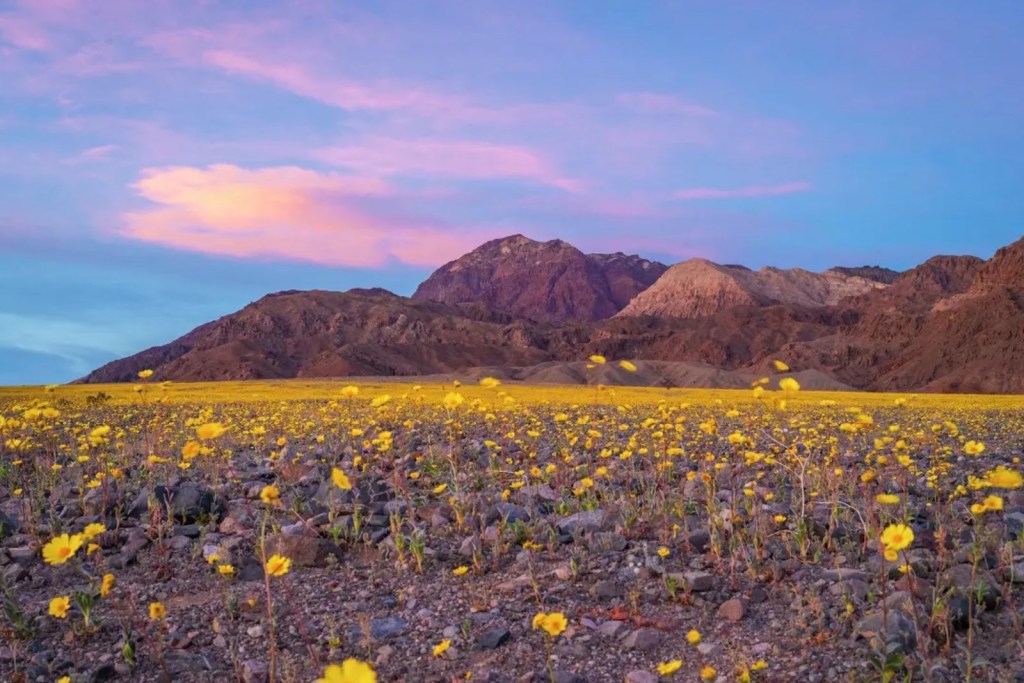
The Owens Valley, it turns out, had other ideas. There was color, mostly brown, but fall hadn’t quite arrived in the desert. Speaking of deserts, we discovered food deserts where finding a decent meal became its own small expedition in a few of these nifty communities. This ain’t Manhattan.
For the first 150 or so miles of our ramble the air was thick with almond and pistachio dust, and wind blown dust from recently tilled acreage. It may sound delicious until you’re breathing it at speed. And there was heat, but that of an “Indian Summer” as valley temps were finally relenting (mid-nineties) offering some relief from consecutive 100+ degree days we experienced a few weeks earlier. Unlike our June romp, there was no need for the evaporative cooling vests.
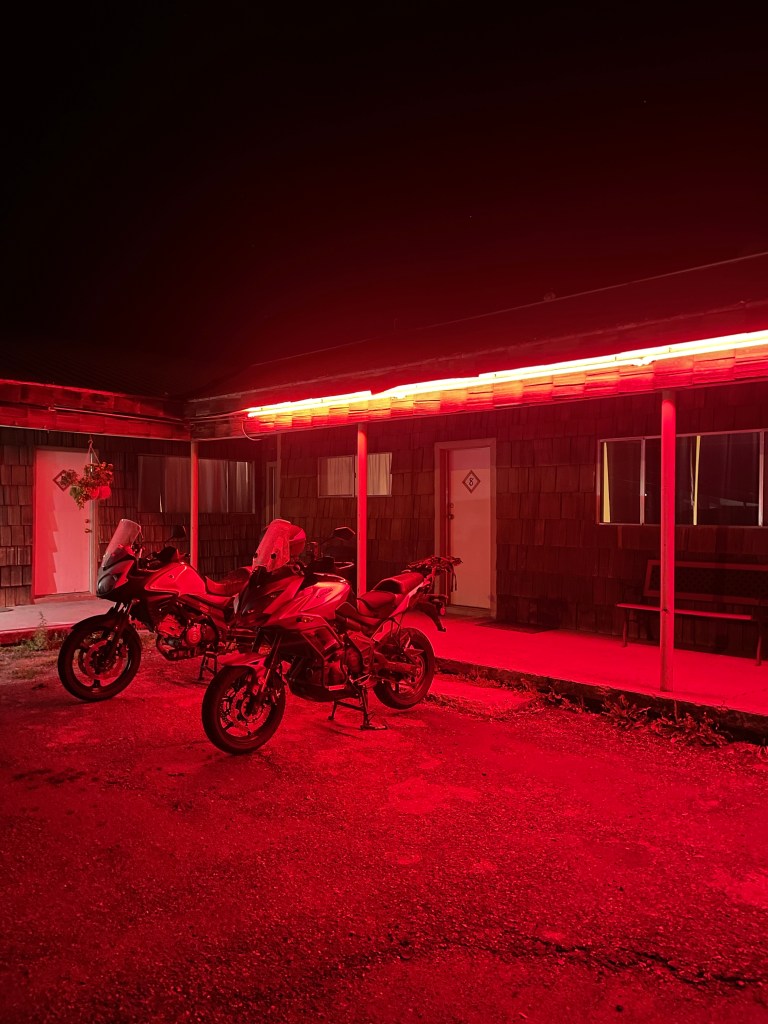
What we hadn’t planned on was the rest of it: A room in a rustic hotel in Kernville in which Humphrey Bogart and Lauren Bacall may have stayed, a lovely eight-room classic motel run by an owner who was a genuine no pretense delight, and a fellow guest who, at 90 years young, was on a search of her own. Not for color, exactly. Certainly not for interesting cuisine. But for meaning.
We went looking for a season. We found something a bit more durable.
Day One: The Valley to Kernville (~230 miles)
California has largely dodged those devastating wildfires for which we’ve become known. But the vegetation is moisture-starved and the heat has been unsettling. SMAP and I have a disdain for riding in either much needed rain or unrelenting heat. We’ve gotten soft in our autumnal phase.
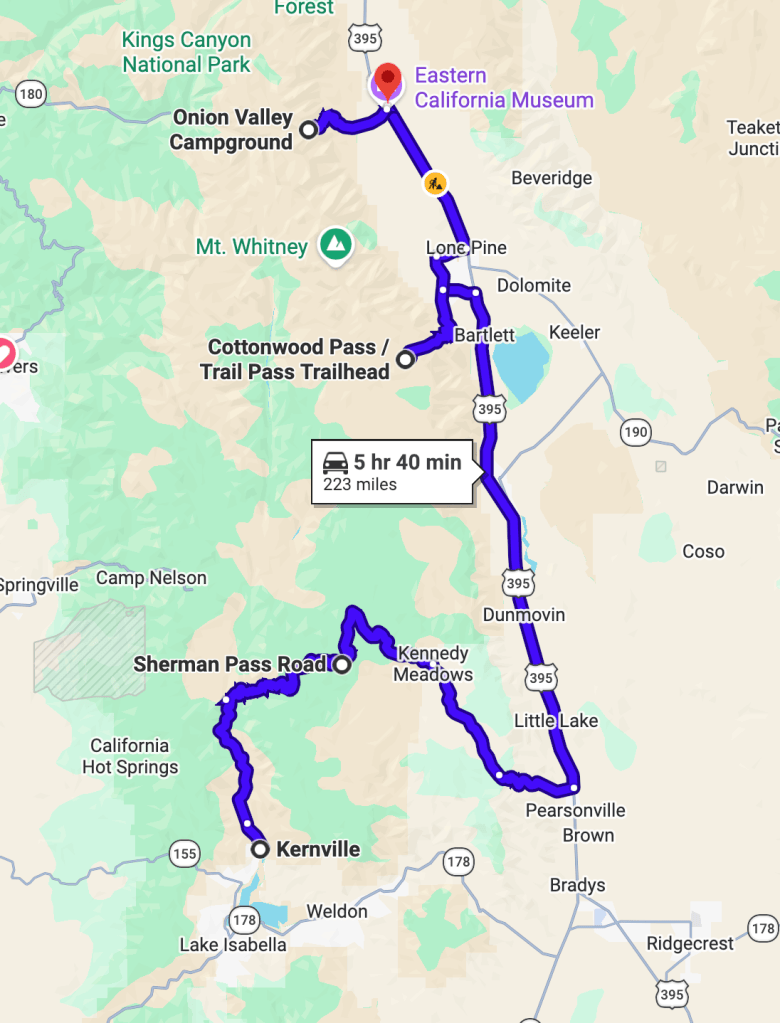
Scouring unreliable 10 and 15 day forecasts offered a short window between the remnant heat and pre-season precip in this confused El Niño situation. It was just enough for a quick four-day ride before Sisyphus would be homebound, nursing his wife’s knee replacement. So we pointed south, aiming to cross the Sierra over Sherman Pass, just north of our first night’s stop in Kernville, to access the Owens Valley.
Zigging and zagging through the Central Valley dusty grocery cart
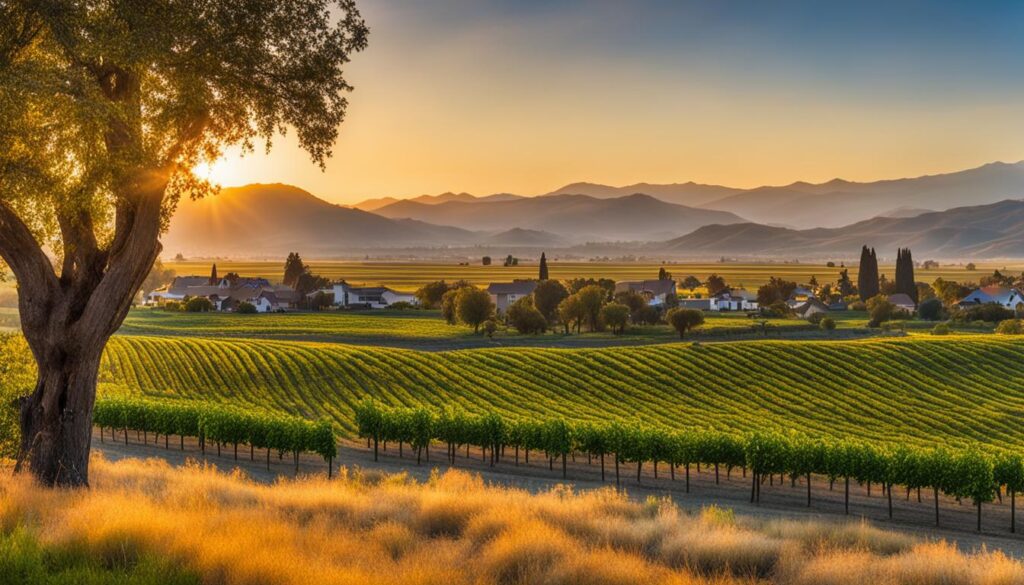
If you know where the food in the supermarket or the fiber for those expensive American-made tee shirts comes from, you know the Central Valley. Our 230-mile day began in almonds, pistachios, walnuts, various stone fruit and citrus orchards, cotton fields, and vineyards (grapes for the table, for raisins, and for vino), plus rangeland with sheep, goats, and cattle, dairy pastures, and fields of garlic, onions, tomatoes, peppers, even agave. We passed a pump jack or two as well. Well, you get the idea. Just like the idyllic photos from my elementary school day textbooks. Only now the mists in the foothills were dust brown.
Illustration from Learncalifornia.org
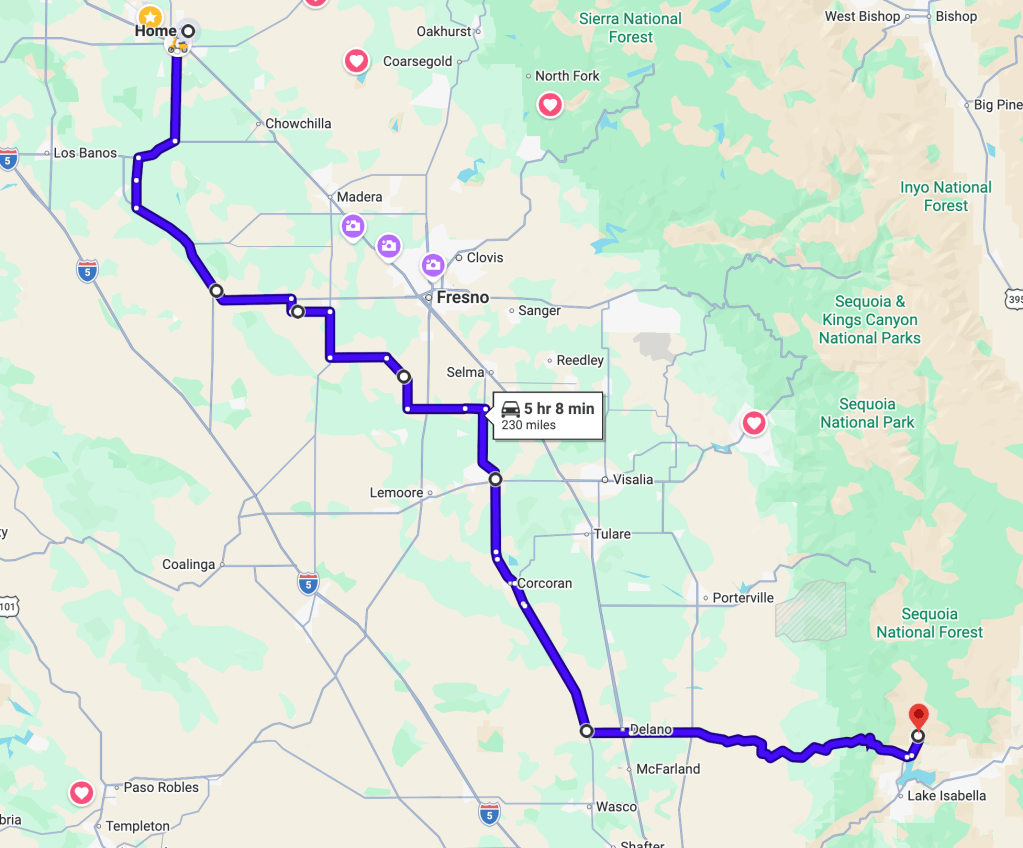
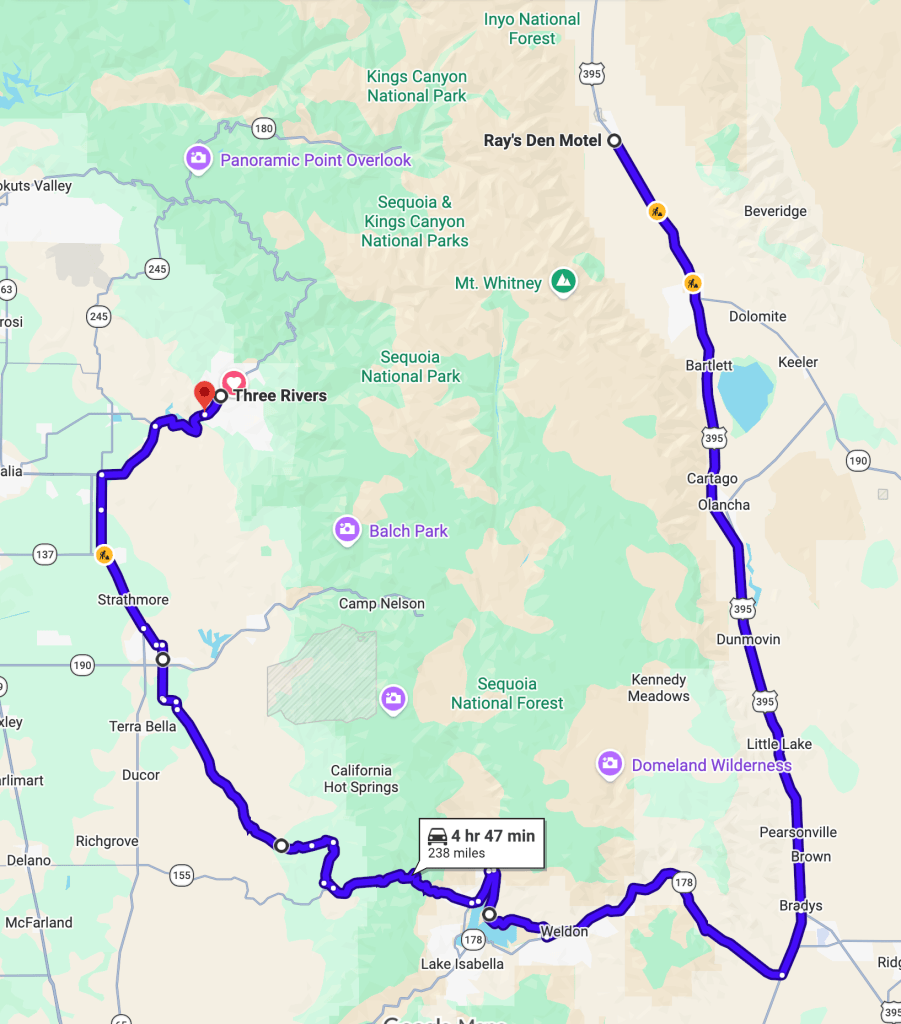
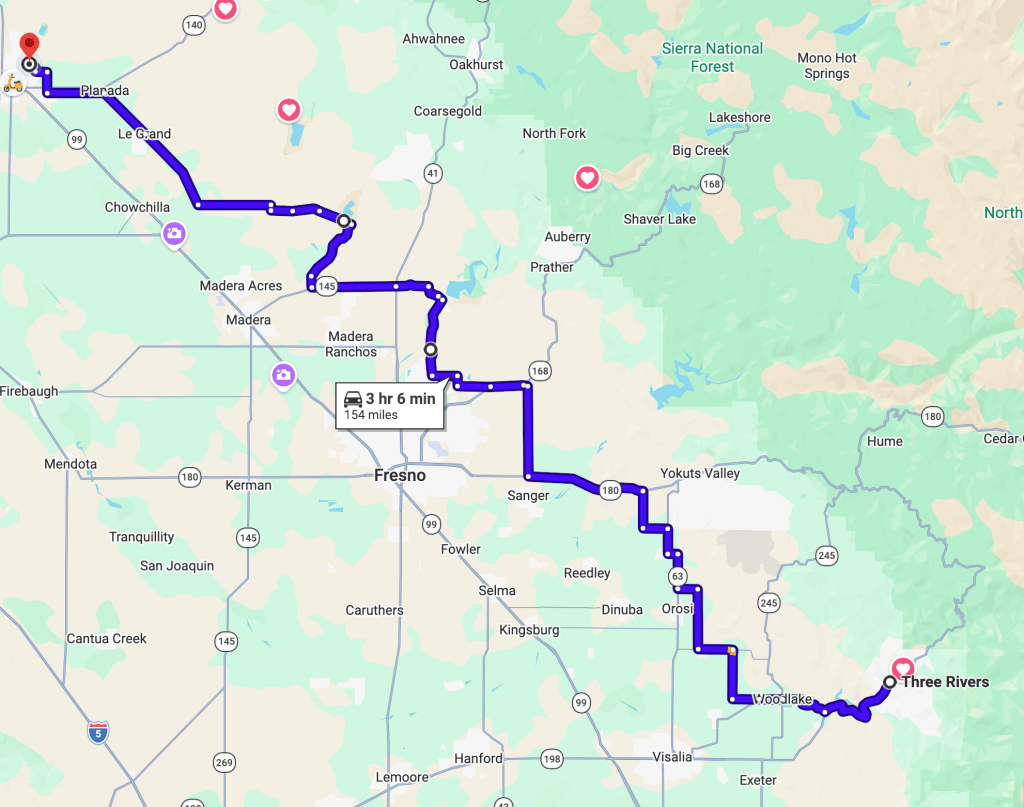
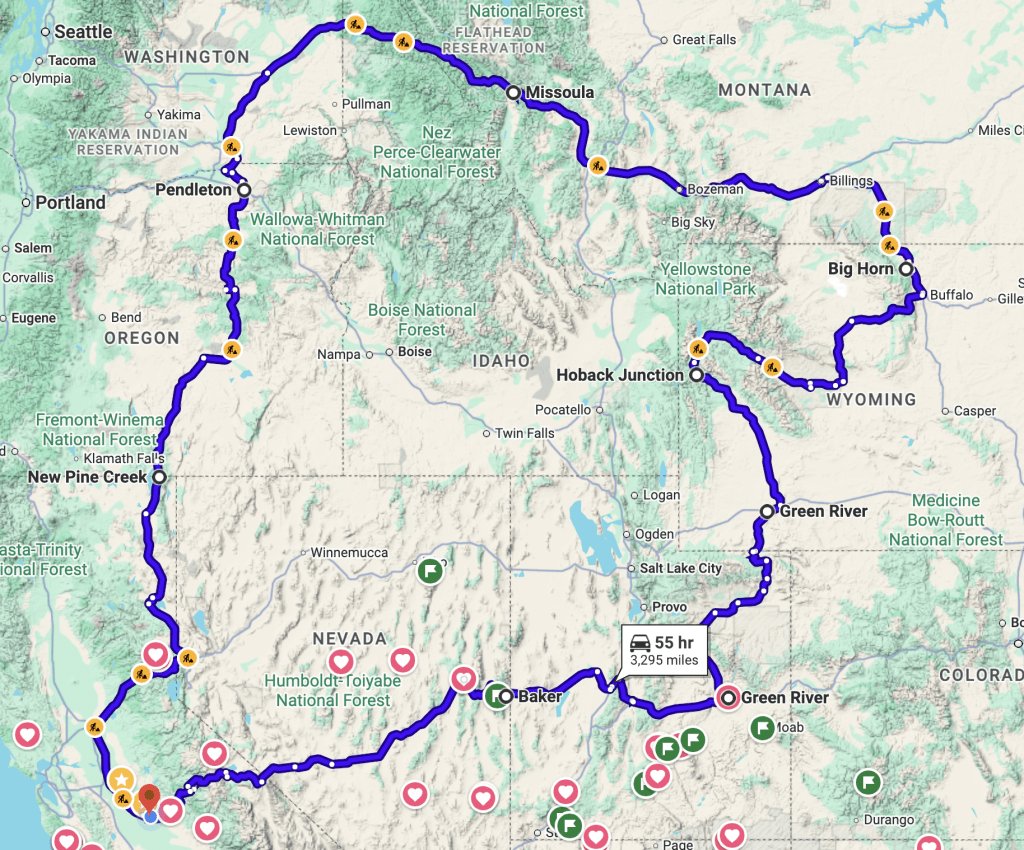
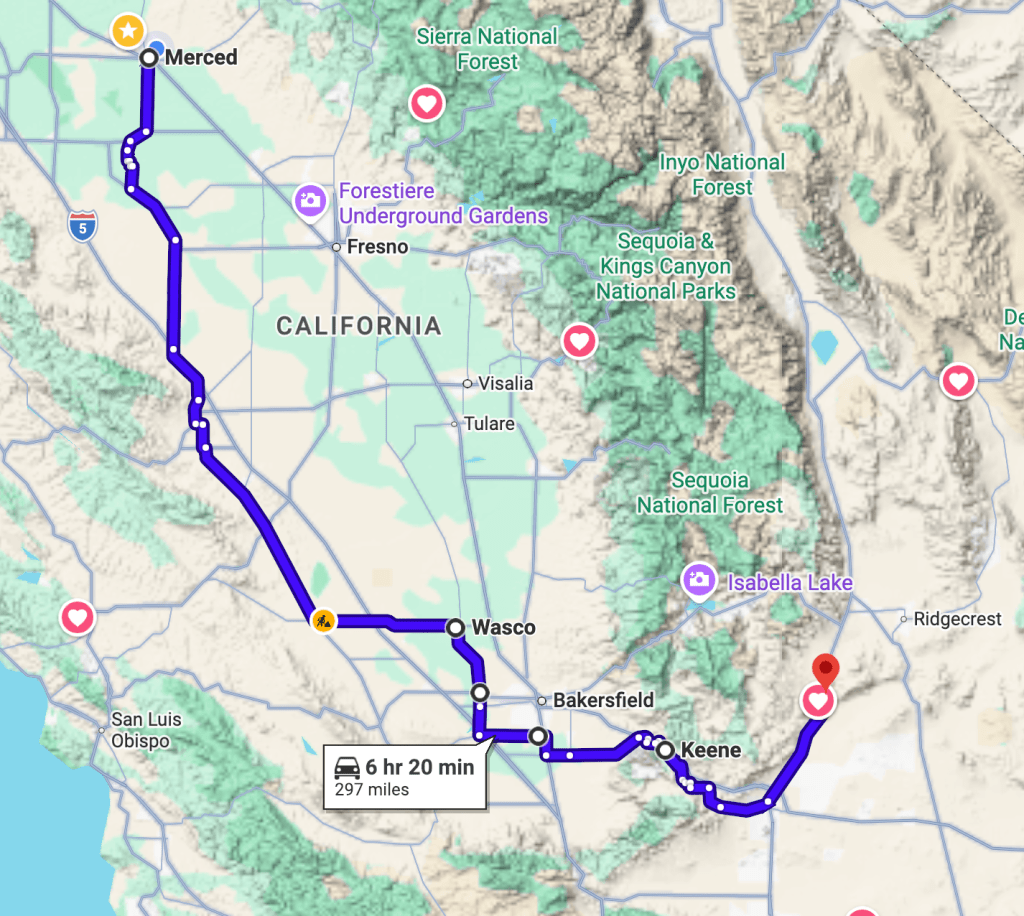
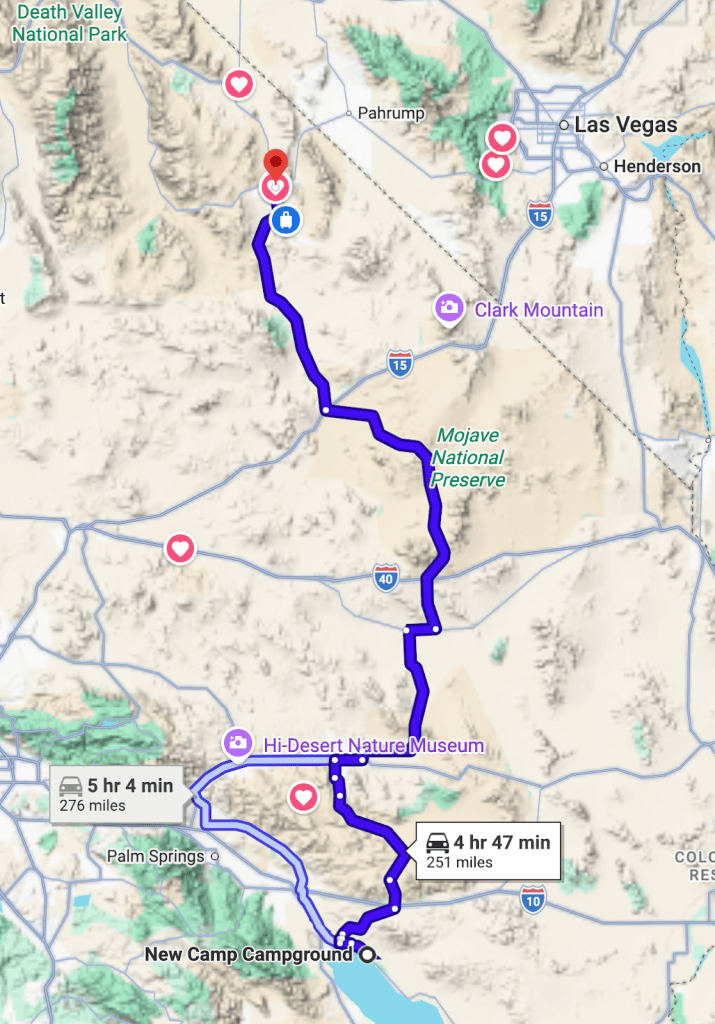
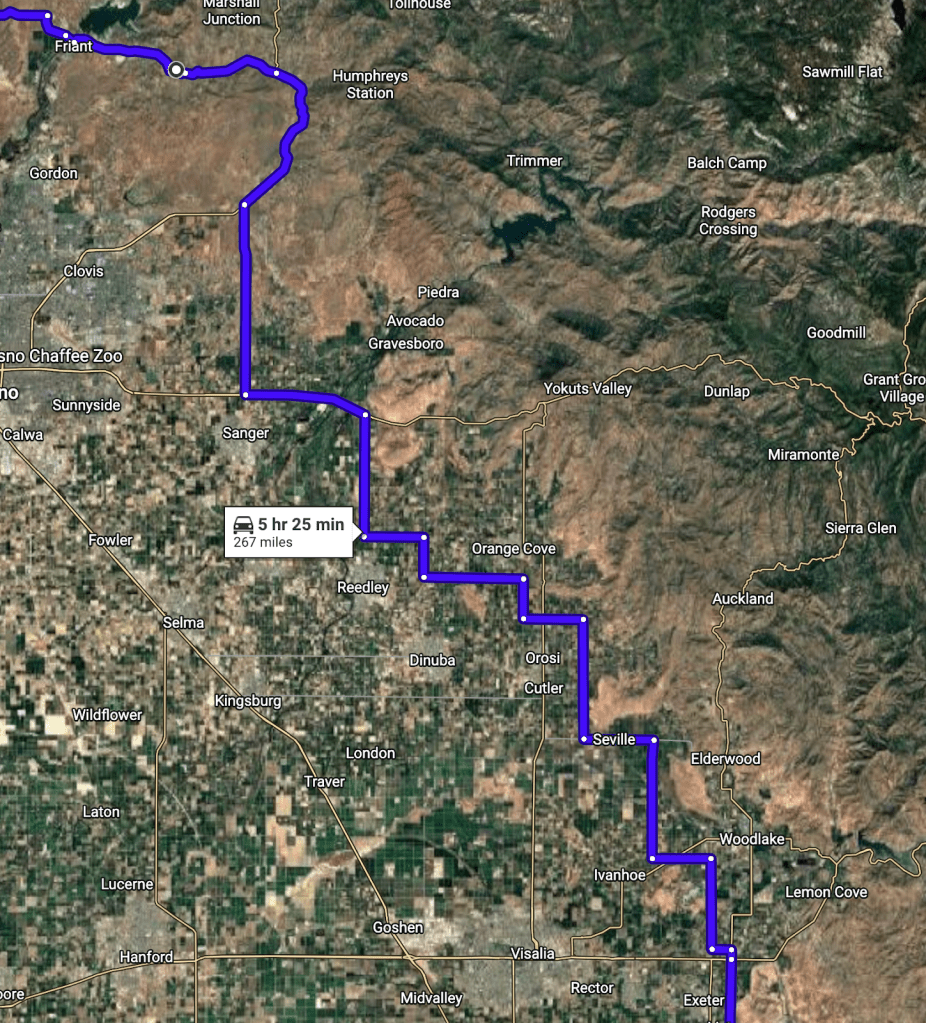
The San Joaquin Valley leads the state in agricultural production, processing, support, and distribution. Our zigzag route down the middle of the Valley (see map above) shows far more of this diversity than you’d ever glimpse from the I-5 or CA-99 slabs.
It’s fall, and the growing season, now stretched by a longer, warmer regime courtesy of climate change, has the nut harvest in full swing. Almonds are the biggest player, and their automated harvest kicks up haboobs of dust. From late August through October, a continuous layer of light brown dust settles on everything gravity touches. We rode through it, not just summoning, but tasting true grit.
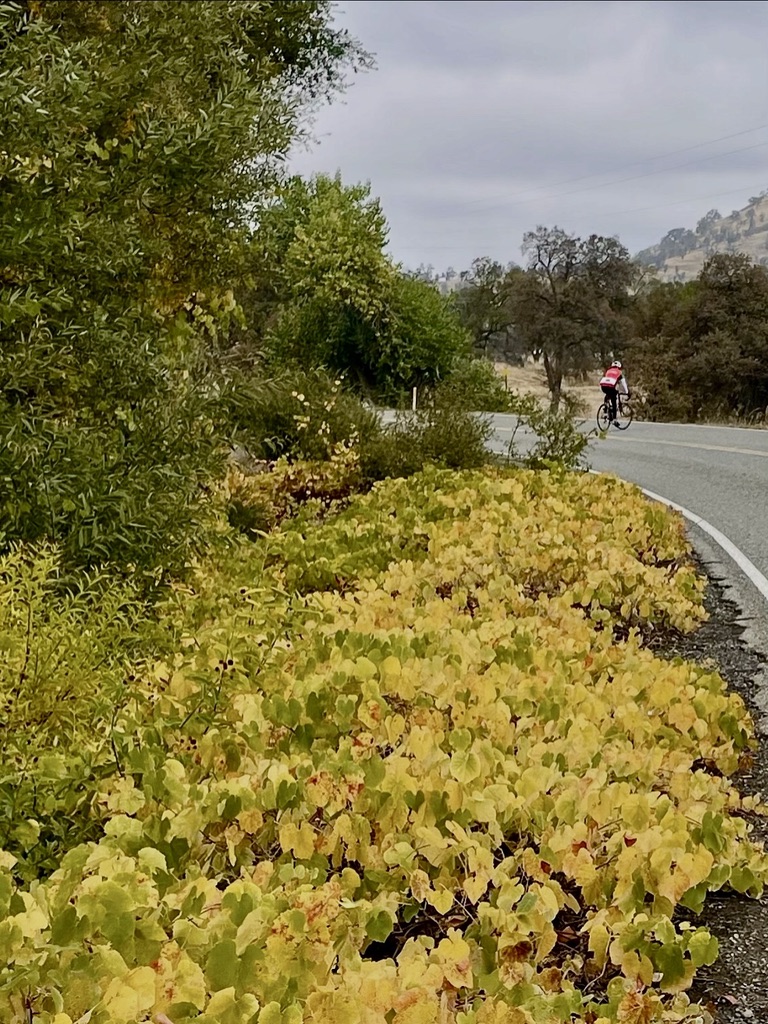
Interestingly, few of the crops we passed offered much fall color. Most orchards simply drop their faded green leaves once irrigation ceases, and whatever else was growing gets plowed under following the harvest for the next planting. The vineyards held a hint of yellow and red, but this hot, dry year left the show muted.
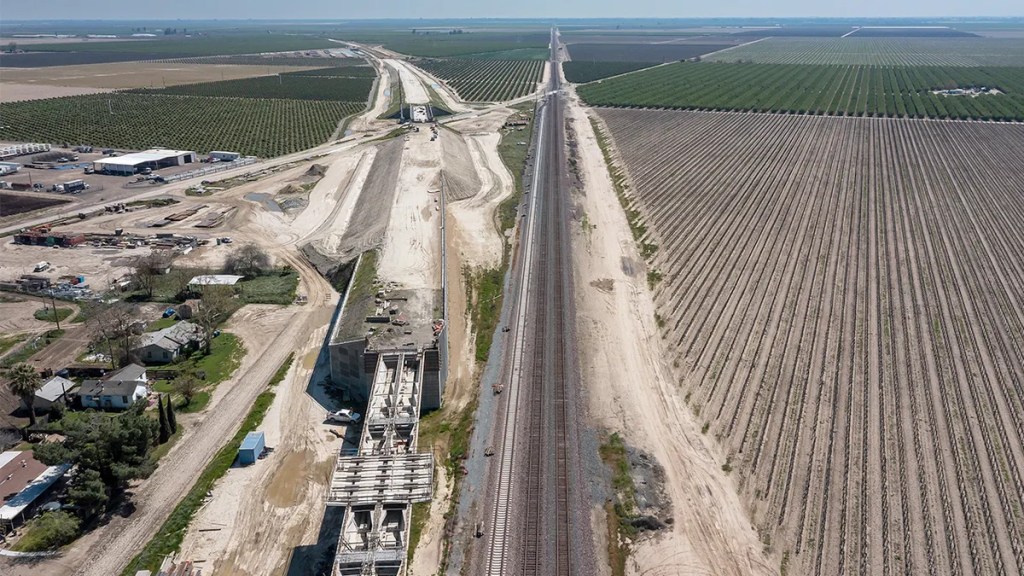
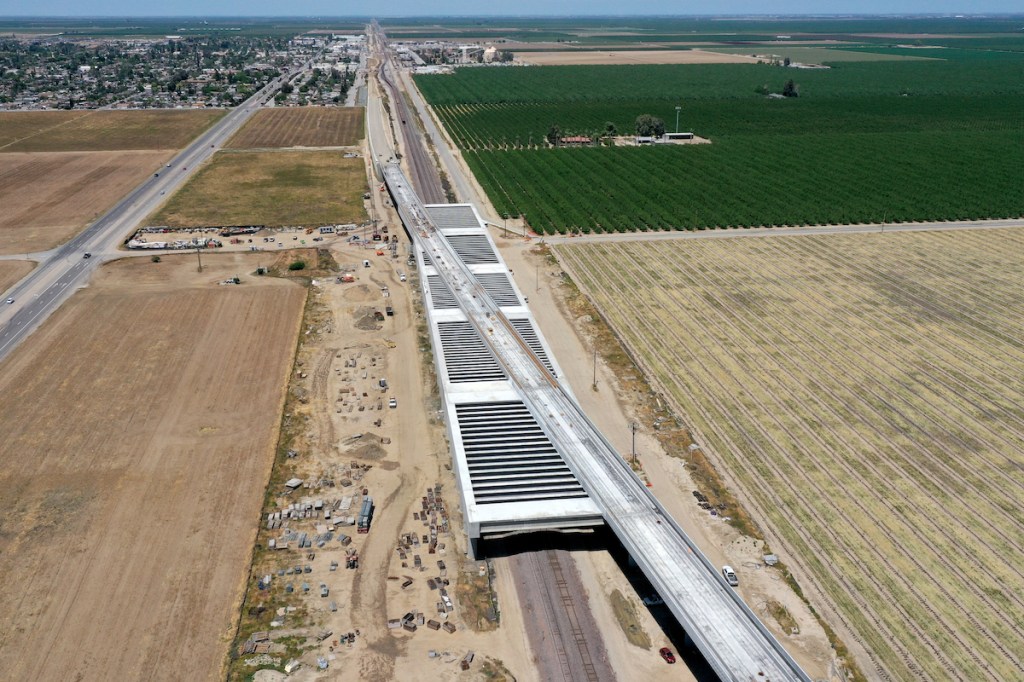
Idyllic High-Speed Rail, Fresno County. Photo courtesy of Fox News, Los Angeles, April 2026
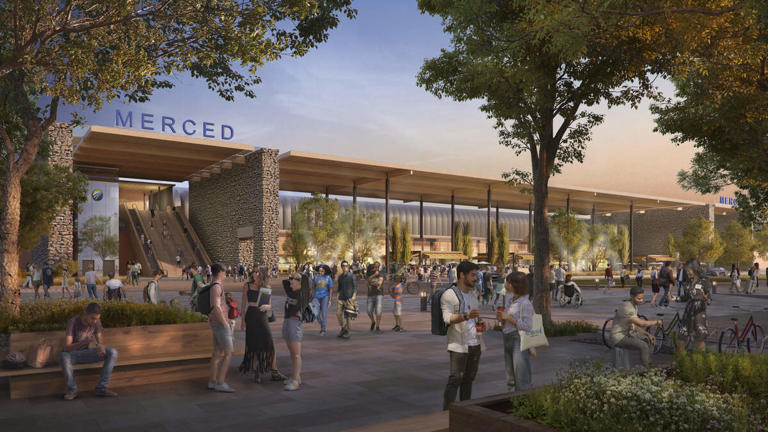
The one idle feature of our route was California’s High-Speed Rail. The photo above, taken in Fresno County, shows a segment under construction slicing right through valley ag next to the existing low speed rail. Maybe our hometown will get a station.
Idyllic High Speed Rail Station in Merced (Photo courtesy of Merced Sun Star)
East on CA-155 we crossed CA-99 and CA-65, winding our way to Glennville, where we had a BLT and fries at the Highway 155 Market and Cafe.
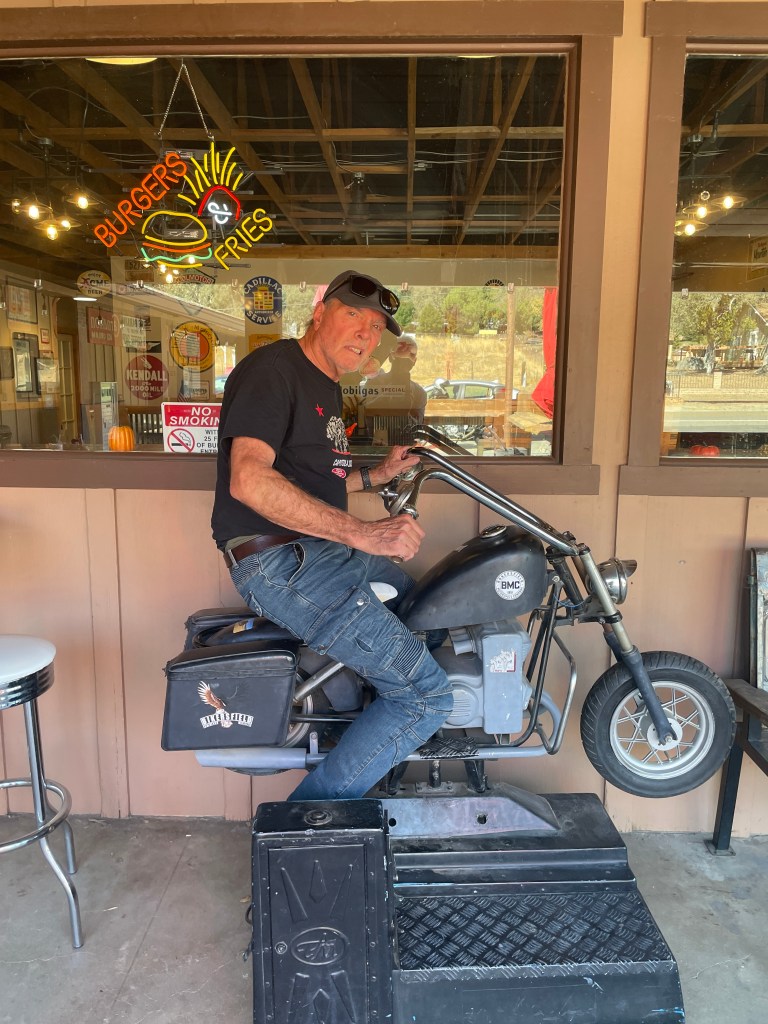
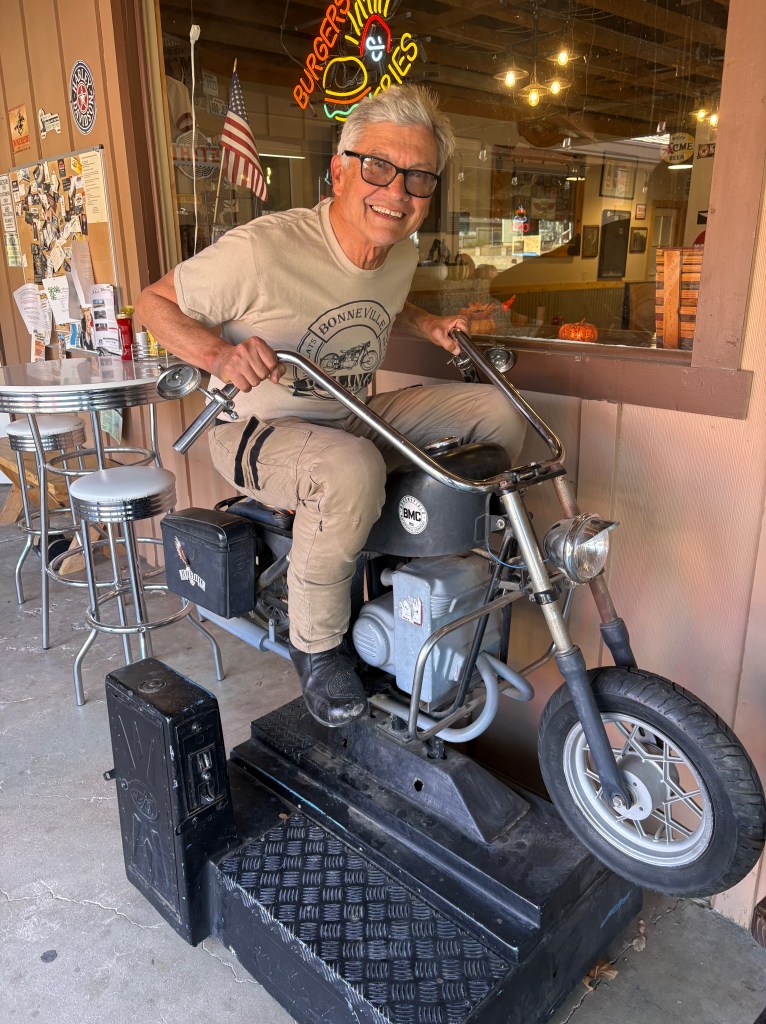
Less soul searching than in Then Came Bronson… Just two wild and crazy guys!
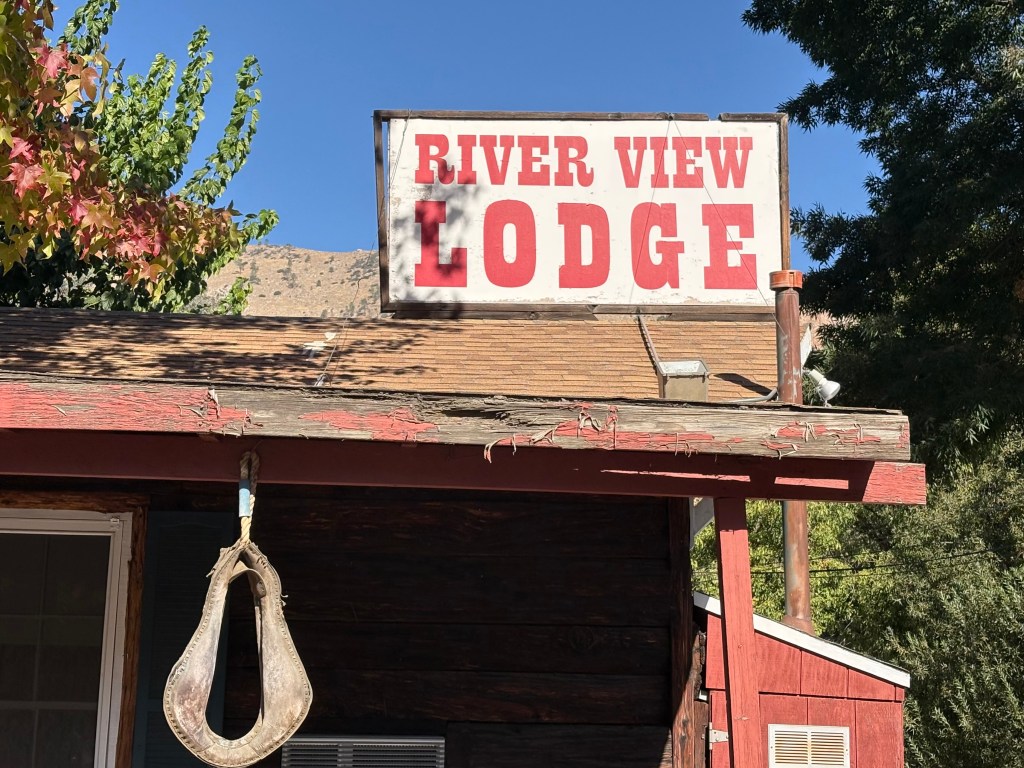
Back on the real motos costing considerably more to roll down the road than this coin operated baaaagerrr, we rambled on an even windier road up and over Alta Sierra and down to Kernville where I had booked a room at the River View Lodge.
We usually camp but are increasingly seduced by beds and showers with meals within walking distance, so this would be a lighter, less gear-dense ramble, in the autumn of our riding days.
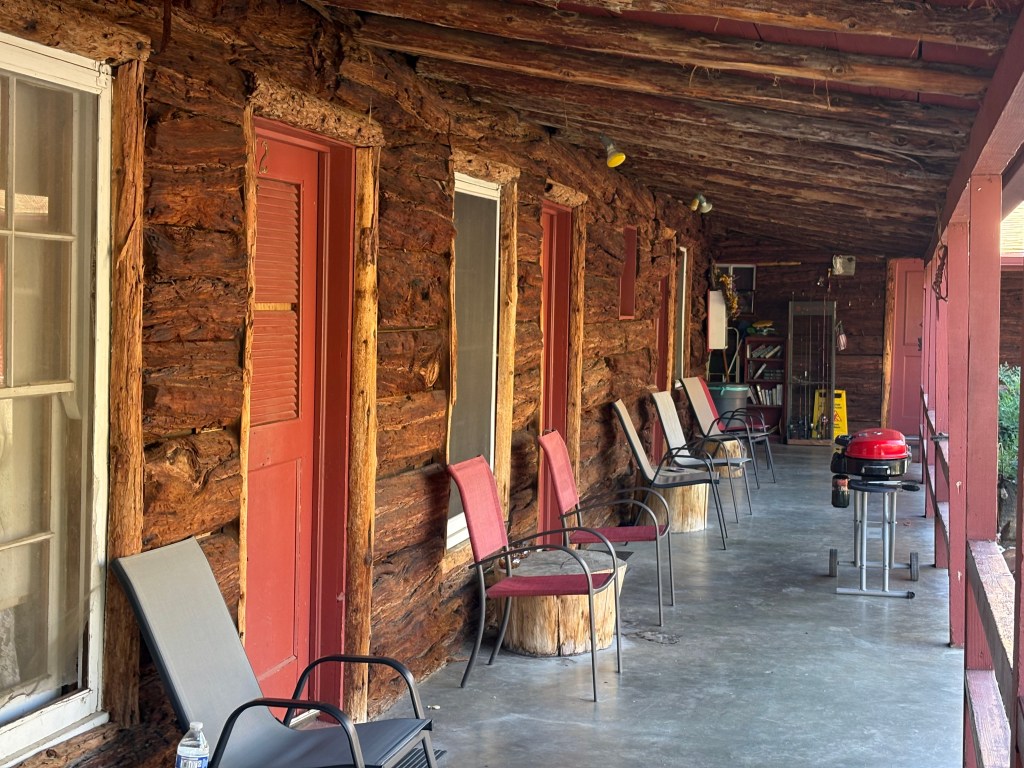
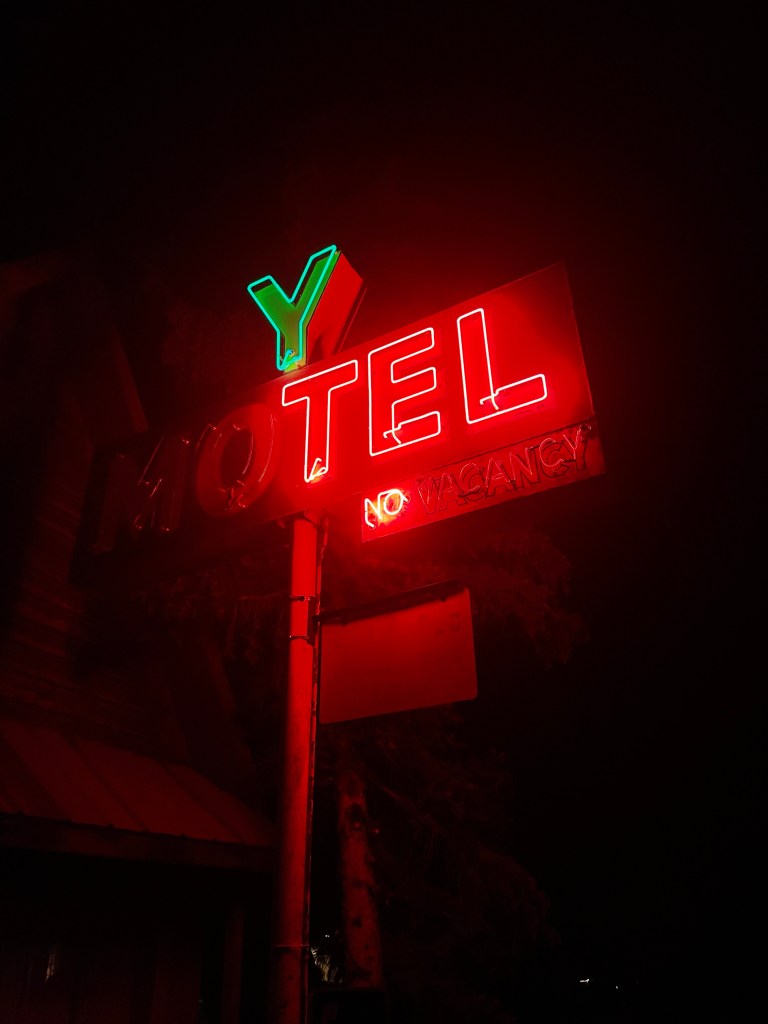
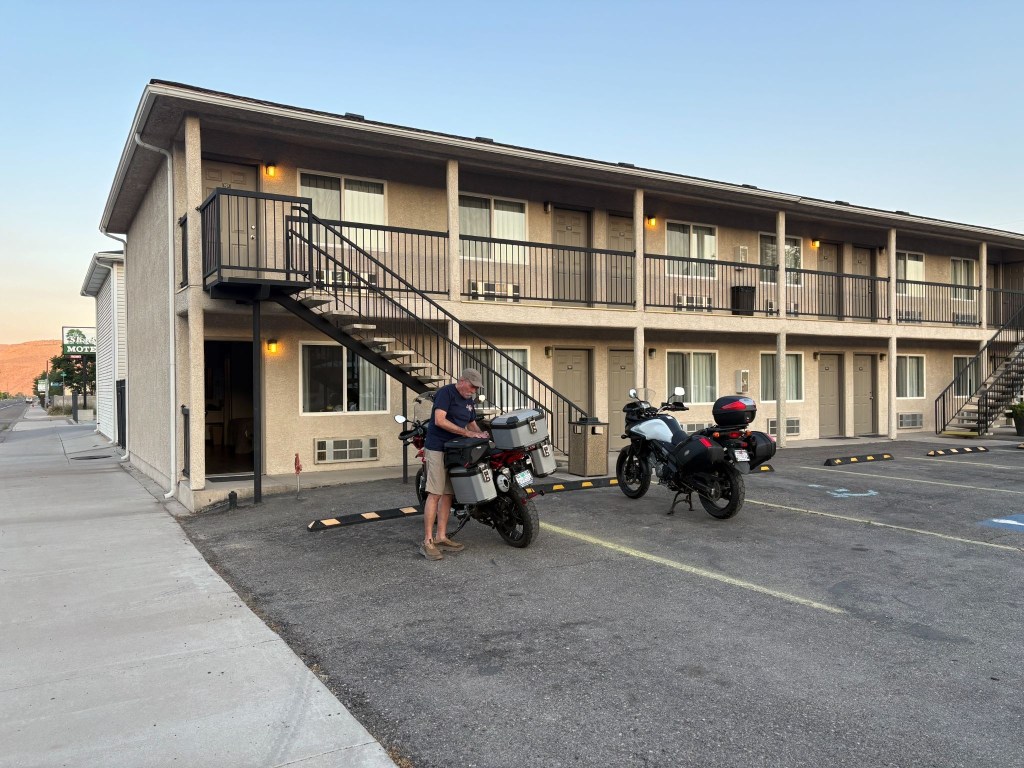
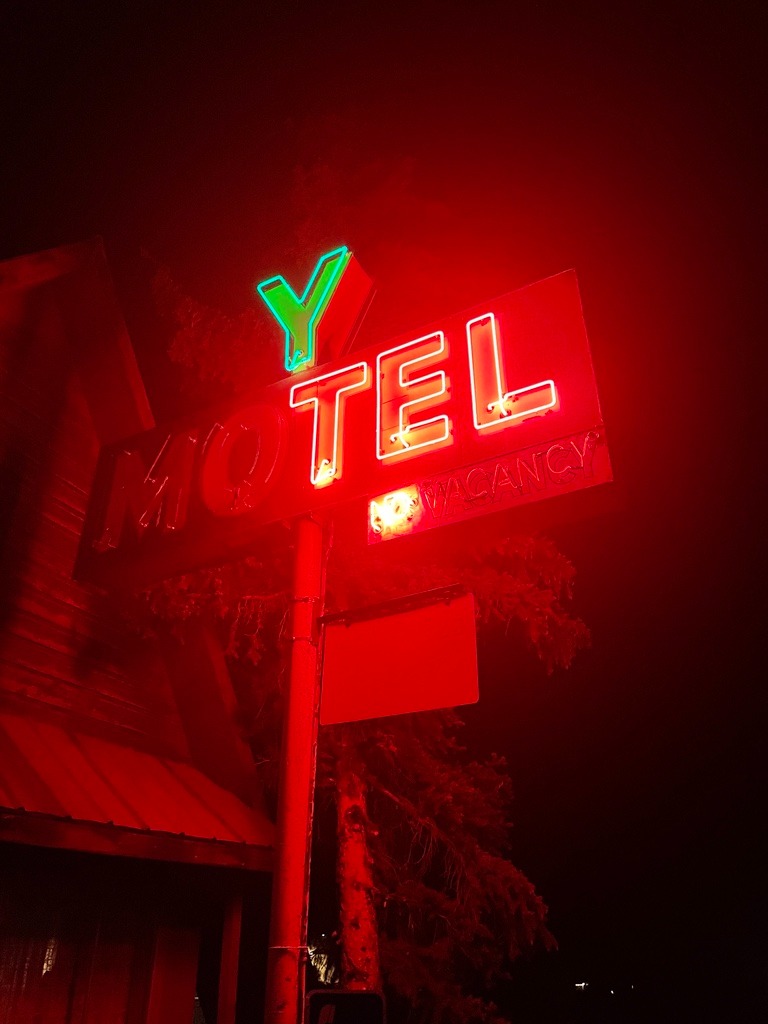
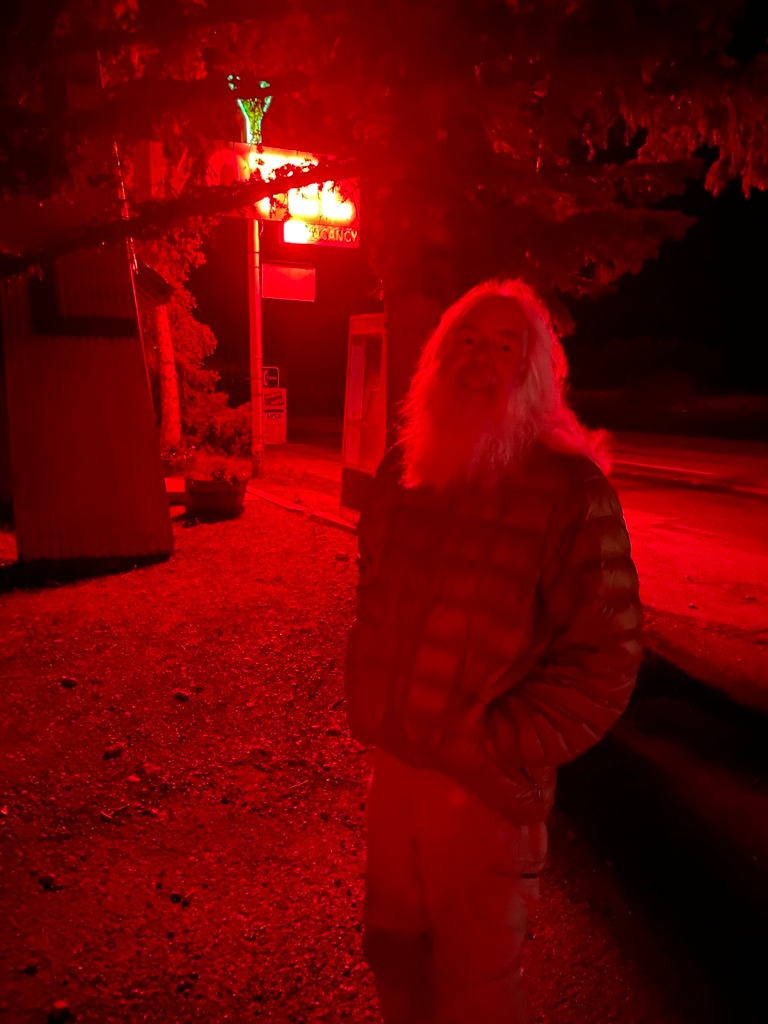
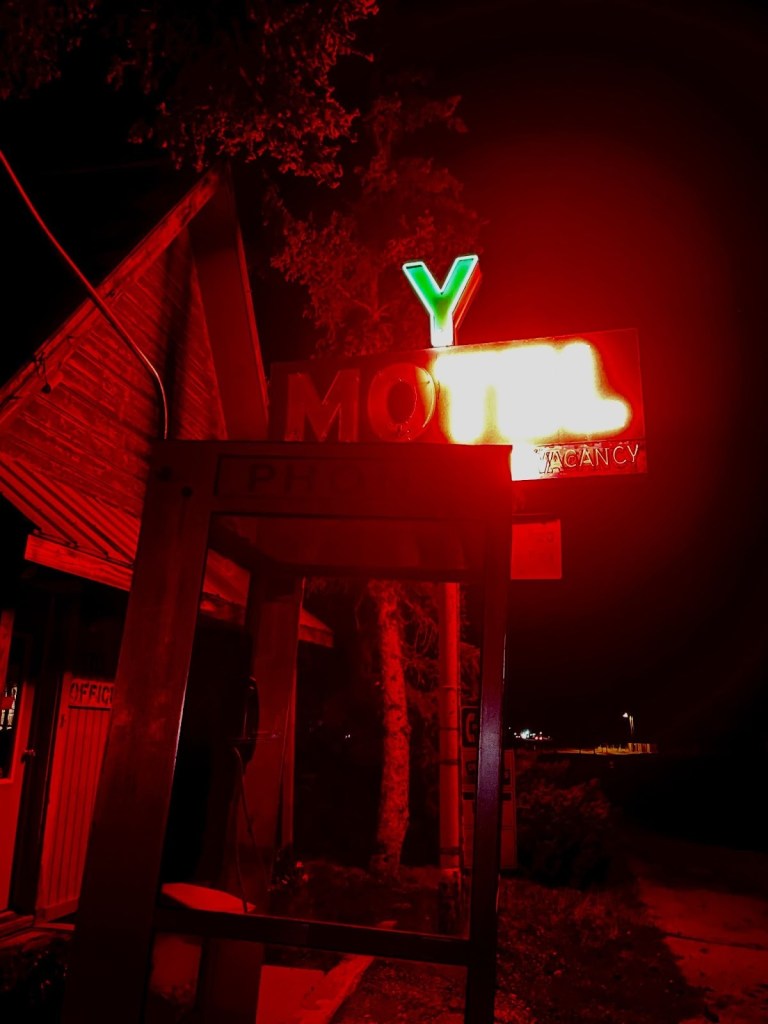
The River View Lodge in Kernville is nearly as rustic as the Y in Chama.
Derivatively rustic, the Y in Chama, New Mexico.
According to the River View Lodge’s website, and attested to by our hotel owner/proprietor John, Hollywood discovered Old Kernville in the late 1920s. The Sierra Nevada and the Kern River made a favorite backdrop for Westerns, and later for TV productions like Hopalong Cassidy, Roy Rogers, Gene Autry, Bonanza, and The Waltons.
When the government-built dam flooded the old town to create Lake Isabella in 1953, the old inn was rescued and moved upriver to its current spot on the Kern, where it became the Sierra South Lodge. The cast and crews kept coming, among them Humphrey Bogart and Lauren Bacall, Audie Murphy, Tom Mix, Andy Devine, Yvonne De Carlo, Rod Cameron, and Gabby Hayes. Not a bad guest book, although we didn’t actually see a guest book. We simply took John at his word as a good faith gesture.
John went on to say that the stars preferred the lodge because each room had a private bath. Ours was about the size of the bathroom in a Tab teardrop trailer. Apparently western stars of yesteryear were smaller than moto-tourers of today.
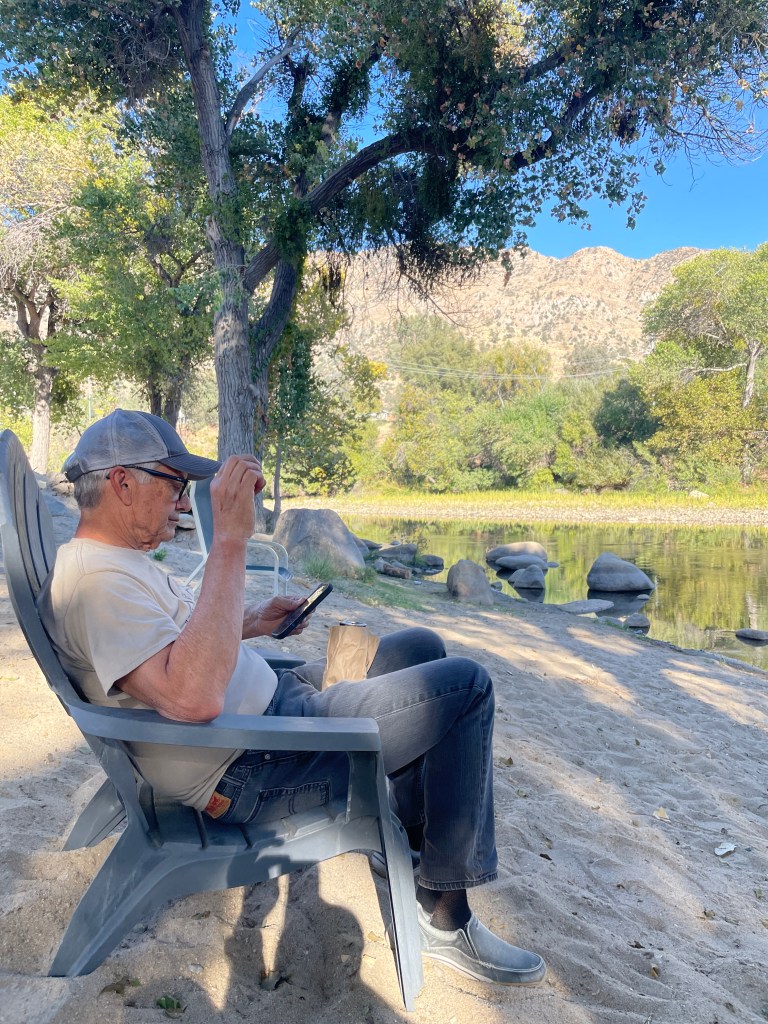
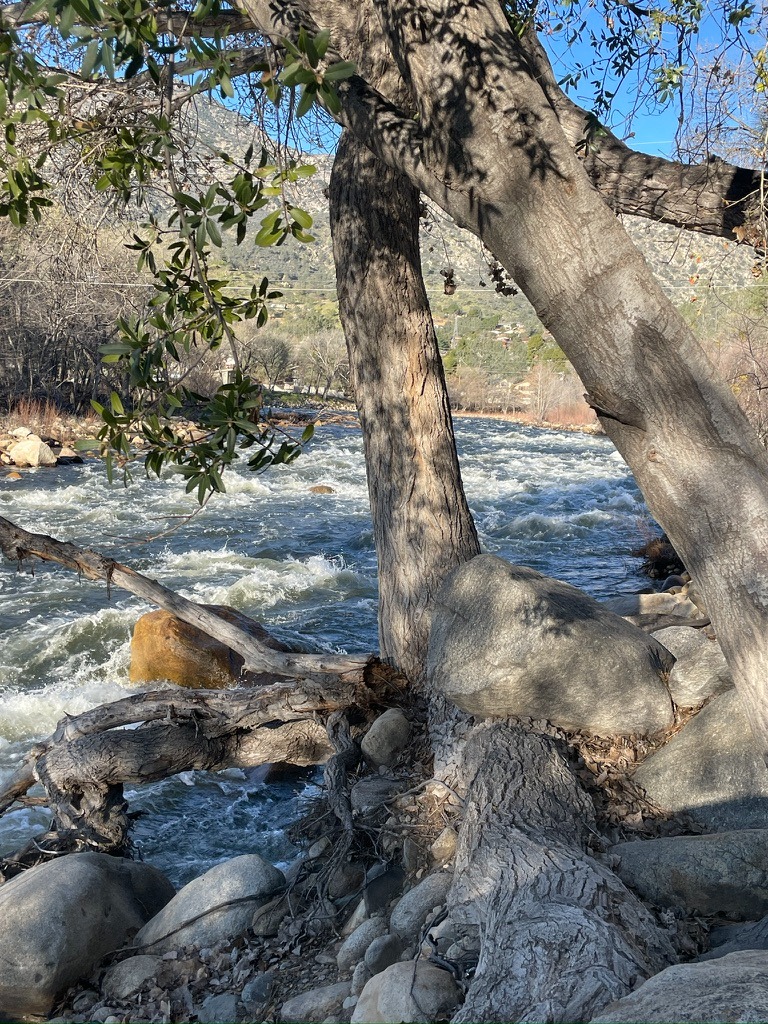
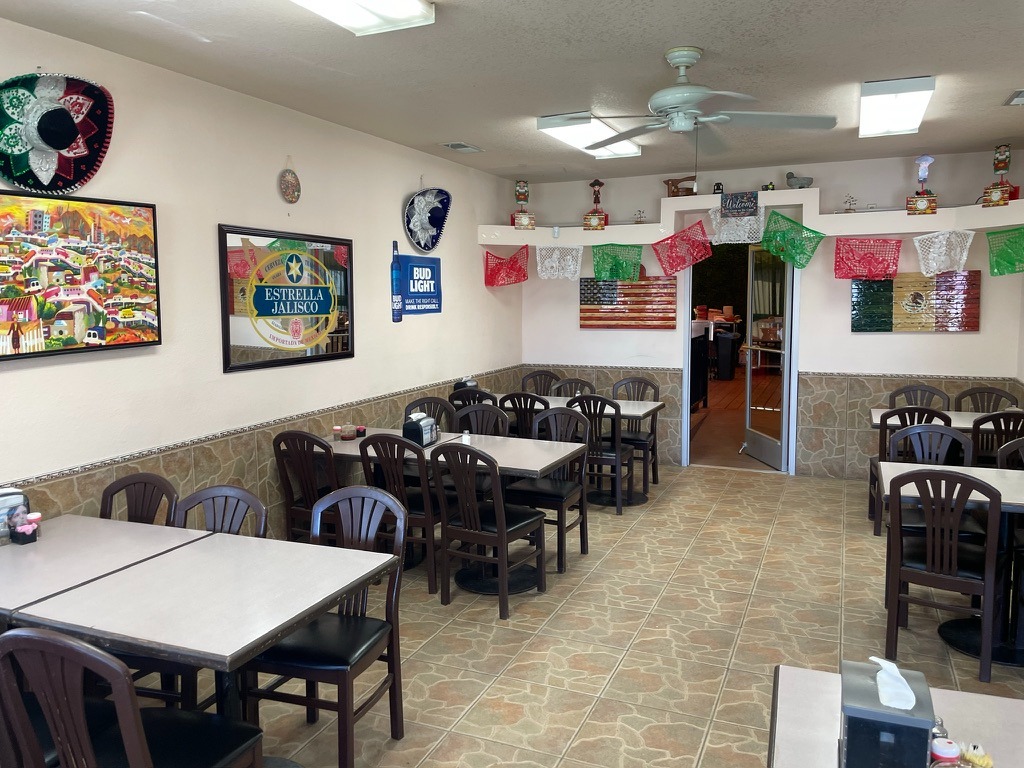
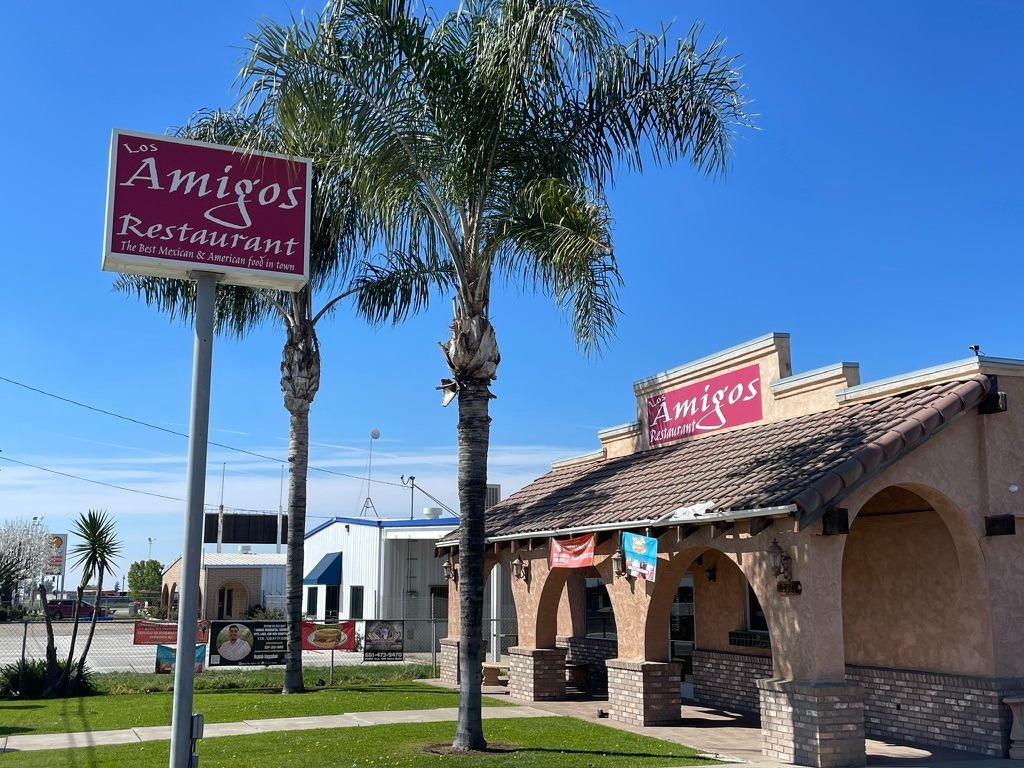
We opted for a Mexican restaurant on our first night, foregoing the Kern River Brewing Company featured in previous stays in Kernville. Not realizing we would have Mexican food for dinner the rest of the trip, I have a few regrets about that decision. The location of the River View Lodge on the Kern, however, and a beach along the river more than made up for the cramped bathroom and mediocre Mexican food.
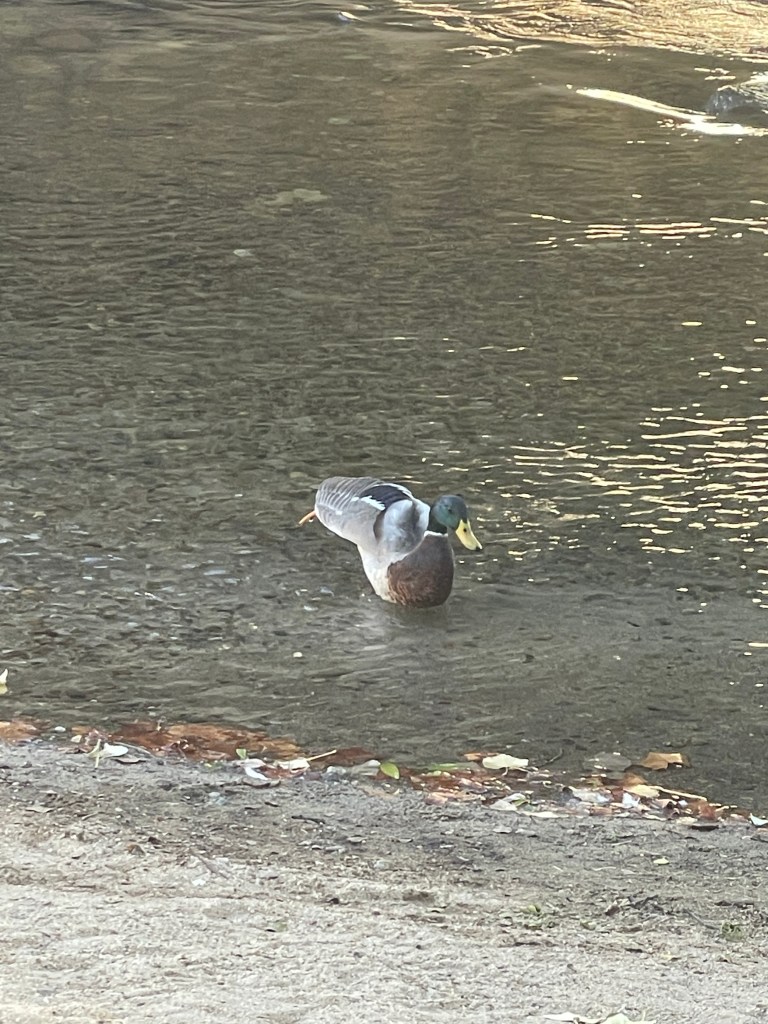
Mallard searching for a snack and SMAP searching for a Mexican restaurant
Day 2 Kernville to Independence ~223 miles
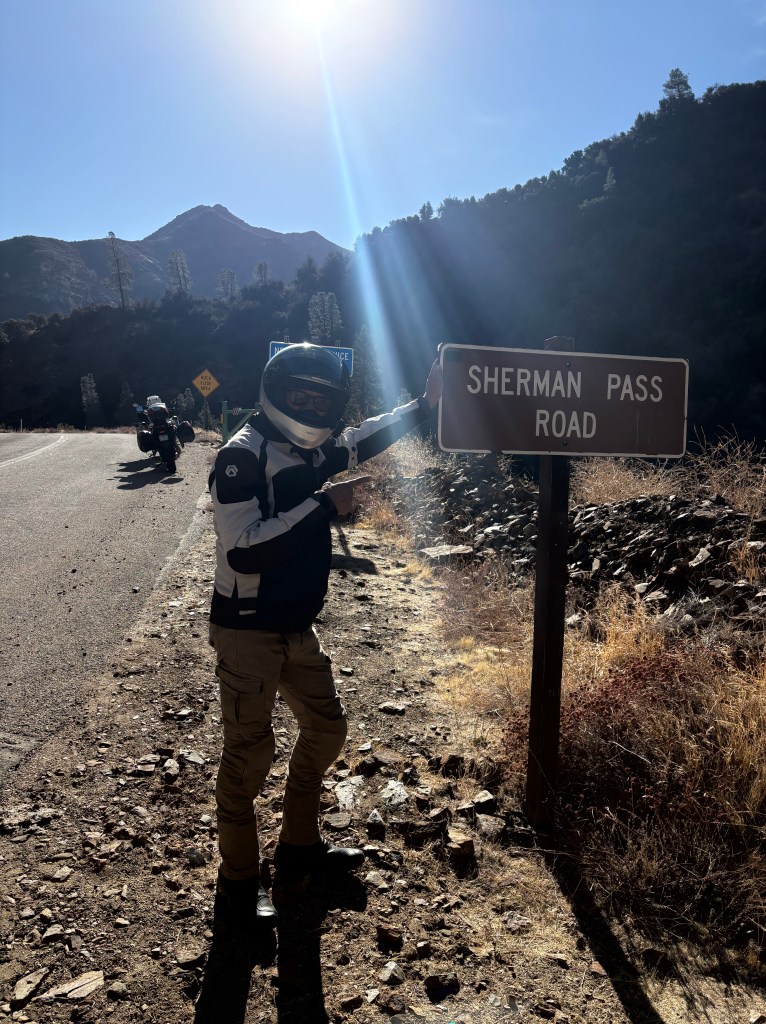
Not having had our fill of winding roads (or Mexican food), we headed for Independence on the east side of the Sierra over Forest Route 22S05, a.k.a. Sherman Pass Road. After omelets at the Big Blue Bear in Kernville, the only eatery open at that early morning hour, we added layers in anticipation of lower temperatures and set off from Kernville at 2,667 feet, bound for Sherman Pass at 9,200.
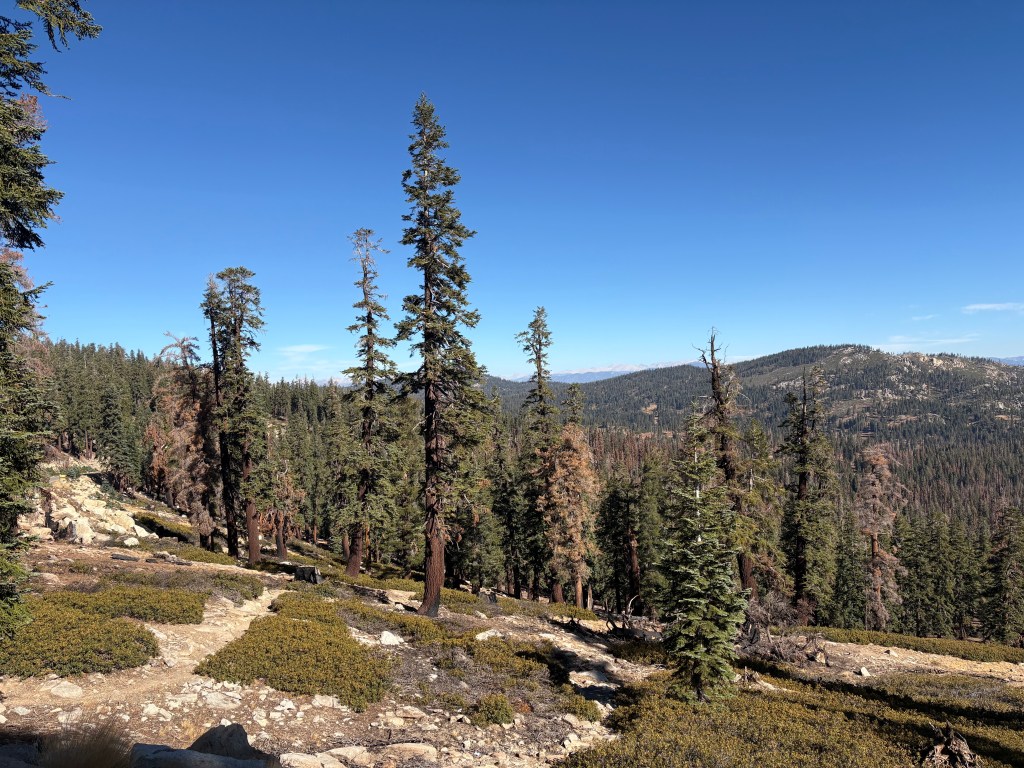
Best way to cross the Sierra if you enjoy potholesThe ascent, relatively pothole free
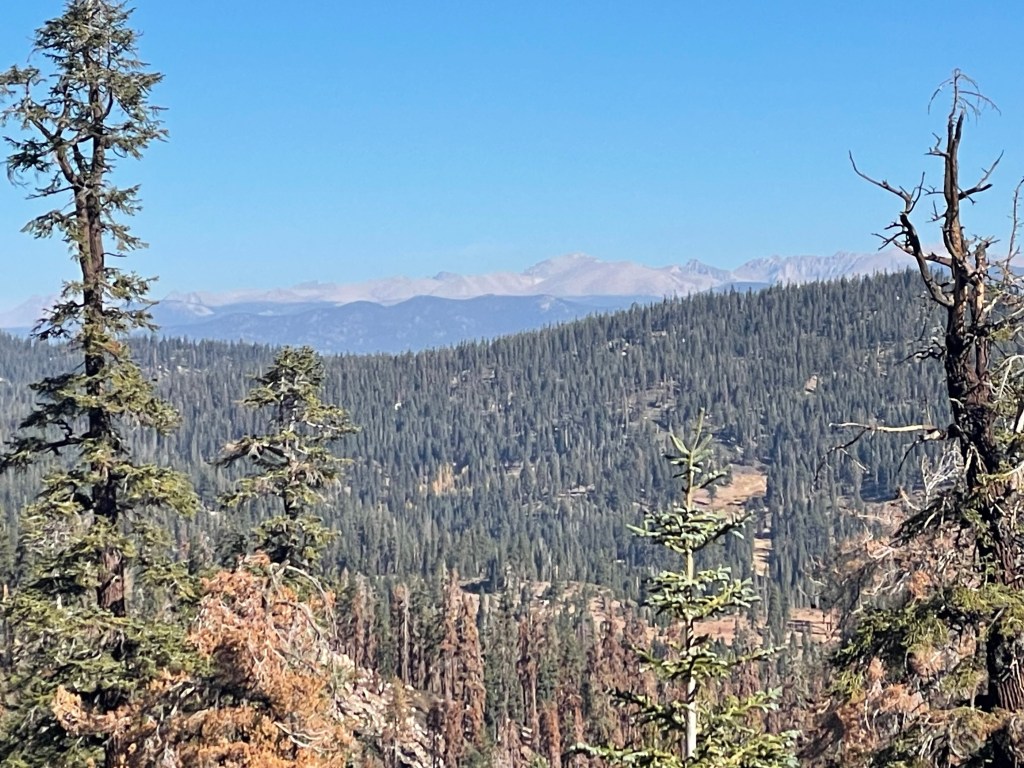
The Sherman Pass summit with Mt. Whitney in the distance
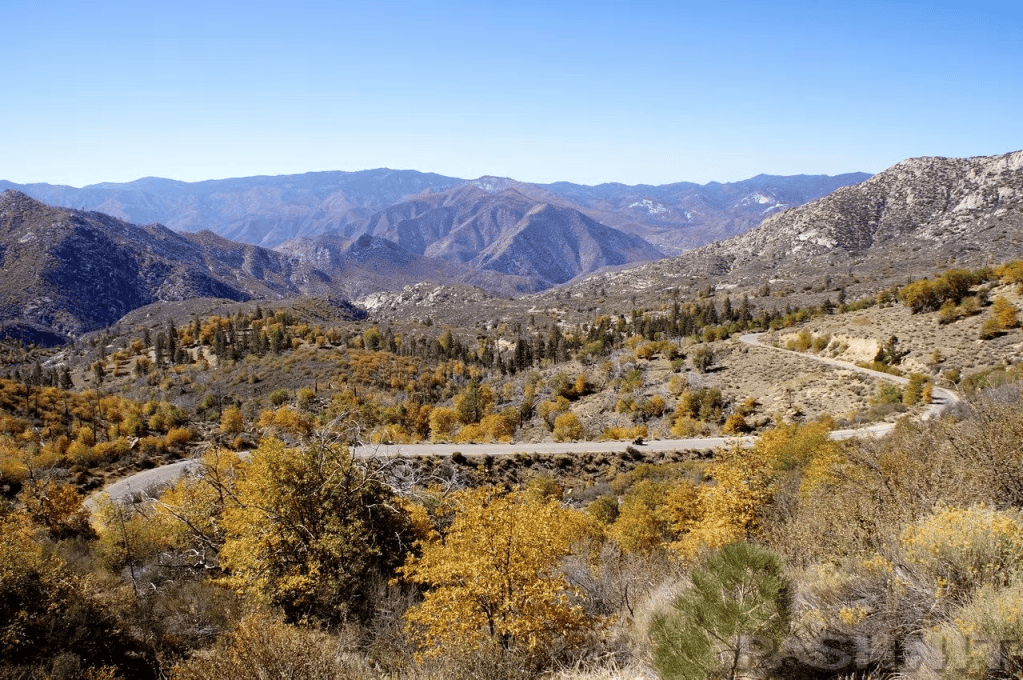
Sherman Pass Rd runs from the North Fork of the Kern River valley in the west to the high desert near US-395 in the east. Few folks are aware of this southern pass over the Sierra. Sherman Pass is not as renowned as Tioga or Sonora Passes in the Central Sierra or Walker or Tehachapi passes in the Southern Sierra but well worth seeking if one wants to avoid the conga line over Tioga Pass.
The Sherman Pass page is worth a read if you want a deep dive.
The Kern Plateau, king of the pot-holed road
Across the Kern Plateau, just before the descent of Nine Mile Canyon to the Owens Valley, lies the off-grid community of Kennedy Meadows. Depending on which website you believe, its population runs from anywhere from 93 to 125. This doesn’t count the through-hikers who take a break from the Pacific Crest Trail.
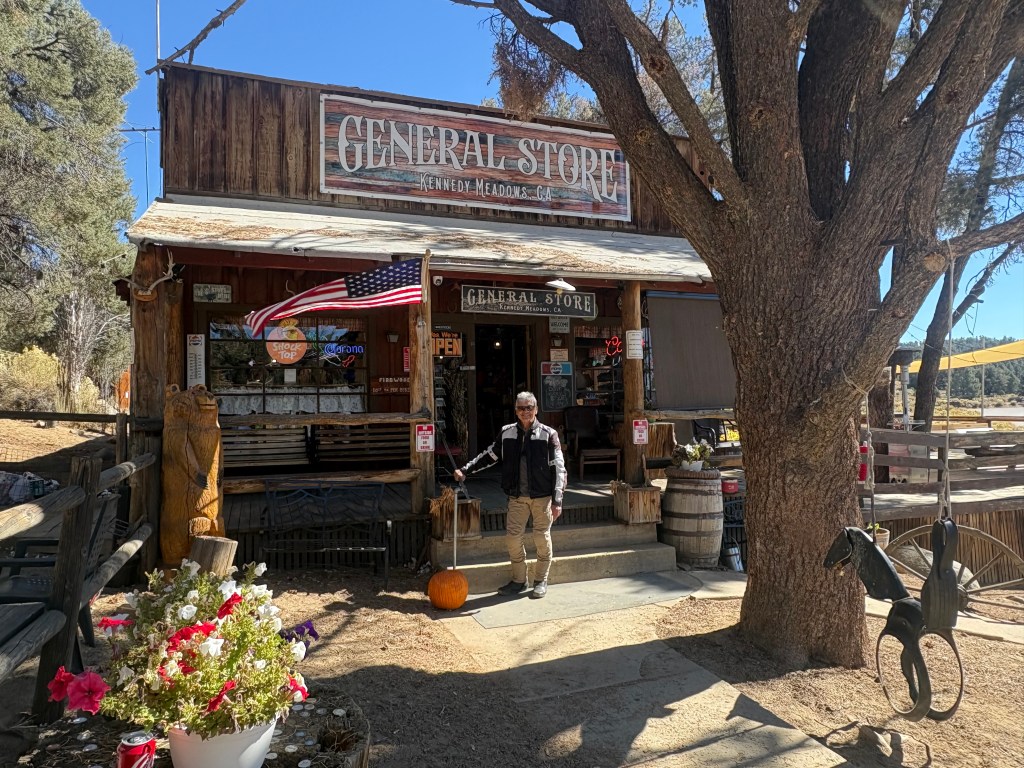
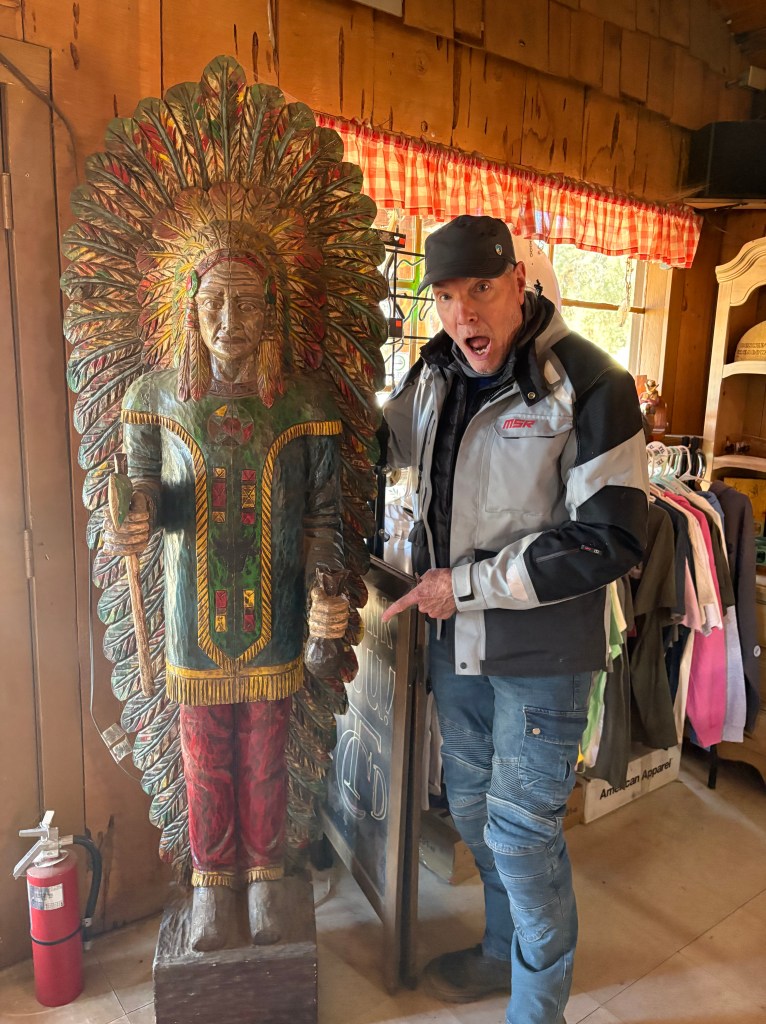
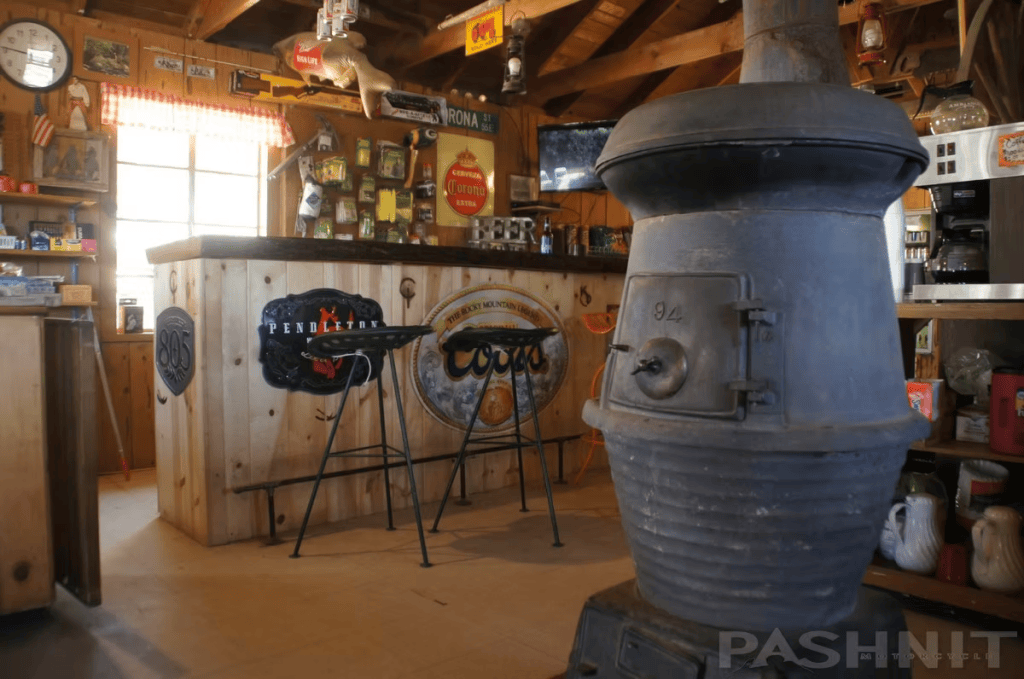
As a featured stop for Pacific Crest Trail hikers, the Kennedy Meadows General Store stocks trail-worthy gear and resupply food and showers. There’s even a small kitchen, the Cook Shack, that serves burgers, sandwiches, wraps, and pancakes. When it’s open.
The Kennedy Meadows General Store, inside and out
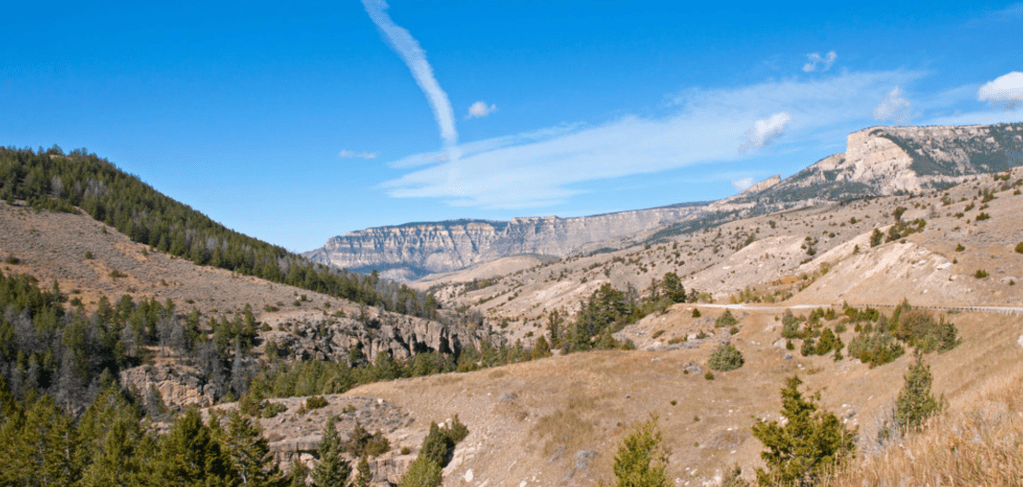
From there the road takes a dramatic turn and drops a breathtaking 3,000 feet in its final 10 miles to US-395.
It was much less scary riding fully armored than in a lycra kit on the descent
Tim Mayhew of Pashnit Motorcycle Roads and Tours describes the descent “as fast, wide open, and intensely twisty, with mostly no guardrails, patches of sand, blind corners, and oncoming drivers who ignore lane discipline.” Sherman Pass Road-my Pashnit. I can attest to the veracity of his description.
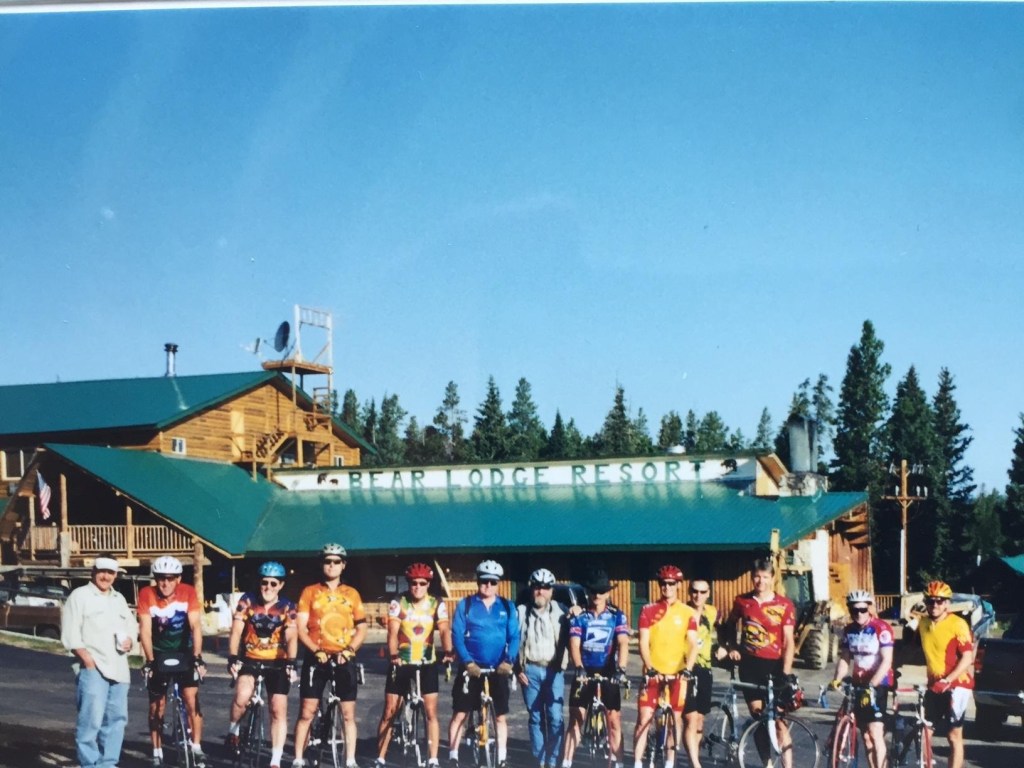
My first two west to east crossings of Sherman Pass and Nine Mile Canyon were by bicycle, in 2008 and again in 2012 with a feisty group of knuckleheads I’ve mentioned in prior posts. Tim isn’t kidding about lapses in attention, sandy blind corners, or oncoming vehicles. Speaking of disregarding lane discipline, this knucklehead remembers passing a descending car on one of those bicycle rides. Fortunately we saw only one oncoming vehicle on this day with no descending vehicles to tempt us.
Open vistas, but you still need to pay attention…
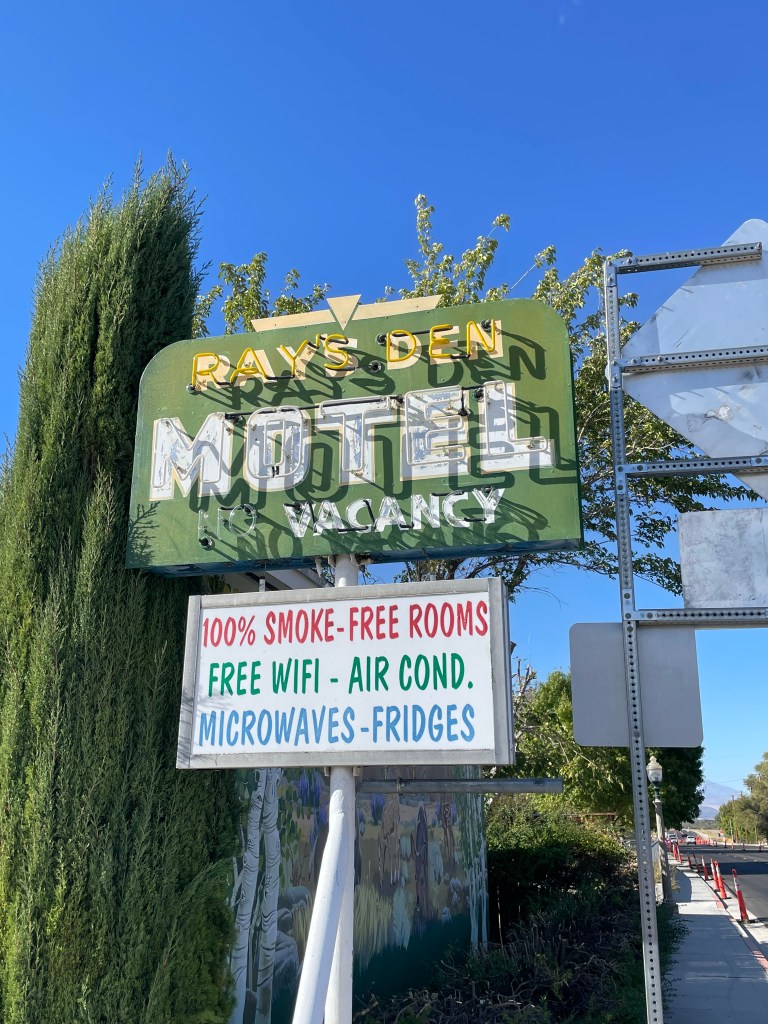
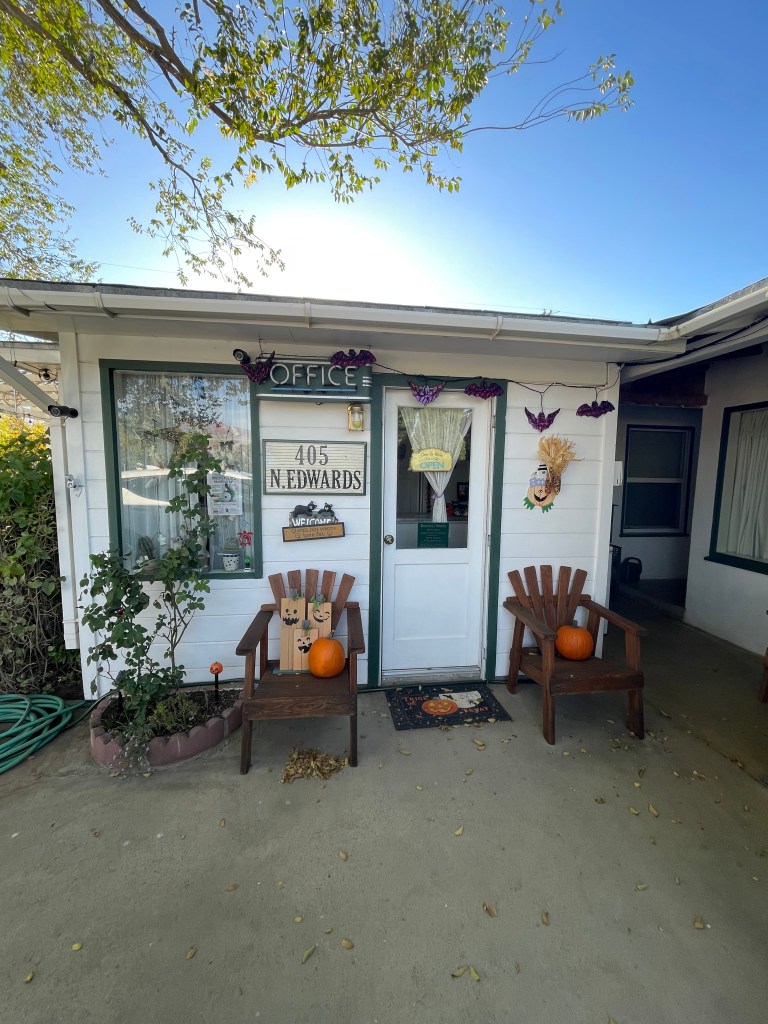
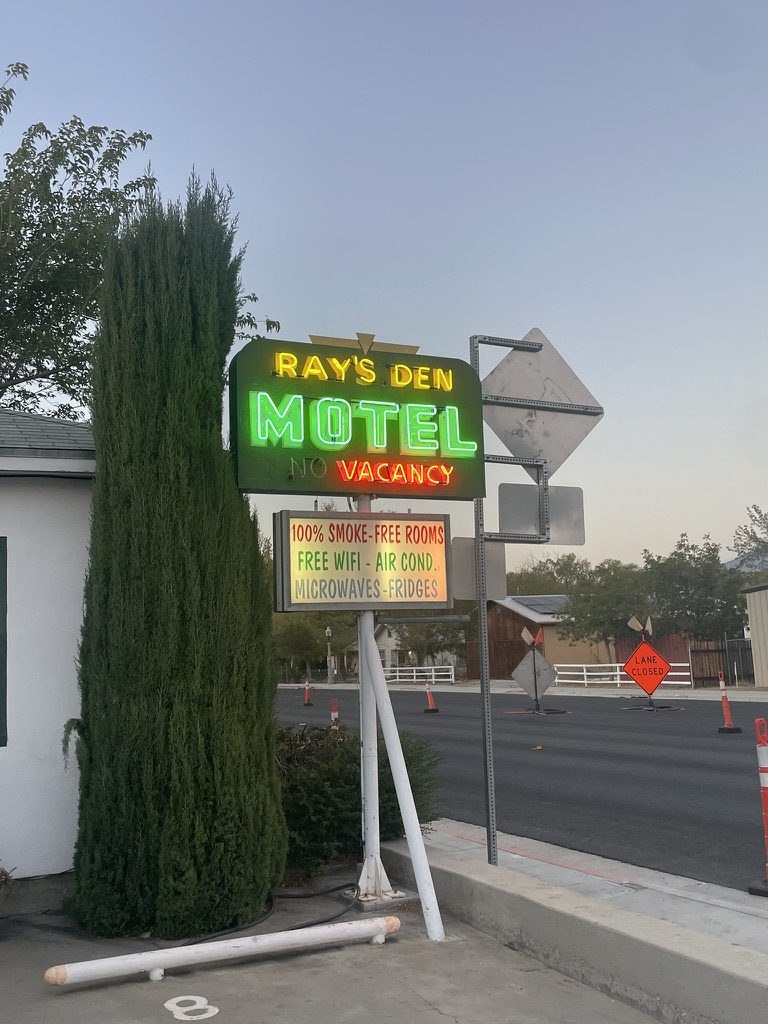
Once on US-395 we headed north past Fossil Falls, Olancha, and Lone Pine to Independence, where I had booked a room at Ray’s Den Motel. There we met Linda, the sole proprietor, room service, custodian, pilot-light lighter, Chevy Volt-driving Jane of all trades, who had just celebrated 20 years of owning her solar-paneled motel. Linda embodies independence, both lower and upper case versions. The upper case Independence is the Inyo County seat between Lone Pine to the south and Big Pine and Bishop to the north. For a deeper dive, see Wikipedia Independence, CA entry.
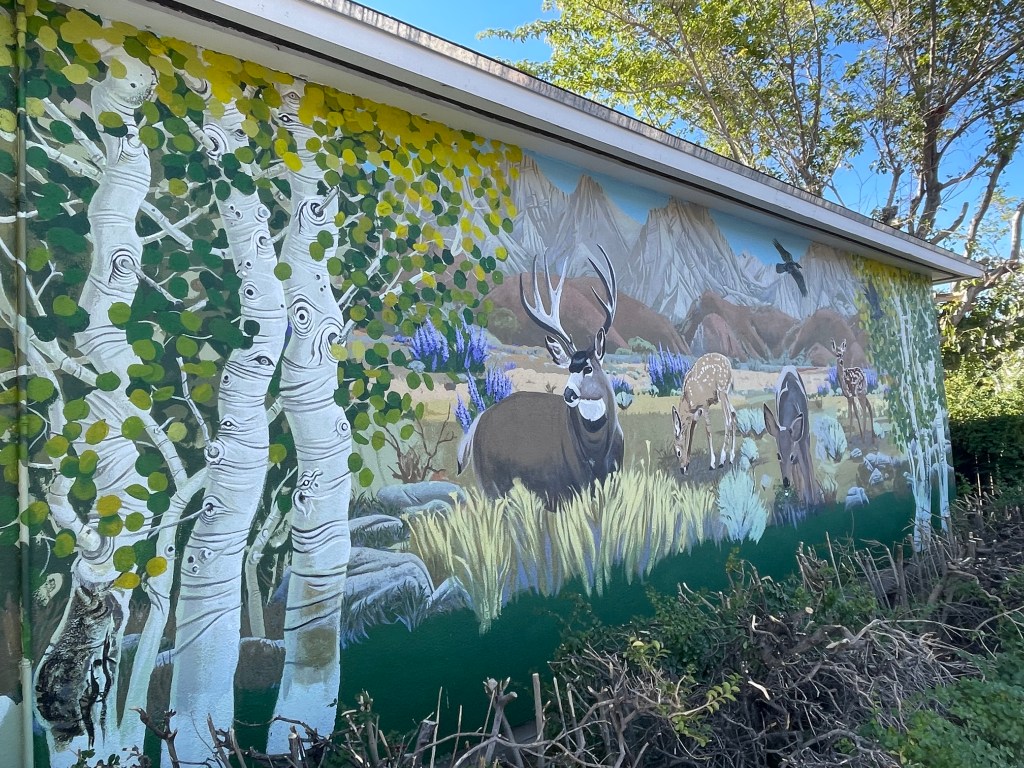
Linda, rightfully proud of a mural she commissioned on the side of her motel
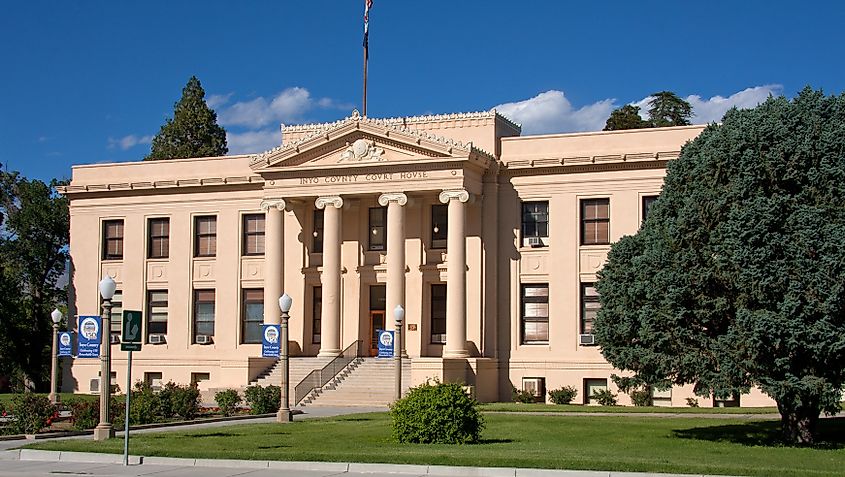
It’s also a town that was once a bit more thriving than today, despite the magnificent Inyo Covnty Covrt Hovse as carved in 1922…
Covrthouse
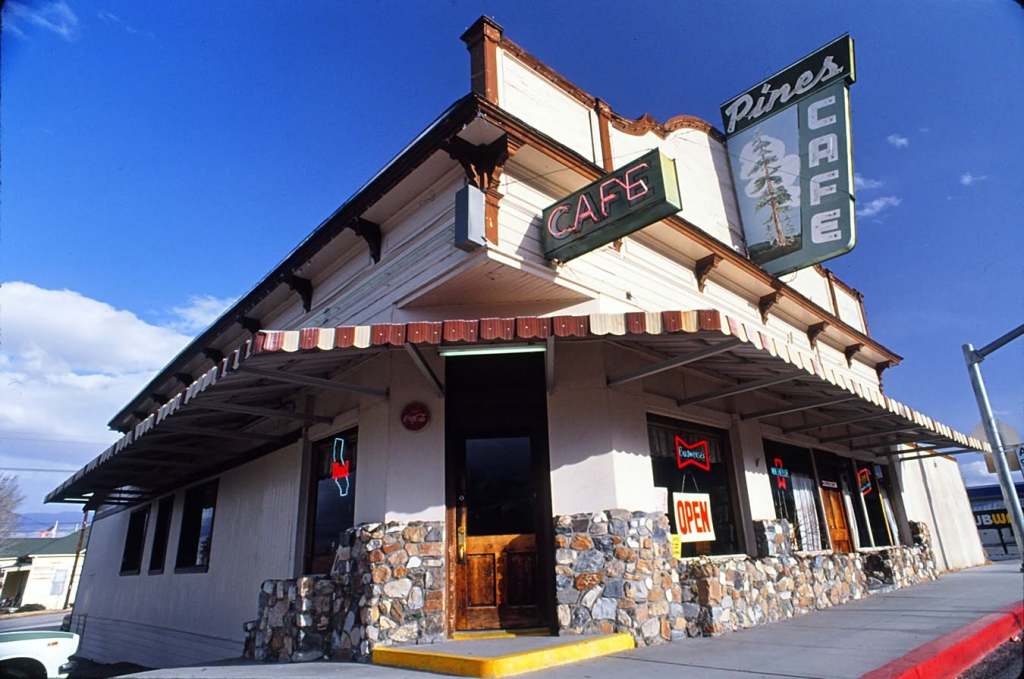
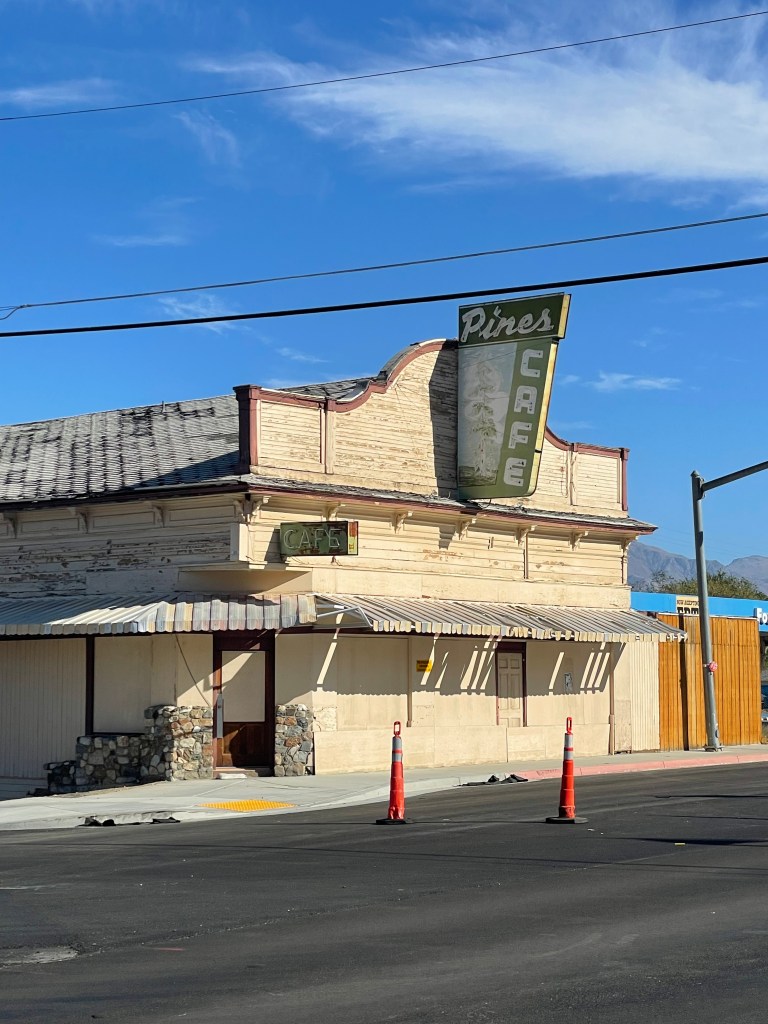
The Pines Cafe in 2004 and 2026
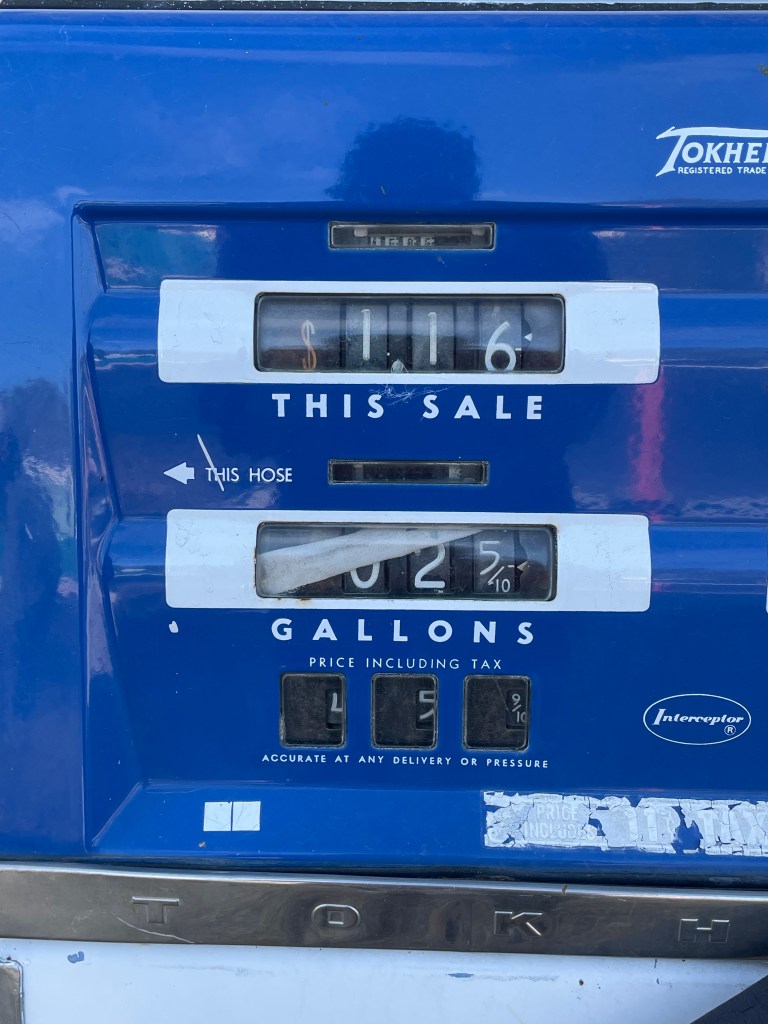
Independence thrived when gas was $0.46 per gallon…
Independence once supported the Still Life Cafe, noted for fine dining specializing in French/Mediterranean cuisine prepared by renowned chef Malika Adjaoud. It closed in 2022. Now there are no sit down eateries. As noted, it’s not Manhattan as if we were looking for a table at the latest bistro, L’Arrogance to try the Reinterpreted Tapas (A Single Tater Tot) for $85, listed on the menu as: one single potato cylinder, deep-fried to crisp perfection in rare non-GMO heirloom lard, dusted with edible 24-karat gold flakes, and served on a bed of smoldering pine needles. We’d have to ride all the way to Lake Tahoe for that. So we cruised the entire main street on foot in search of the two food trucks Linda had mentioned.
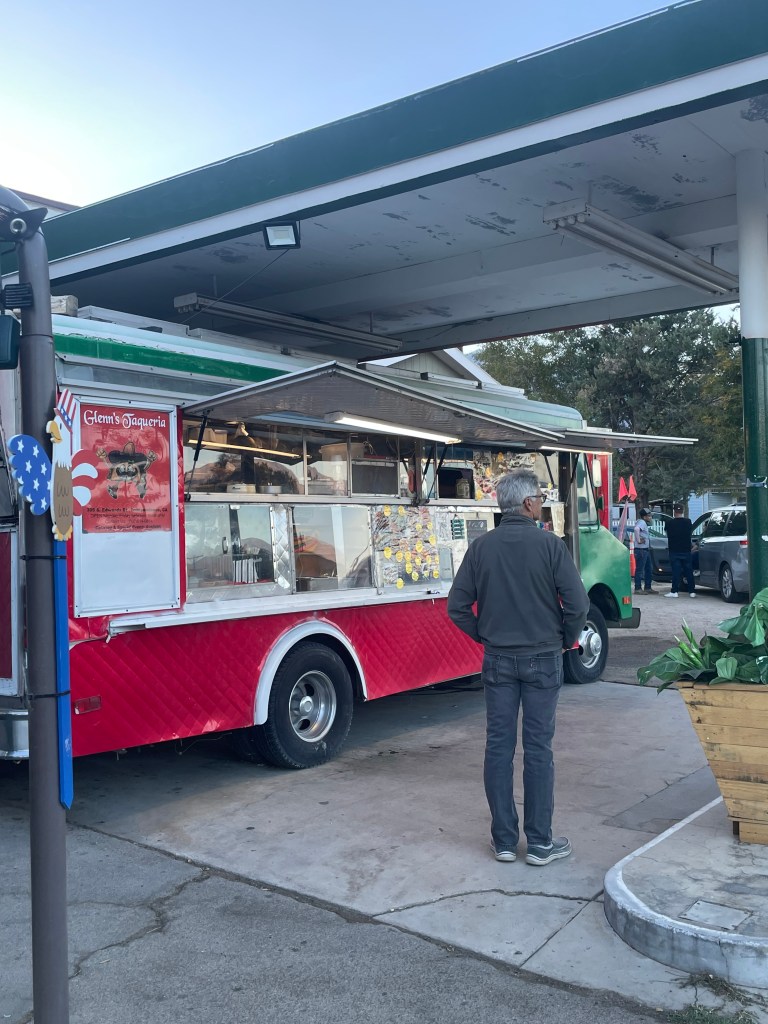
It turns out only one food truck (Mexican) was open in town on a Monday evening, besides the two gas station mini-marts. Highway 395 was being repaved through town and was chock full of 18-wheelers, cars, SUVs, and pickups passing through. Missing were any traffic lights that might give Mammoth- Reno- or Tahoe-bound Southern Californians reason to pause and grab a bite, I suppose. Here’s an idea: install a traffic light and open a L’Arrogance franchise in the vacant Pines Cafe building.
Glenn’s of Independence
In my biased opinion, Glenn’s of Independence was not Ramone’s of Planada, Marco’s of Le Grand, or M&D’s of Snelling. But it was open. Business was good what with all of the highway construction workers joining us. However, adding a Reinterpreted Tapas to the menu might change its blue collar clientele …
A nod to “I’ve Been Everywhere Man”
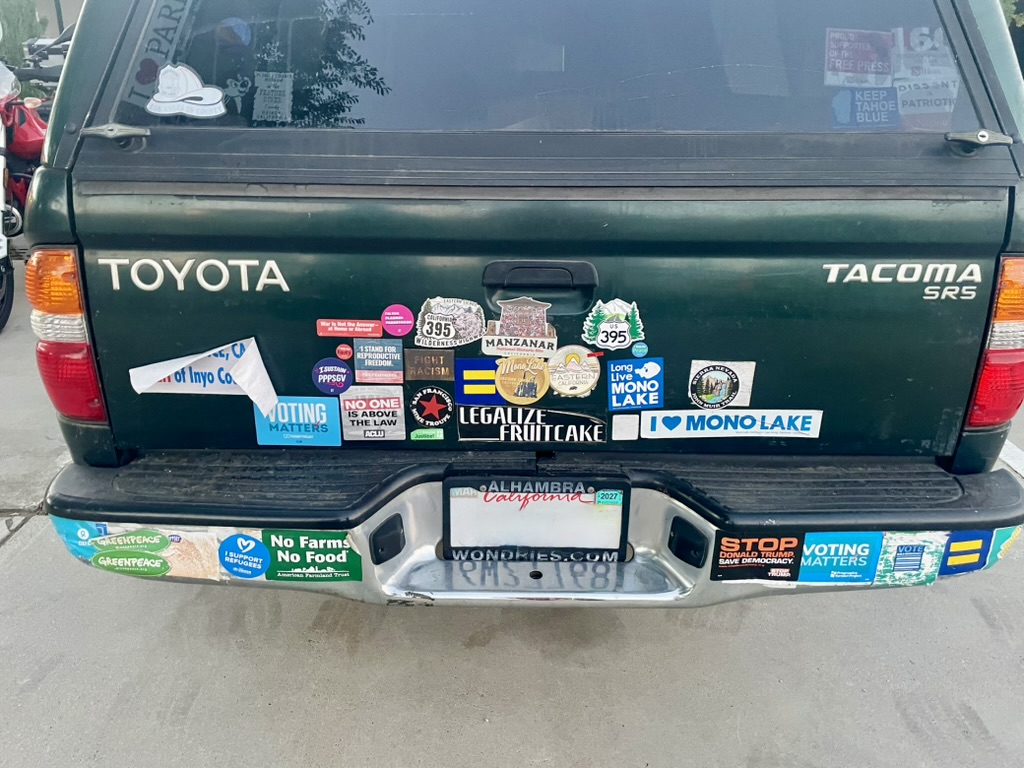
Before our culinary adventure, we met a fascinating ninety-year-old woman who pulled up in her 2002 Toyota Tacoma at Ray’s Den with a camper shell and a tailgate covered in stickers telling just part of her story.
Her name was Frances, a widow from Pasadena, who lived next to the Eaton fire that consumed 14,021 acres, burned 9,419 structures, and killed 19 between January 7 and January 31, 2025 (Cal Fire, CDC, LA County Medical examiner). She evacuated and was later able to return to a home that remained standing, heartbroken by the destruction of her neighboring community.
She had just come from a reenactment of a baseball game between teams of descendants of Japanese families interned at Manzanar War Relocation Center, now a National Historic Site. Frances, who traveled with her cat Lexa, was incredibly present and sharp as a tack. Her wit and intensity came through in lively conversation, and I was astounded to learn she had driven solo to Independence from Pasadena, something she does regularly.
We chatted about our common past as teachers, she in special education and later as an instructor at UCLA. Her sons, like mine, went into firefighting; hers are now retired, and mine will likewise be when I’m 90.
Then chat turned to conversation. I may have tipped my persuasion when asked whether I knew of Howard Zinn’s A People’s History of the United States. “Indeed”, I replied with some enthusiasm and in my best academic semblance since she had UCLA cred: “The People’s History, oh yes. Zinn’s U.S. history from the perspective of folks often left out of traditional accounts. As I recall, he emphasized grassroots movements and conflicts over power.”
Given my entrée, Frances, in her Brooklyn accent, made several animated comments about the current state of politics, spiced with Yiddish phrases and a couple of near F-bombs. She was thrilled to have picked up a copy of The People’s Historian: The Outsized Life of Howard Zinn, by Dave Zirin, a sort of biography and tribute to Zinn, in of all places at a Lone Pine bookstore and insisted I read the book.
Pete thought I was flirting. I thought Frances was flirting.
Frances’s tailgate left little to the imagination about her politics, with a “Legalize Fruitcake” bumper sticker adding a note of humor. Our talk of Zinn, The Nation, The New Republic, and The New York Review of Books was unexpectedly refreshing in a small rural town that has seen better times. To a casual bystander it might have looked like woke elitist academic proletarians whining about what capitalism has done to this rural community.
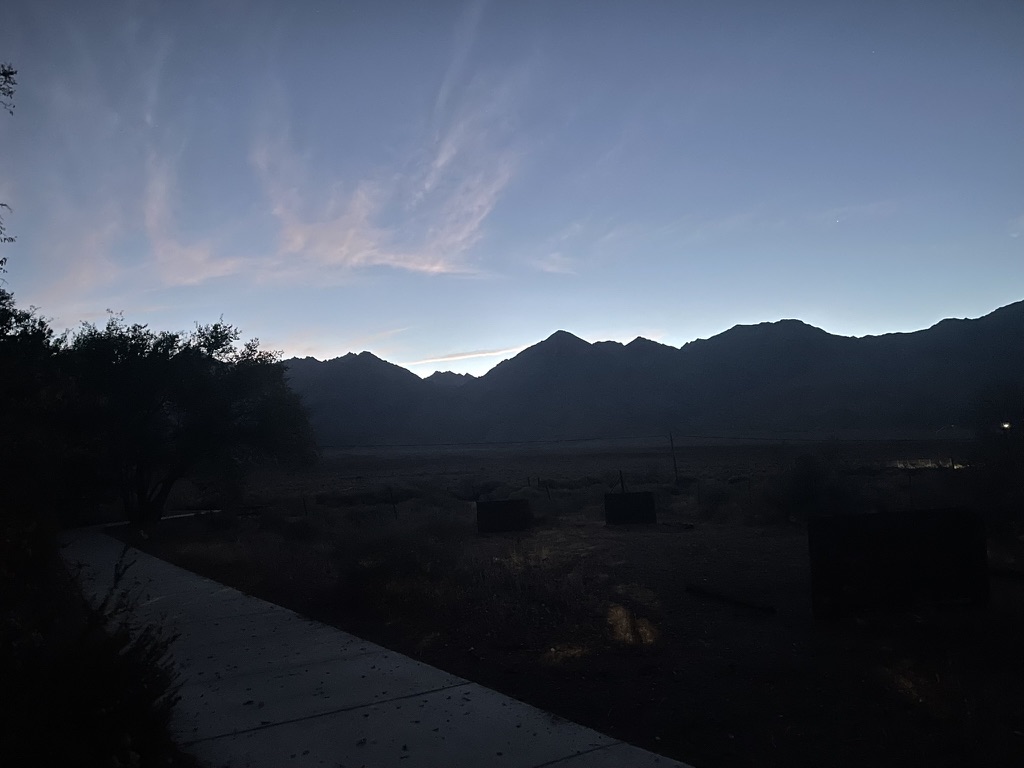
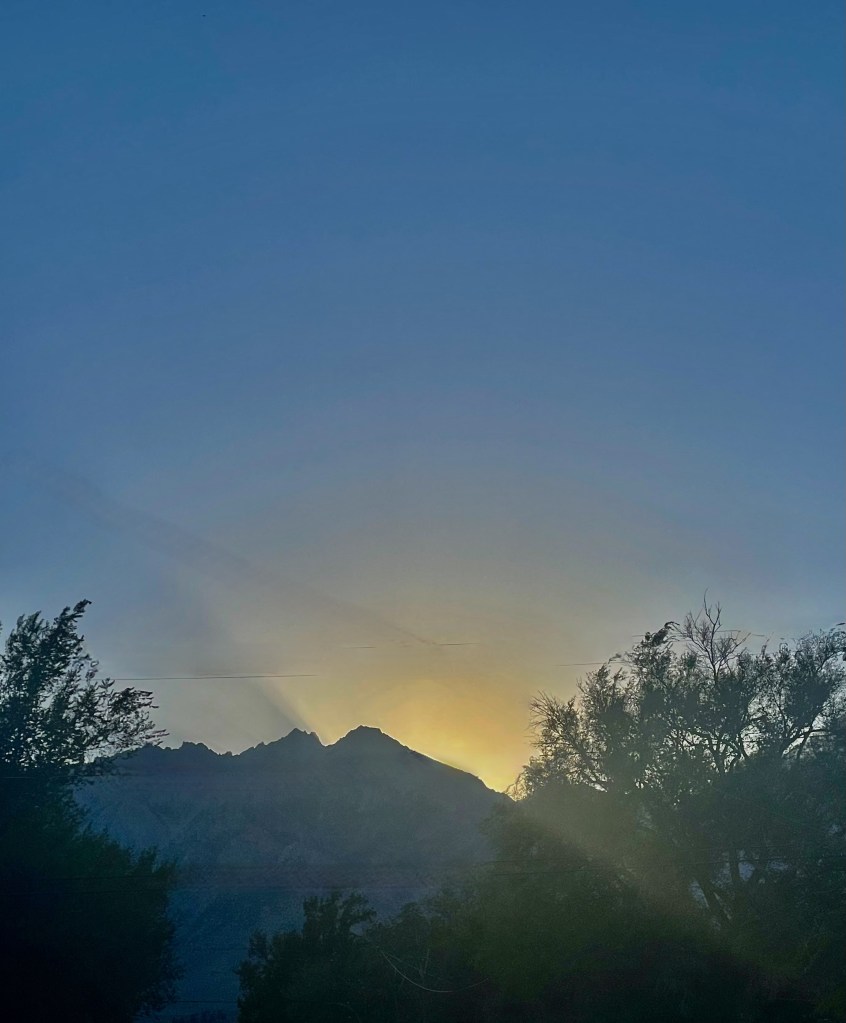
Linda’s standards are firmThere’s something sentimentally nostalgic about motel neon……And the Sierra, silhouetted by the last light, from Dehy Park along Independence Creek, just behind Ray’s Den Motel
Day 3 Three Rivers Bound ~238 miles
We opted to return to the western Sierra over CA-178, Walker Pass. Skipping breakfast (the Taco truck was closed) we layered up and headed out on a crisp fall morning.
Sunrise from Ray’s Den parking lot
On the downhill reach of CA-178 having crested the summit, a fool in a pick-up with two dirt bikes in the truck’s bed, attempted to pass on a double yellow striped blind curve. He got around me just as an oncoming car came around the curve. I immediately slowed and moved over to the right side of the road as he slammed on his brakes, swerving back into the lane right behind SMAP who was ahead of me by 25 yards. Pickup man then had the audacity to stick to SMAP’s tail light. SMAP, who raced motorcycles in his youth, took off attempting to lose this annoyance.
Perhaps Tim Mayhew, whose comments were noted earlier about “oncoming cars disregard[ing] lane discipline entirely” might want to add, “and dirt bike toting pickups (or substitute any appropriate profane references) disregarding lane discipline while impertinently attempting to pass on blind curves.”
Where’s the CHP when you need them? I cautiously proceeded and met up with SMAP who had pulled over once on the floodplain of the South Fork of the Kern River on a long straightaway to permit the nitwit in the pickup passage.
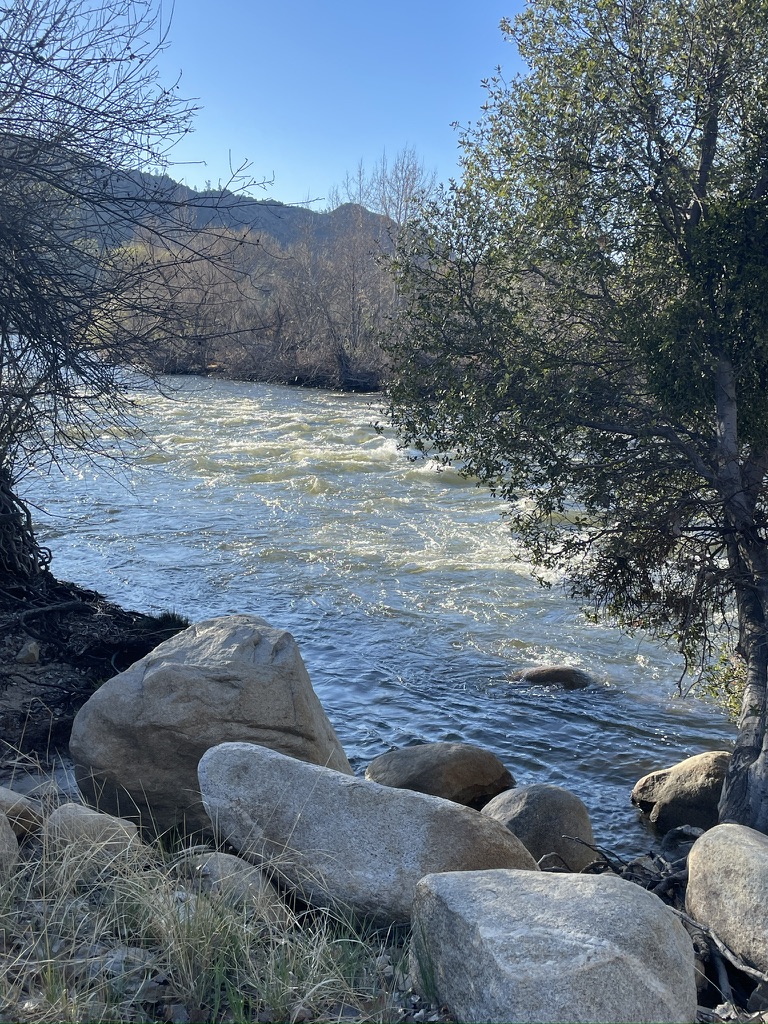
The verdant riparian habitat of the South Fork of the Kern River lies in stark contrast to the arid, golden hills through which it flows. Cutting off CA-178 at Weldon to enter Kernville through the back door we crossed the river, or what might be the subterranean aquifer that represents the river and supports the lush habitat, after the spring runoff ceases. Signs of fall, the poplars among the oaks, were hinting at yellow. We didn’t make it up to the ends-of-the-road trailheads where aspen might have been in full color. We had to settle for hints and not the show.
From there we retraced our inbound route over CA-155 to Glennville where we then turned north on White River and Old Stagecoach Roads populated by cattle ranches every few miles or so. From Porterville we continued north on CA-65 to Woodlake where we took CA-198 into Three Rivers near the entrance to Sequoia National Park.
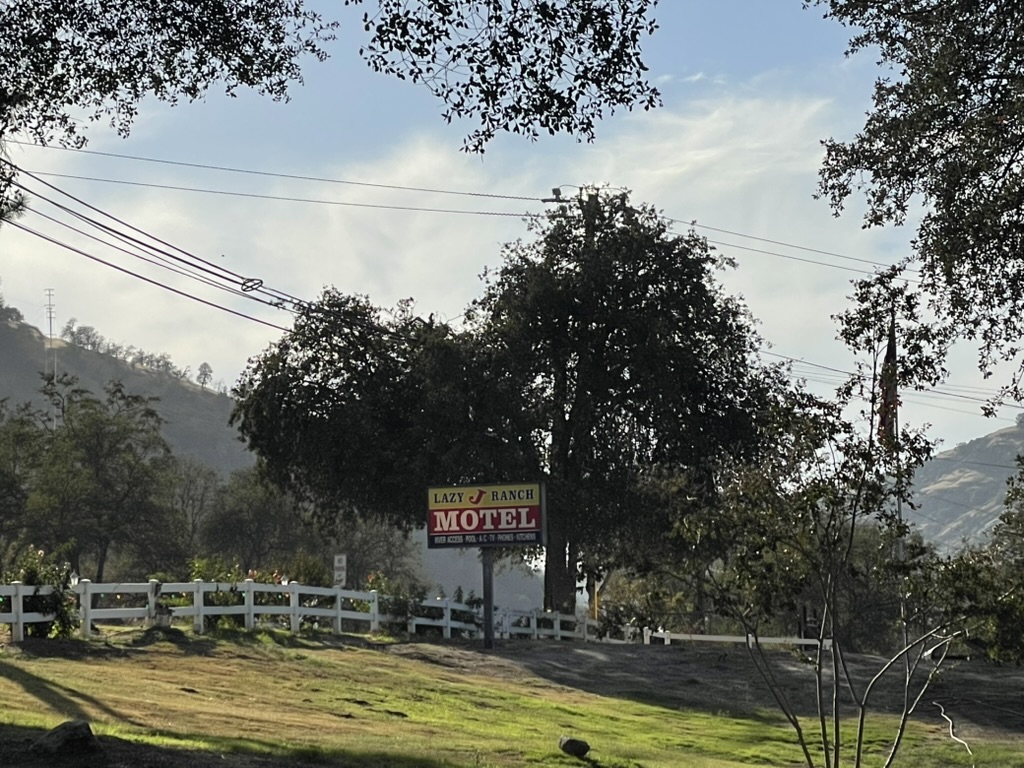
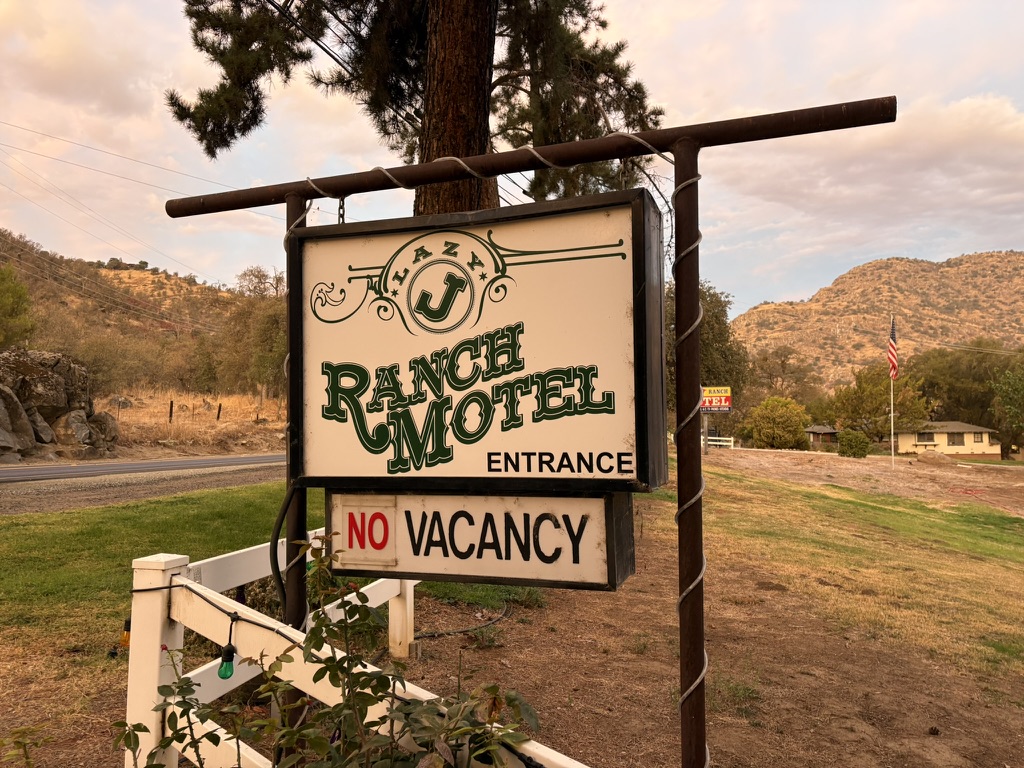
The Lazy J in Three Rivers
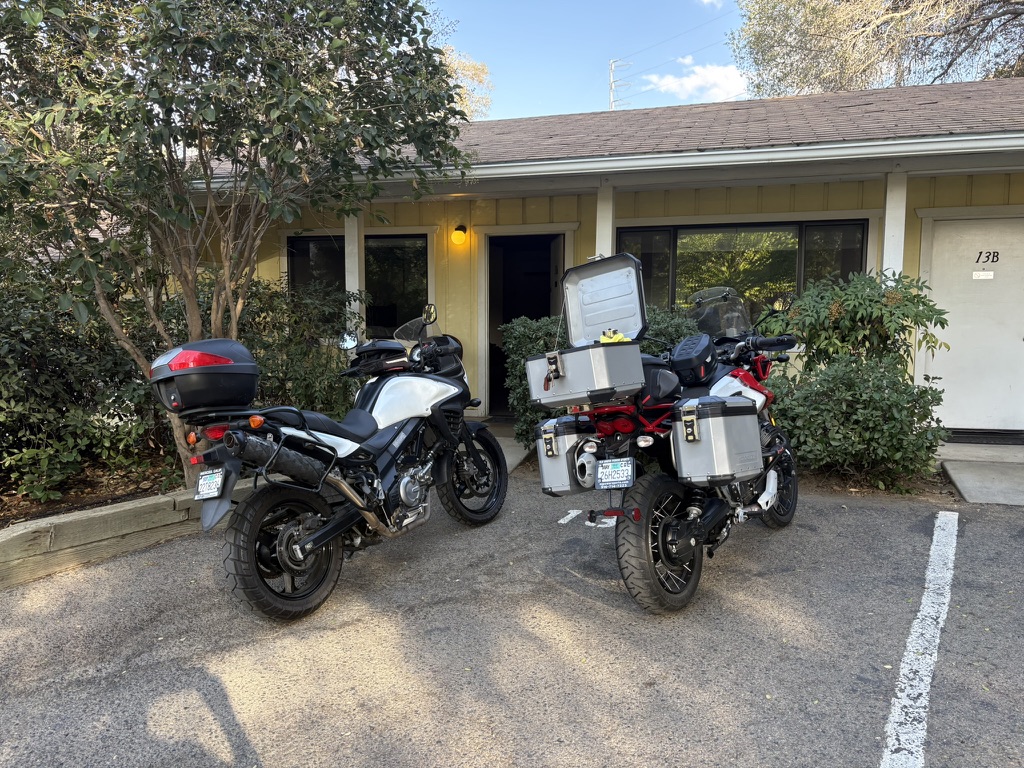
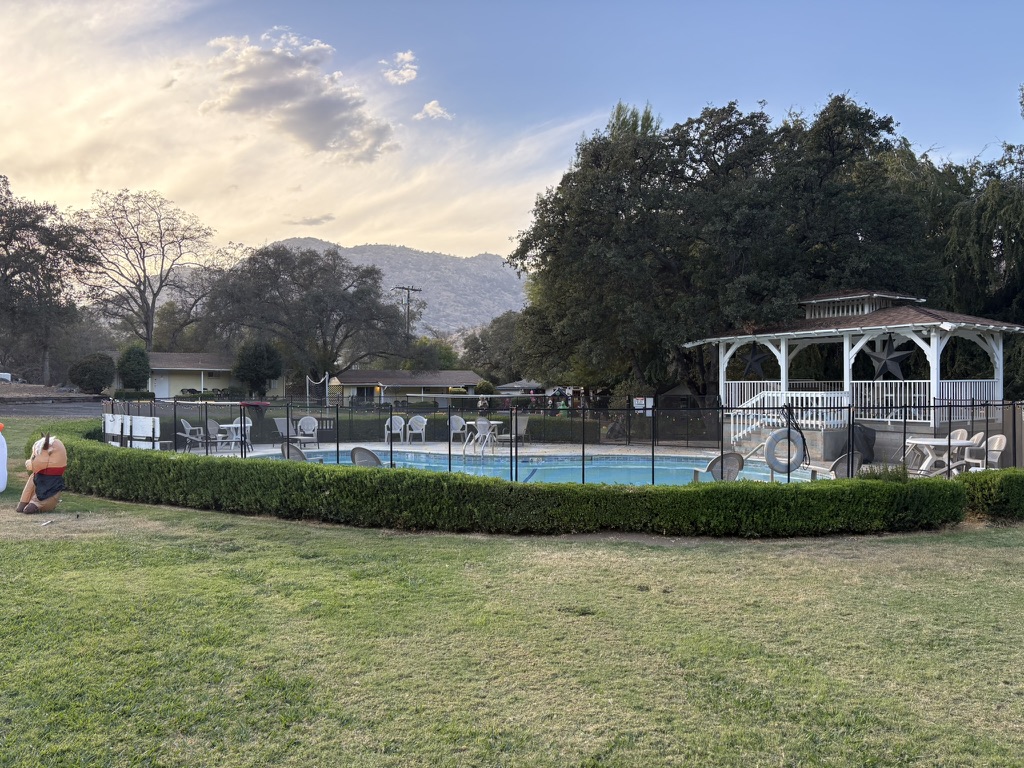
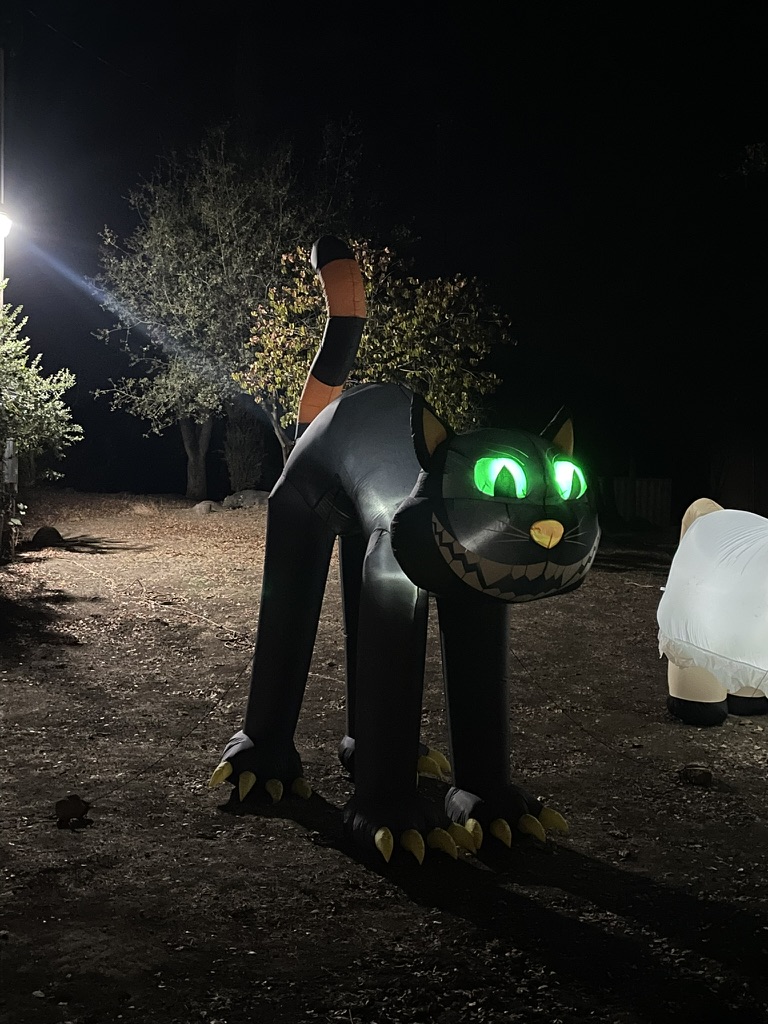
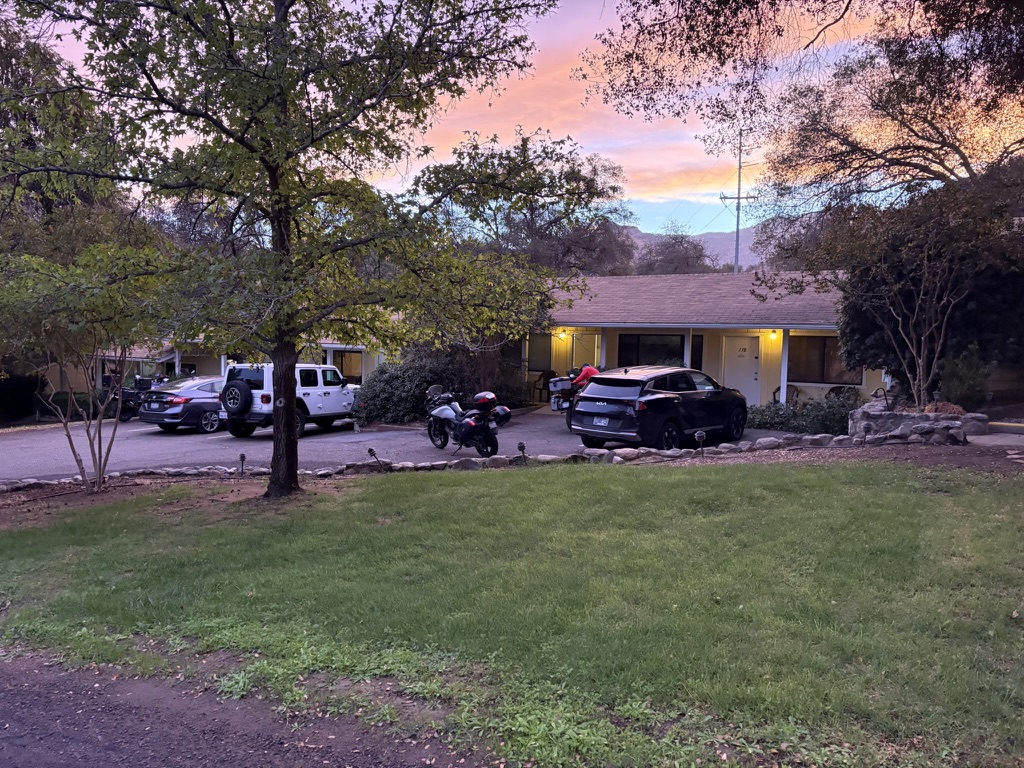
We settled in at the Lazy J Ranch Motel then rolled into town for 3R beverages and, yep, you guessed it, Mexican food. Though I swore against having Mexican food for the third night, I have to admit, I was seduced by the fish tacos and chicken mole enchiladas on the menu. We watched the sunset on the ride back to the Lazy J where we were greeted by an assortment of inflated whimsical Halloween decor as we strolled around the grounds.
This fella was my favorite
Day 4: Homeward Bound ~154 miles
The next morning we bid adieu to the Lazy J. Clouds were gathering with rain in the forecast as the deflated Halloween characters lay at rest.
The Tulare & Fresno Counties citrus belt, home of Lemon Cove and Orange Cove
What would have been a two and a half hour sprint down CA-99 was in the classic Sisyphean “ramble” form, a three and a half hour zig-zag through massive groves of dust-less citrus, with a stop in Friant where SMAP had a coffee and bear claw and I, the rest of my roasted pecans.
We went looking for fall color and found it only in patches on our 845 mile ramble. What we found instead was a western lodge haunted by stars of yesteryear, a motel owner who has kept her place going for twenty years despite a town on the brink of evaporating, and a ninety-year-old woman who drives alone across the state with a cat, a bumper sticker filled tailgate, and her hunger for small towns that matched our hunger for mediocre Mexican food. Not a bad season to be in search of.
We managed to beat the rain arriving home shortly after 11 AM, giving me time to mow the lawn, put out the trash cans for pickup, and get drenched while cleaning out the rain gutters that I should have cleared before going on the ramble…
Days were getting longer, warmer, and closer to the solstice. A northern route was proposed with an AI assist, one that I found useful, however inaccurate at times. This route ended up disappearing from glitchy technology while on the ramble. The paper map back-up also disappeared somewhere along the road from Vernal to Torrey Utah. Somehow we managed to enjoy seven states (CA twice) in eight days without navigation or incident and I quietly celebrated my birthday…
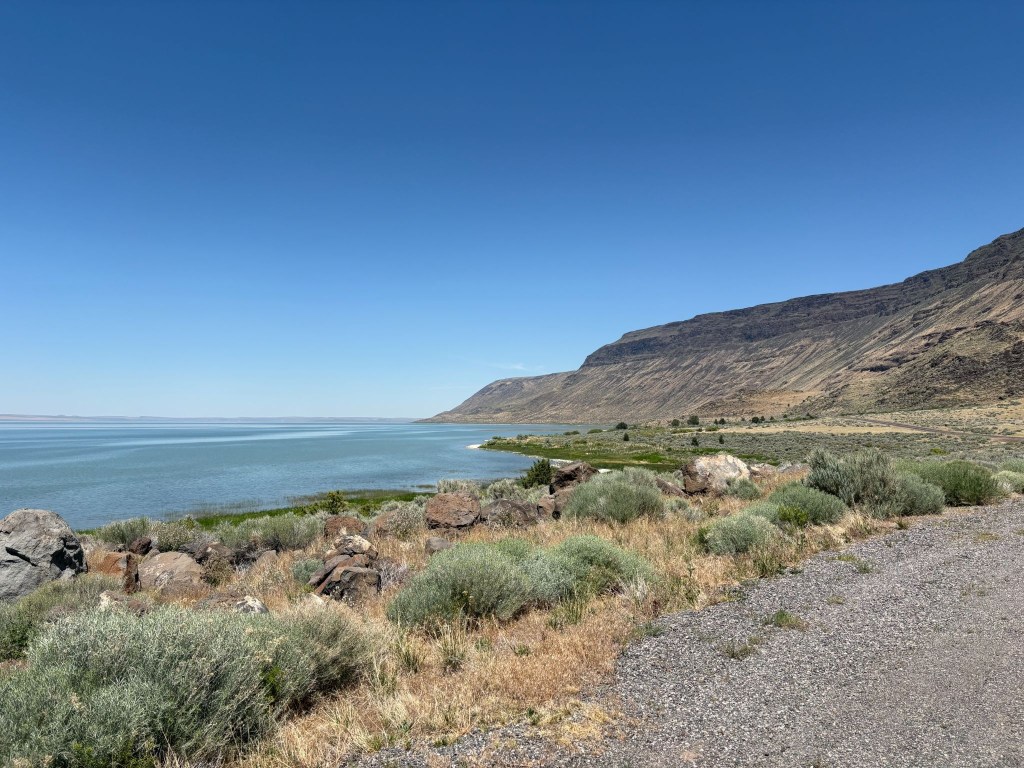
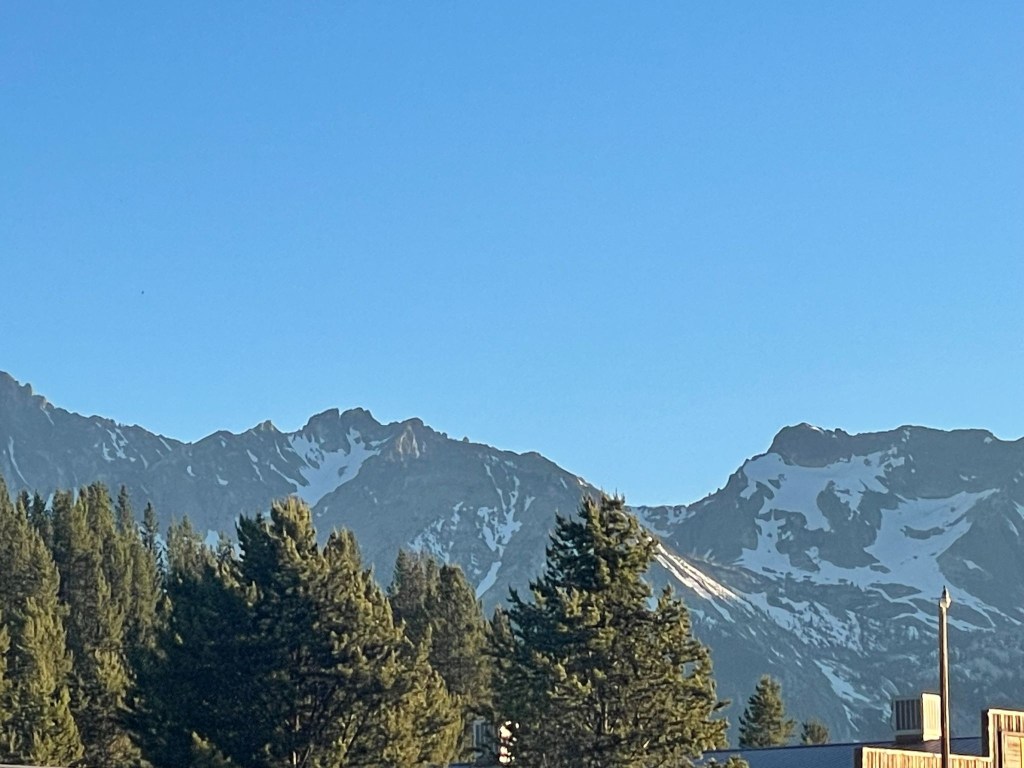
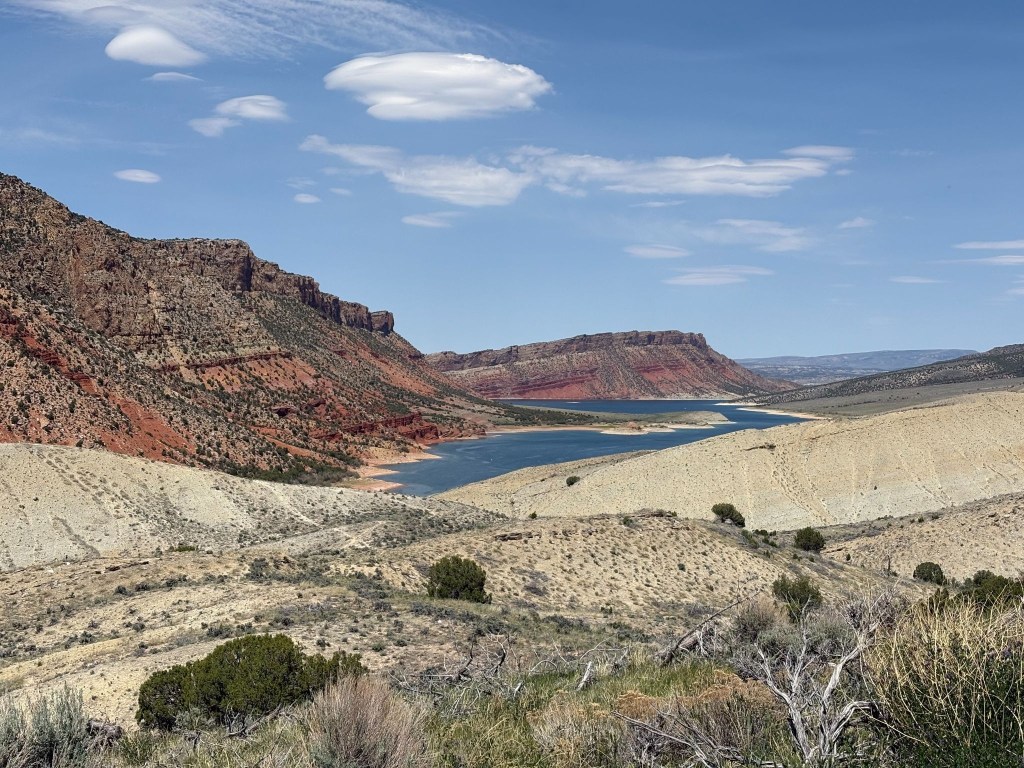
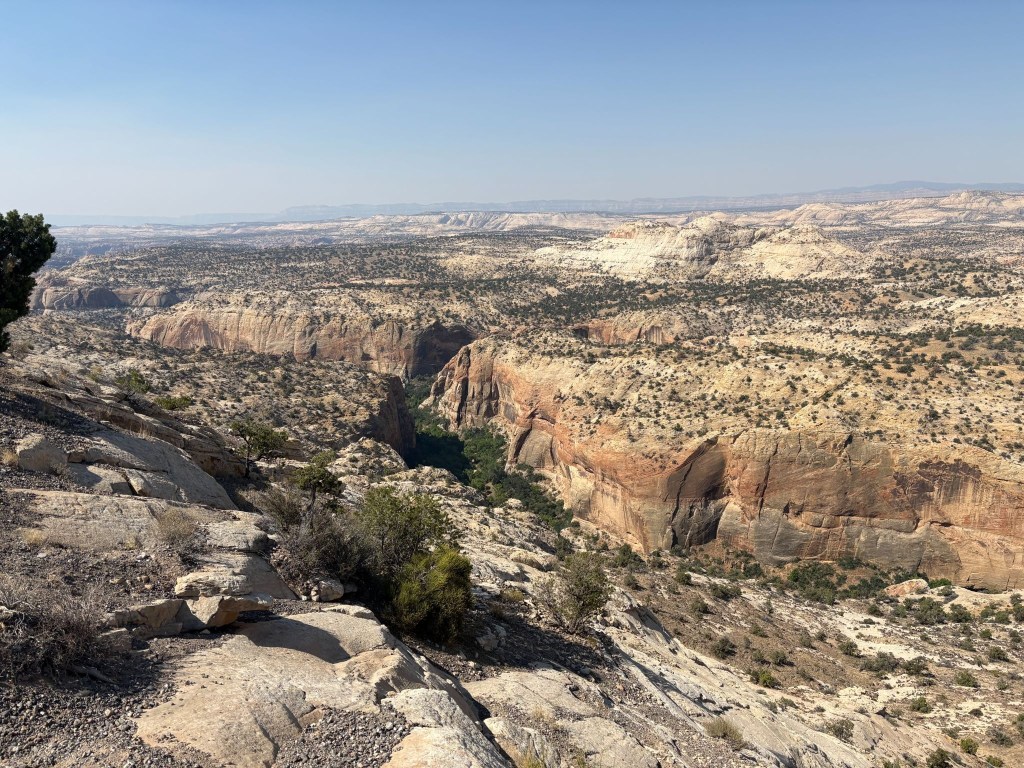
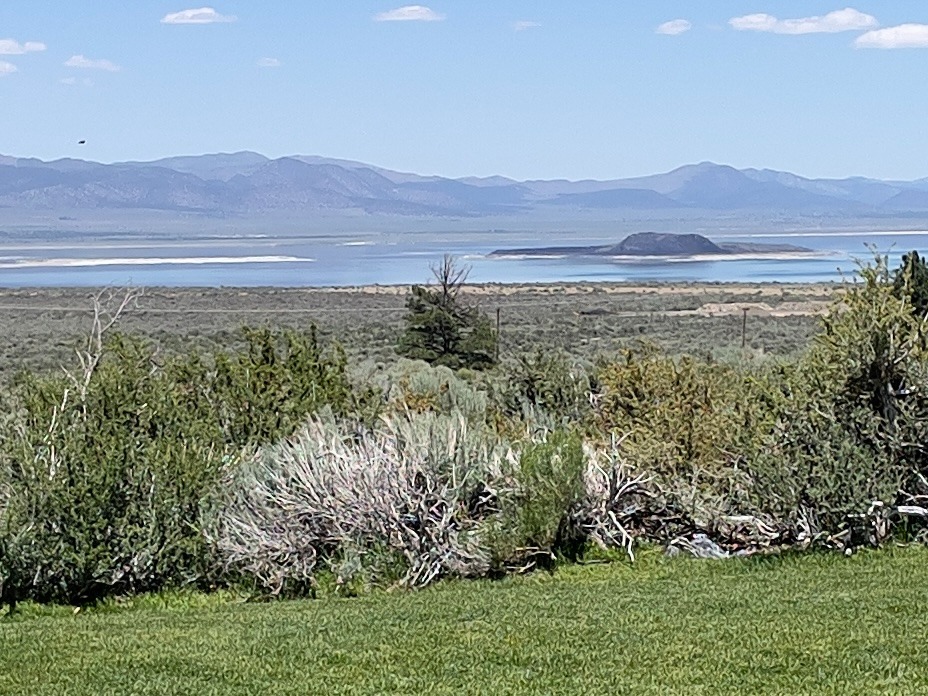
Albert Reservoir and the Albert Rim in OregonThe Sawtooths from Stanley, IDFlaming Gorge lake, UTThe Escalante, UTMono Lake, CA
Per the usual trip highlights, we rode through amazing landscapes, quintessentially western and met interesting locals and travelers, who like ourselves, were curious about these iconic western locales. And for at least three days, it was technology free rambling. Cellular coverage is weak if not totally absent from many of these rural western locales. Our Cardo comm devices defied spotty cellular coverage so we could at least converse about the scenery and whether the route resembled the plan. Columbus didn’t need cellular coverage. All he had to do was shout an order from the deck. Though, he might have made it to India if he had…
Sisyphean Ramble Planning Criteria (SRPC)
Our “absolutes” when rambling include roads that follow the Butler Motorcycle Map descriptors:
Butler Motorcycle routes are graded with descriptors such as G1, G2, and G3, where G1 indicates the best combination of twisty pavement and scenic views. Additionally, routes are marked for features like “Paved Mountain Trails,” which indicate roads with no center line and uncertain conditions or “Lost Highways” roads with faded center lines, crumbling shoulders, and long lonely miles, i.e., a “blast from the past” feel.
If you read the SRPC (Sisyphean Ramble Planning Criteria), framework in the preceding post, File this Under: The Old Dog Learns a New Trick (A Cautionary Tale) the Butler grading system explanation reframes the AI conflict from “old man yells at chatbot” to an interesting navigation philosophy clash. Especially in light of losing the digital “Drive” routing as Google Maps disappeared on the third day while on the bike. As did my iTunes. On more than one occasion, Google and Apple were yelled at, I might add, often in vain…
This presented one of the difficulties while planning in convincing AI that avoiding highways of the Interstate variety or freeways in populated areas would necessarily lengthen the day’s ride beyond another absolute, limiting 300+ mile days. Since we were motelling this ramble, our preferred camping mileage of ~250 mile days, was suspended as setting up and breaking down camp has more moving parts than checking in and out of a motel. And there are showers. I used AI in selecting lodging for the first five days, on the recommendation to do so as the post-Memorial Day vacation fury was about to convulse. Apparently motels, like campgrounds, aren’t the only place to seek refuge in an unfamiliar place that gets hoarded by anxious travelers on January 1.
Departing the Central Valley on CA-59 and stepping onto the historic J-59 foothill corridor, the journey climbed steadily into the rugged heart of California’s Gold Country. The landscape traded flat farmland for rolling, oak-studded hills as we arrived in the historic hamlet of Jamestown. Forget the pork, the historic chicken wing of Jamestown, home of the Chicken Ranch Casino.
Joining the iconic CA-49, we wound north through the heart of the Mother Lode to Angels Camp, a town steeped in frontier frog lore and the Mark Twain Vrbo. At Angels Camp, the route pivoted east onto CA-4, launching a dramatic ascent into the High Sierra. The road narrowed to a “Paved Mountain Trail,” and twisted sharply as it conquered Ebbitts Pass, a breathtaking, white-knuckle alpine crossing that tops out over 8,700 feet amid granite crags and sweeping wilderness vistas. Be sure not to miss a shift down to first gear, thus hitting neutral, on a 10 mph hairpin. I speak of experience.
Descending the eastern slope, the highway brings you into the quiet mountain outpost of Markleeville. Like most small mountain towns open all weekend, it was pretty much rolled up on a Monday morning.
SMAP enjoying a spot of Markleville’s shade as Sisyphus stretched his nalgas
From Markleeville, you pick up CA-89 and link up with CA-88, dropping out of the high alpine forest into the wide, sweeping ranch lands of Minden, Nevada. Turning north onto the historic US-395 highway along the Eastern Sierra flank, the route passed straight through the heart of Carson City. Cruising through Reno, the final, long northbound stretch carried us back across the California line and through the arid sagebrush plains of Lassen County.
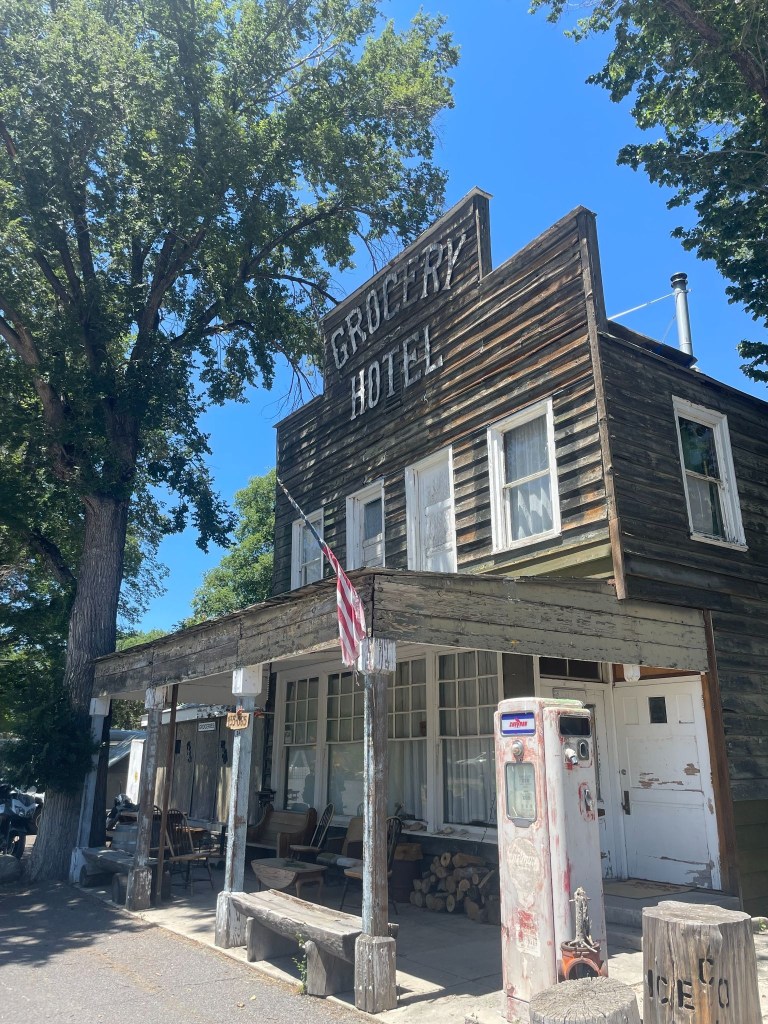
The SRPC motel criteria has evolved. We prefer classic motor courts or motels. They must, however, not be decrepit. For instance, this is an example of a place that would be rejected by applying the SRPC:
Sorry Doyel, we’ve got miles to go before we sleep
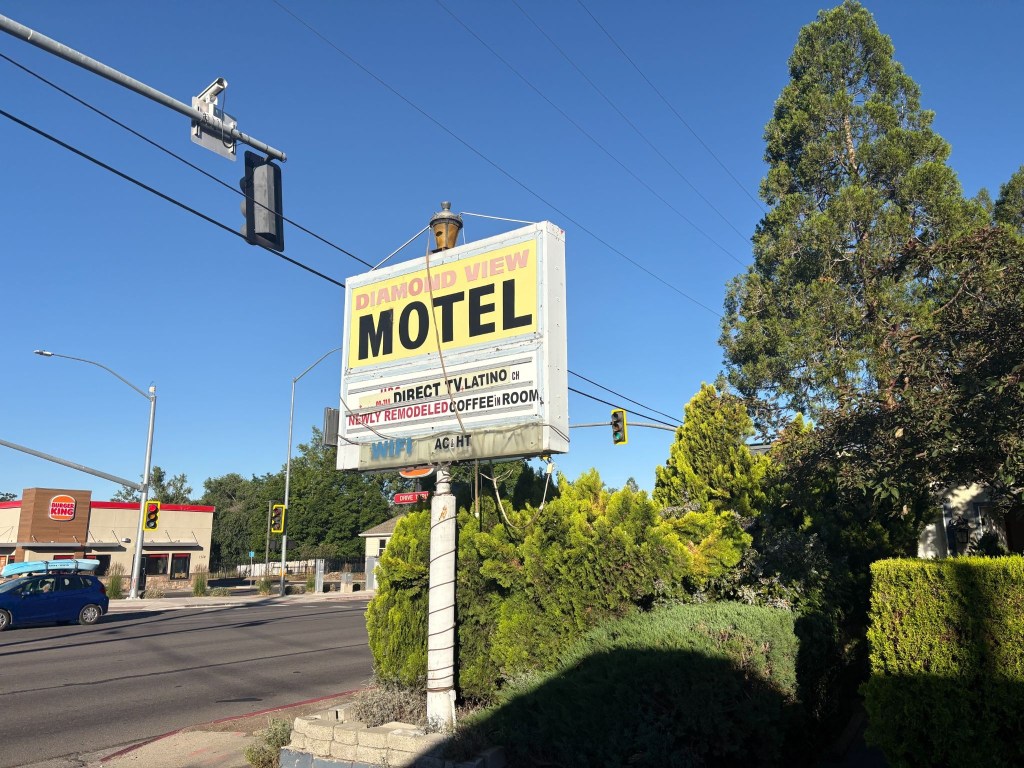
Not because it was a Hotel and not a Motel, not because the towels probably weren’t transparent, but because it was in Doyle, California a town decidedly not on the rise. Towels notwithstanding, gas was a bargain at the Doyle Grocery Hotel where the red pump was retired long before the proprietor and long after it had lost its sheen. Back on the bikes, some 42 miles short of our destination, we ultimately brought the day’s long ride to a close at the faded (and presumably lighted by a series of extension cords) marquee of Susanville’s Diamond View Motel.
The sign sums it up
Just prior to departure, I decided it would be best to secure reservations for lodging for the first half of the trip. I did so because Claude, my AI assistant, recommended confirming reservations as this was prime vacation season in the direction we were headed, particularly for moto-ramblers like ourselves. However, discovering that I had the wrong dates for each of the four reservations I had hastily made, rather than call back and rearrange and possibly lose a booking, I revised our departure date. I did this without Claude’s assistance.
Susanville, CA rivals Chama, NM, long the gold standard of Sisyphean overnight stops
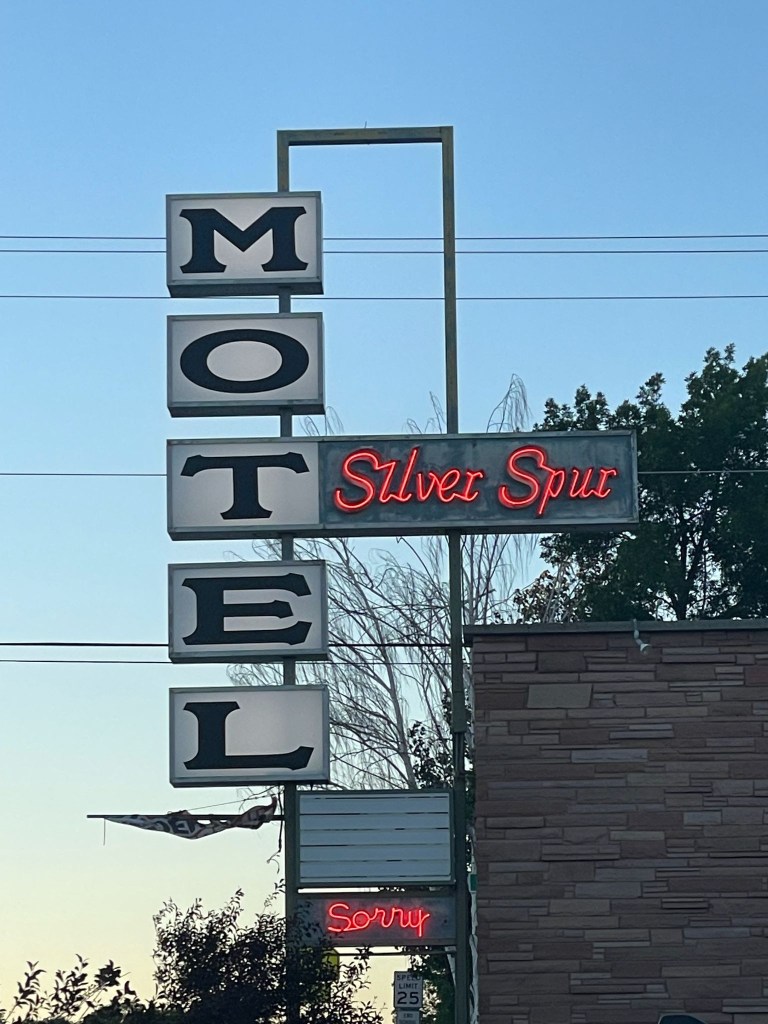
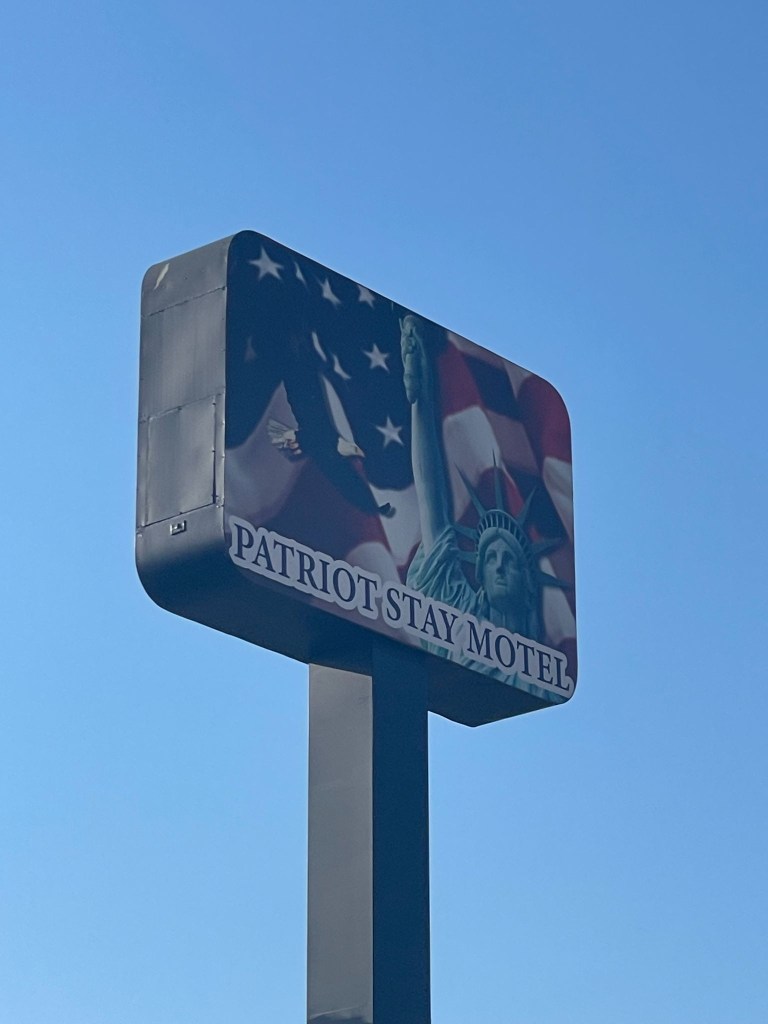
In making the reservation for the Diamond View with Ming, the sole proprietor of the place, on the Friday prior to our intended departure on Sunday, June 14, I accidentally booked the room for our first night on the road, Monday, June 15, my birthday. Along with reservations for the Silver Spur Motel in Burns, OR, the Mountain Village Resort in Stanley, ID, the Swiss Mountain Motel in Thayne, WY, the Patriot Stay Motel in Vernal, UT and the Rim Rock Inn in Torrey, UT, all were subsequently a day off too. So, rather than risk losing any of the aforementioned lodging, I simply rescheduled the departure. I didn’t need Claude to figure that out either.
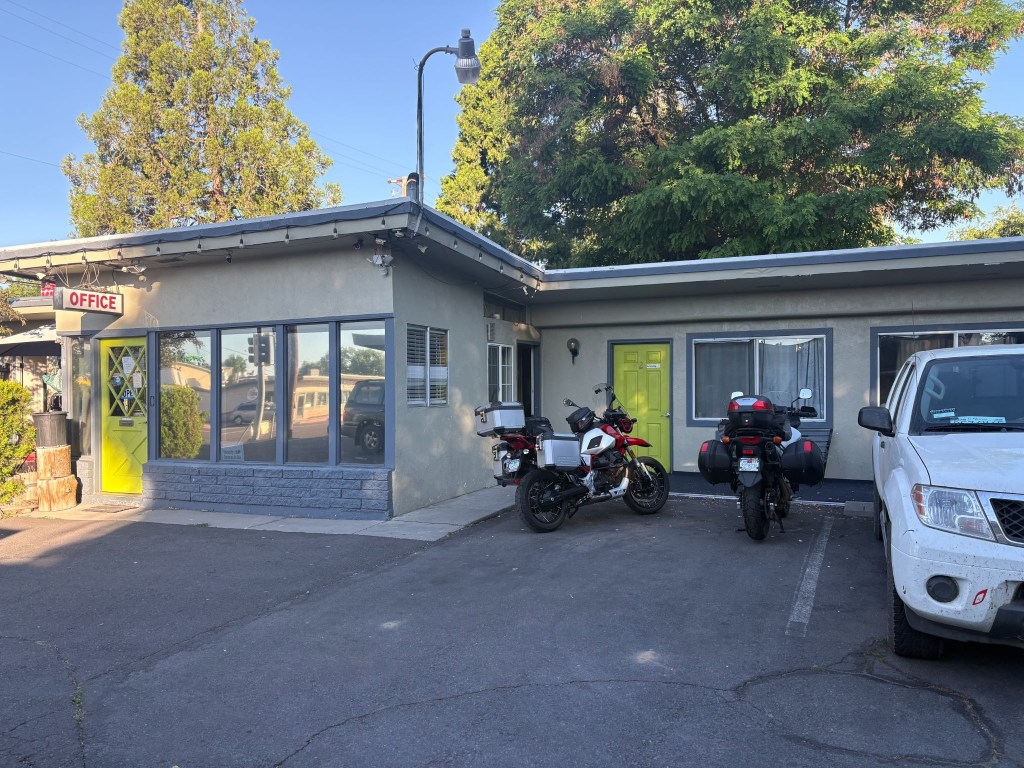
Ming sounded to be a nice, if somewhat, non-fluent English speaker over the phone. Upon checking-in on our arrival I requested, politely with a touch of snark, the “presidential suite.” To which she mumbled in response, something like, “What a president?” Her perplexed look, staccato English, and my embarrassing explanation that it was a joke concluded our only contact with her. She retreated to the laundromat across the driveway, further mumbling, unimpressed by my sarcasm.
Check-in now achieved, we unpacked and cranked up the room’s air conditioning. It was in the mid 90’s by mid-afternoon. The air conditioning, noted on the marquee along with HT (heat?), worked fabulously. I guess that was compensation for not having “coffee in room or WIFI”. It all began to make sense. The motel appeared to be populated by a group of “eccentric” folks of questionable sobriety and means. The sheer number of security cameras attached to the office eves and the room decor explained everything. Maybe Ming preferred viewing the motel’s parking lot tableaux to “Direct TV.Latino”.
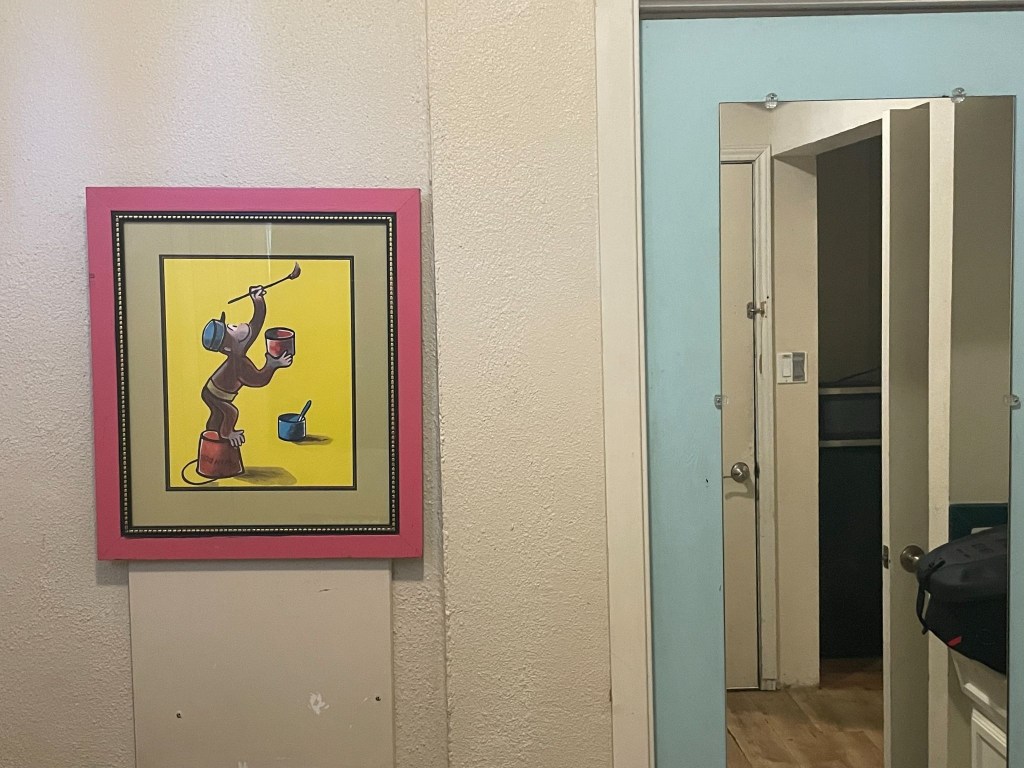
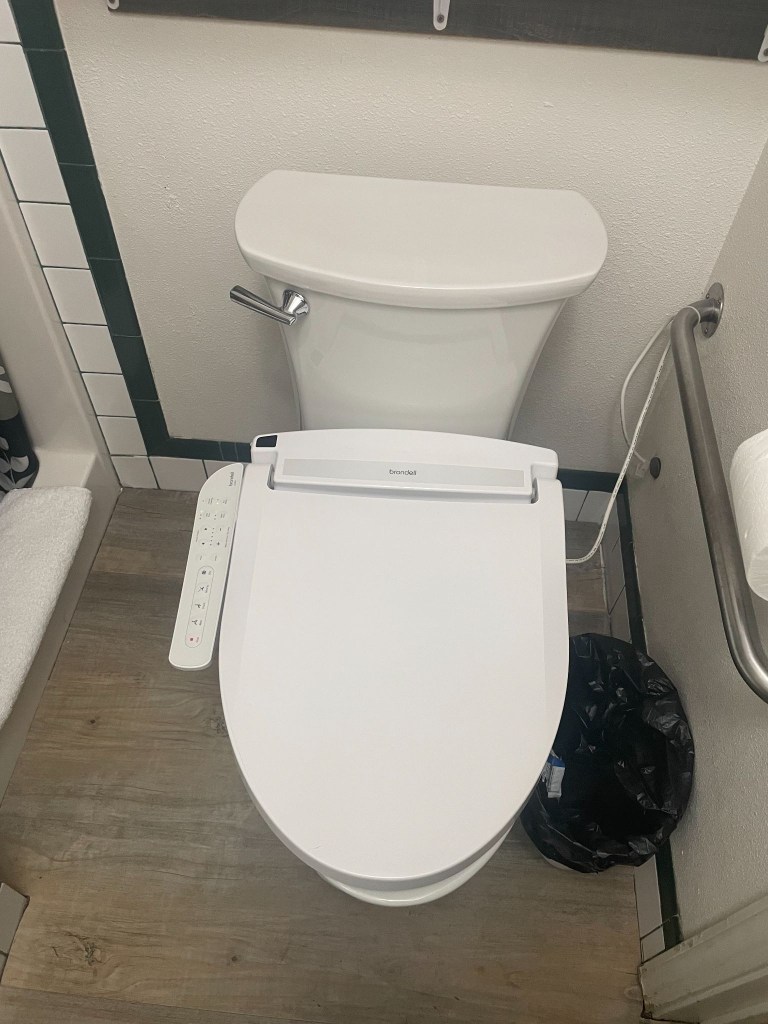
Room #1 was the “Curious George Suite” with a bidet
And Yes, Susanville, California is considered the definitive textbook definition of a “prison town”
Little did we know that local business owners, including multi-generational motel operators, openly state that their properties rely directly on business from families traveling across California to visit incarcerated relatives. In spite of such transparency, Ming neglected mentioning when I arranged the reservation that The Sierra View was just such an establishment. Our first impressions were confirmed when our immediate neighbor in room 2 emerged from her room as we rolled up. She sat down, a woman who painted her toenails while chain smoking. We later found her with two young children who appeared from the room. This was likely an inmate’s family visiting. In the spirit of Bill Maher, we didn’t know it was a fact, we just knew it was true.
Since all of the rooms were Non-Smoking, we soon became familiar with mom and her family. While putting the finishing touches on her toenails, her young son, maybe 10 years old, came up to me with a can of soda and invited me to, “See a great prank to pull on someone.” Was I being set up?
Pointing out that the tab of the can was intact, and by all appearances looked to be a full can of soda, he demonstrated the can was empty. He did this by dropping the can to the ground to emphasize its emptiness. Summoning empathetic amazement I asked how in the heck had he done it. He explained, “I just pull the tab a little bit then supersuck the Sprite then I push the tab down.” I wasn’t sure if this was the pre-dinner show — I probably owed him a tip.
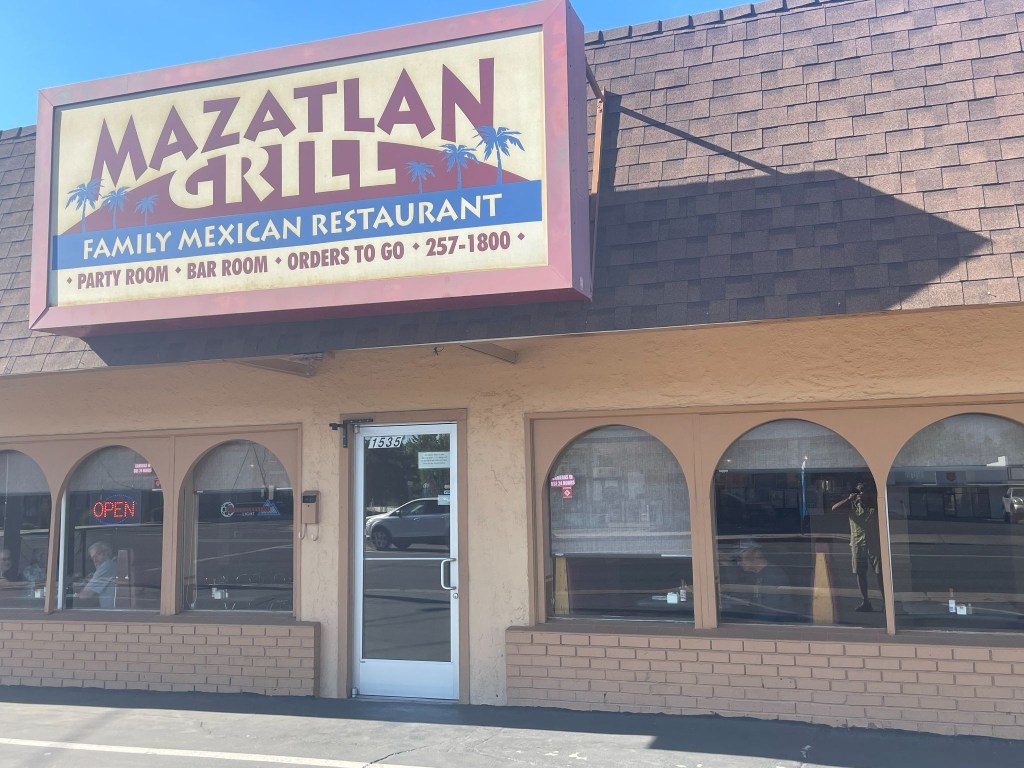
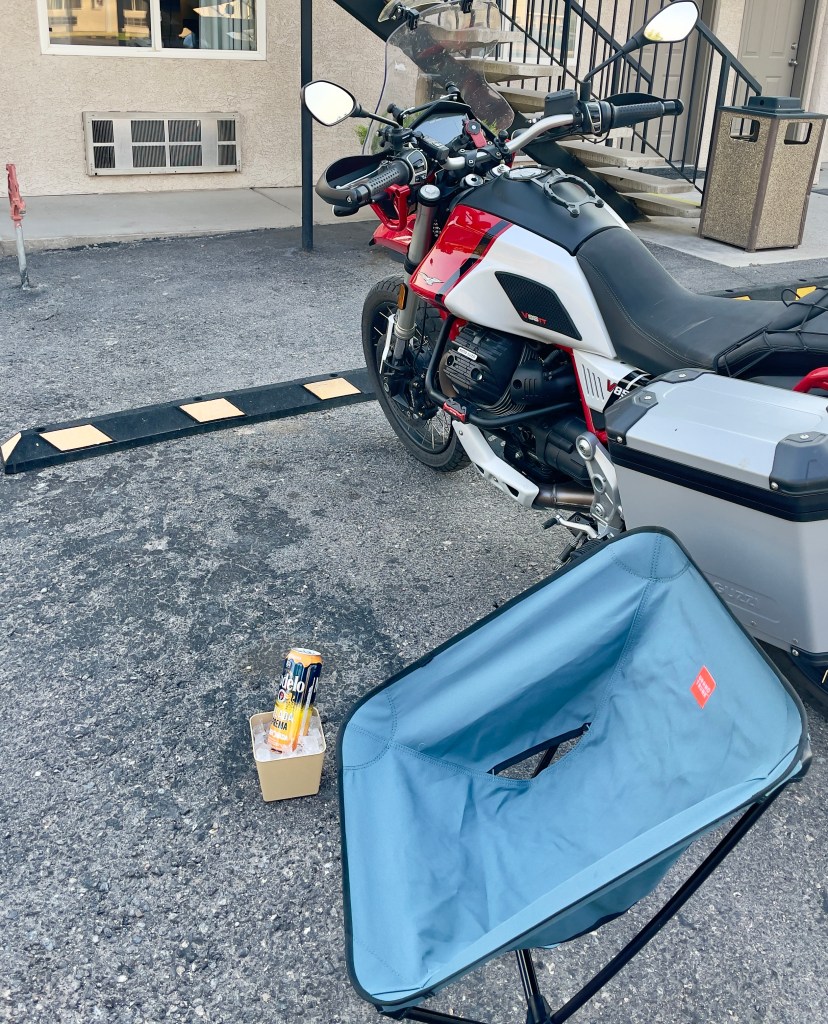
After dining next door at the Mazatlan Grill, we retreated to our camp chairs, as is our routine, outside of the room, to enjoy beverages procured from the gas station across from the motel à la the 3R’s: rehydration, relaxation, and reflection on the day’s ride as well to gain some sense of the rhythms of Susanville as the sun was setting.
Sisyphus in reflection, literally, and SMAP (right) studying the menu as the guest (left) reflected, figuratively, on what I was doing
About that time a group of Latino laborers showed up in a pickup shouldering a 36 pack of Budweiser and other packages, likely take-out. They appeared to eye the parking space we had planted our bikes in that was likely theirs on nights when the only room, Room 1 not rented by the week or month, isn’t occupied. They quietly retreated to the room attached to the motel’s office, presumably the proprietor, Ming’s residence. Odd, thought we, but perhaps this was the nature of the Diamond View perfectly aligned with the rhythms of Susanville. We then surmised that not all of the guests were inmate visitors. We raised our beverages in salute to the working men and they quietly acknowledged our gesture.
Pete, bilingual, later found out they lived in what was the motel office manager’s apartment, all five of them, and they spent their days in the mountains above Susanville harvesting pine cones. Pine cones that are used in making wreaths, flower arrangements, and anything else requiring little pine cones. Other guests at the motel wandered back and forth throughout the evening, joining them. Perhaps they were little pine cone mules. Perhaps that explains why Ming retreated to the laundromat across the parking lot.
It was an interesting community made up of folks who managed to endure what Sisyphus and SMAP take for granted: secure in our intent to ramble, willing to risk some of that security in pursuit of a little sketchiness. It all must have made interesting video alerts for the security cams: Smokers, children doing magic tricks, laborers enjoying a 36er, and two blokes in camp chairs taking it all in. One of the guests who appeared to be familiar with abusive substances commented that our little camp chairs would be ideal for using while fishing. We didn’t leave them out that night.
A Susanville resident who was a retired firefighter on a vintage steel road bike… An exception to the demographic we had thus far met.
CA-139 → Alturas → US-395 Oregon Outback (New Pine Creek → Lakeview → Wagontire → Riley) → US-20 → Burns → Silver Spur Motel
California’s Loneliest Road
An early start guaranteed we’d be spared the afternoon heat. Sort of. SMAP suggested we depart from US-395 to make our way to a breakfast stop in Alturas taking CA-139. This state highway 139 from Susanville to Alturas takes you through one of the most rugged, isolated, and untouched volcanic corridors in the American West. Officially ranked by data analysts as California’s “loneliest road,” this two-lane highway averages fewer than 1,500 vehicles a day, carving a quiet path through vast high-desert basins and dense pine forests. Perhaps where the pine cone harvest takes place.
Because CA-139 actually runs northwest toward Oregon, traveling from Susanville to Alturas requires driving CA-139 north to the town of Adin, then merging onto CA-299 east to complete the trip into Alturas. The Susanville Climb & The Volcanic Rim Ascent begins just east of Susanville, where CA-139 splits from CA-36. It immediately hits a steep, winding mountain grade as it climbs up the rugged slopes of Antelope Mountain. This was a brilliant detour from the planned route. SMAP recalled having taken this road in the opposite direction on a ramble a few years back. Who needs Google maps when SMAP is on board. If only Columbus had a SMAP on board the Santa Maria.
The first 60 miles out of Susanville are notorious among truck and RV drivers for being exceptionally narrow and “skinny,” lacking shoulders or large breakdown lanes. It features continuous roller-coaster ups and downs. As the road crests the rim, it descends into the spectacular Eagle Lake Basin. The highway skirts the eastern edge of Eagle Lake, California’s second-largest natural freshwater lake offering sweeping high-desert lake views and premier opportunities to spot nesting osprey and bald eagles. We saw some mallards.
Eagle Lake visited a couple of times back when I attended Chico State
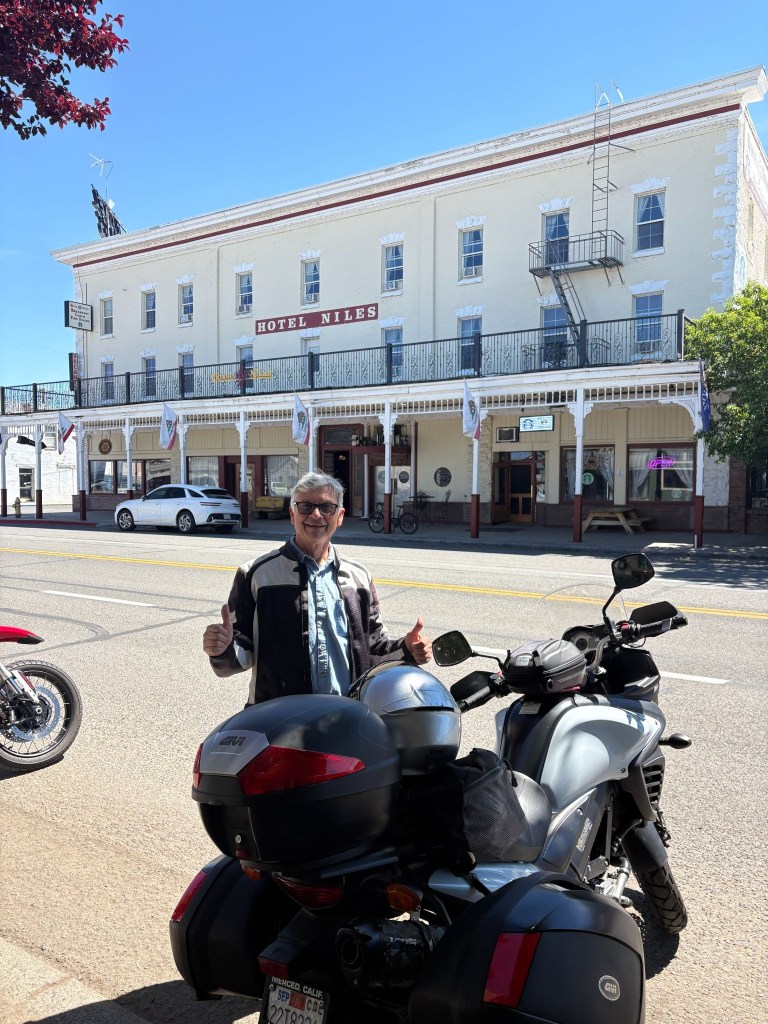
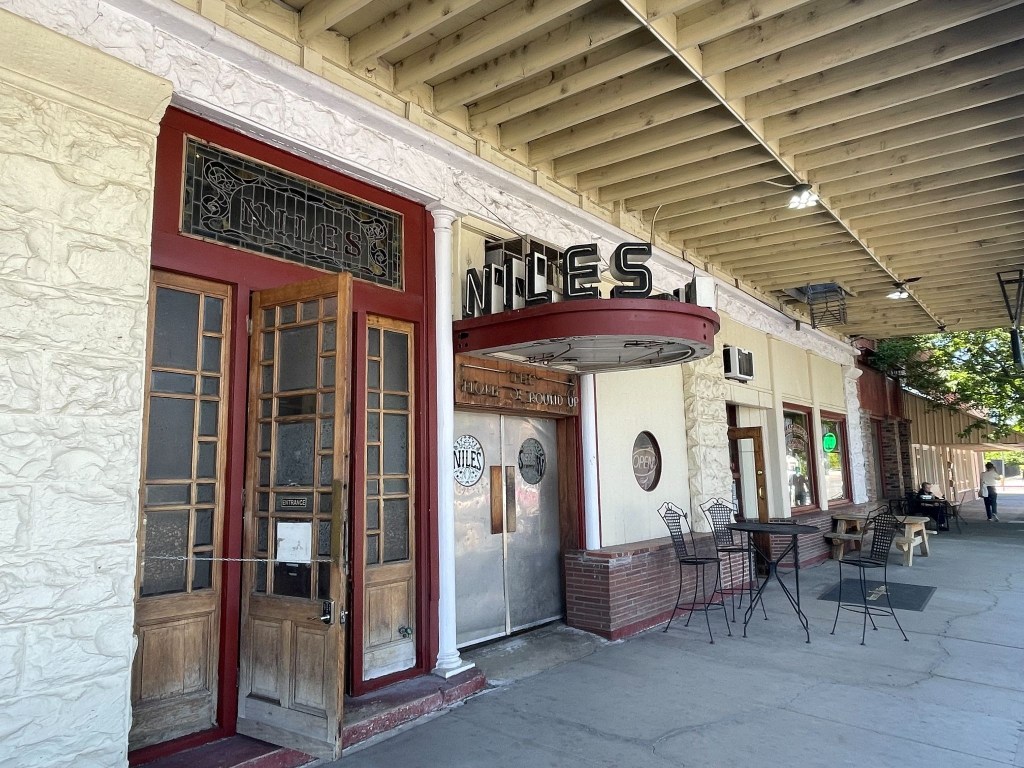
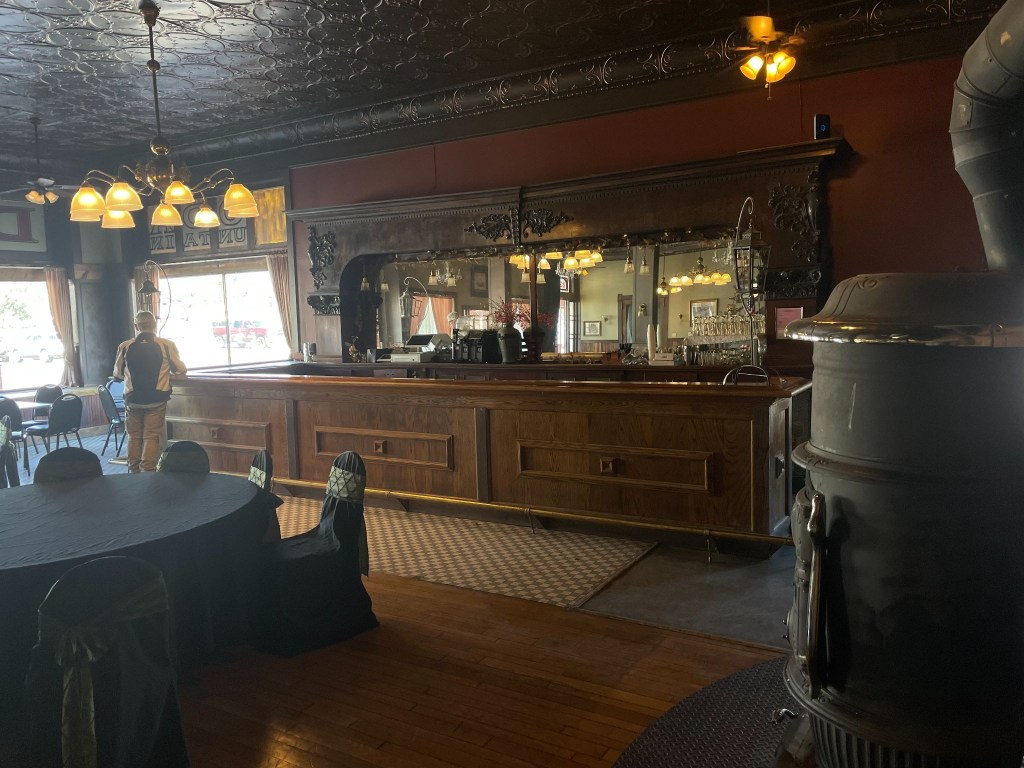
A breakfast stop at the historic Niles Hotel in Alturas punctuated the beautiful morning ramble up CA-139. As with most rural small towns, this Tuesday morning was peaceful with an easy feeling. We were tryin’ to take it easy. (Hotel Niles isn’t the Hotel California)
SMAP enjoying the peaceful easy feeling of the Niles (not California) Hotel in Alturas, CA
Heading north from the California border toward Burns, the landscape is defined by the Great Basin high desert. The terrain is an open, desolate expanse of sagebrush plains, dry lake beds, and volcanic rims. Landscapes we would be seeing throughout this ramble.
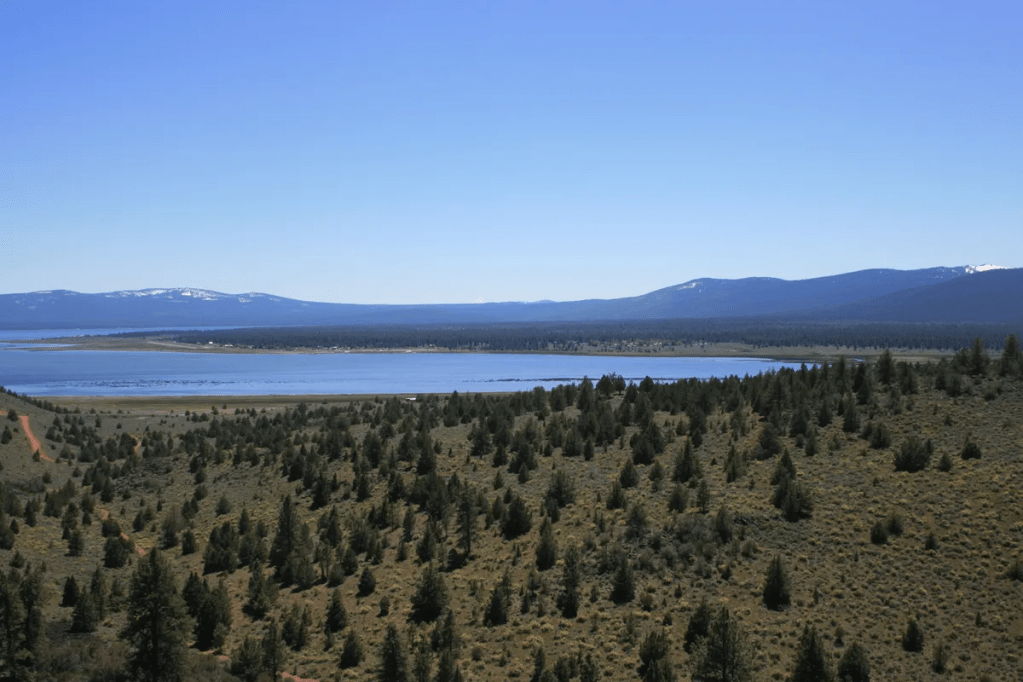
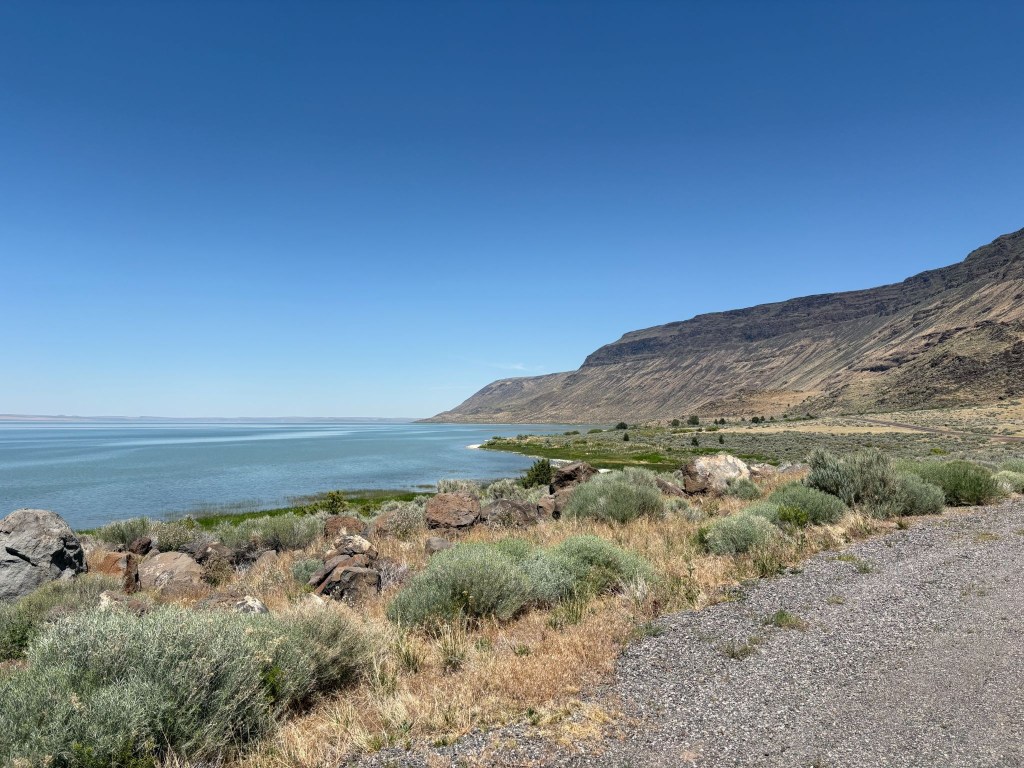
Lake Abert, not currently a dry lakebed, and the Abert Rim, currently an ancient lava flow
The Abert Rim is one of the most visually spectacular and geologically significant ancient lava formations in North America. Located right along US-395 south of the Valley Falls junction (on the southern approach toward Burns), it is not a fresh, black lava flow like Devils Garden a few miles up the road near Wagontire or Hell’s Half Acre or Craters of the Moon in Idaho, but rather a massive, 30-mile-long tilted block of ancient flood basalt layers that has been thrust thousands of feet into the air. Oregon seems to have won the volcanic dunk competition. The Albert Rim makes the lava flow in our neighborhood from Dardanelle, near Sonora Pass, to the Stanislaus Table mountain, near Copperopolis, appear puny, a mere volcanic layup.
At Valley Falls a brief stop for hydration at the Valley Falls Store afforded the opportunity to meet a couple, she on a Harley, and he on an Indian, who, by their own admission, were headed to Winnimucka-ish. It wasn’t getting any cooler but they looked worthy of making the miles. Apparently the Indian-Harley kerfuffle hadn’t soured their relationship. The Lowdown Show by ADVrider
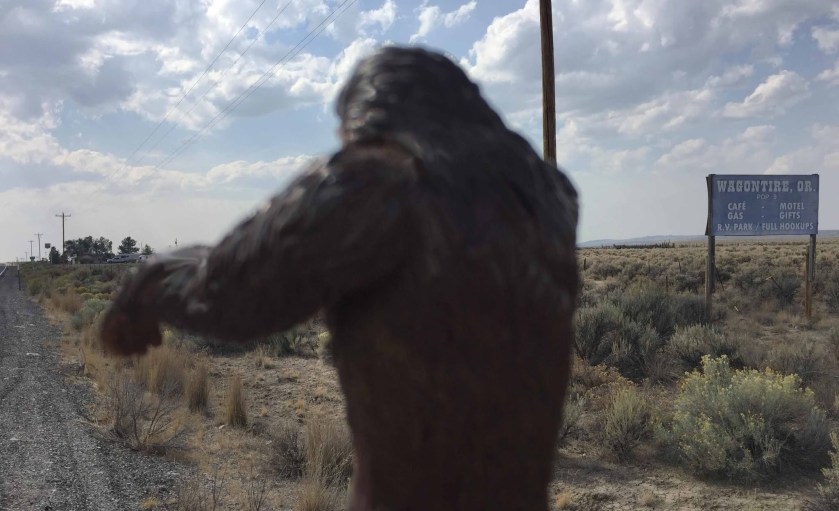
From here, you enter an incredibly isolated 140-mile stretch. You will pass through the tiny outpost of Wagontire—famous for having a population of fewer than five people and this fellow…
US-395 is long, straight, and empty. You must watch out for “Open Range” signs, as cattle frequently wander onto the unfenced highway. Maybe at times, even other large hairy mammals. At the tiny community of Riley, US-395 merges with US-20, turning east for the final hot flat stretch into Burns and our destination for the night, the Silver Spur Motel.
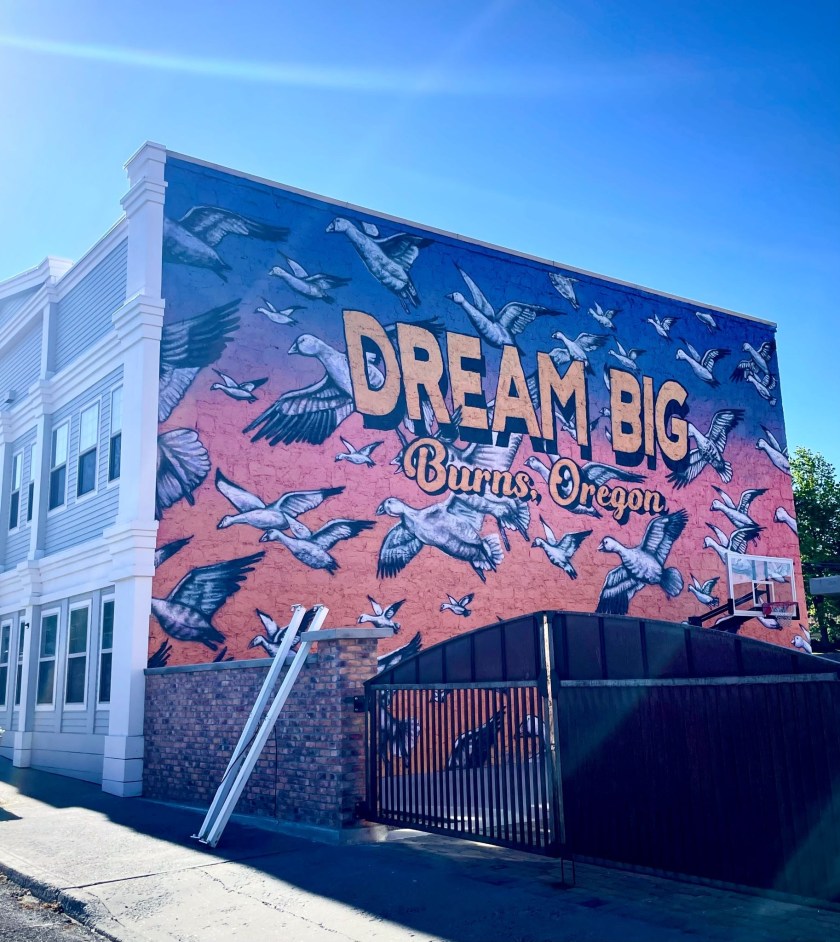
Dreaming Big In Burns
We checked in at the Silver Spur first by startling the attendant at the desk as I introduced myself, “Hi Marisa, I’m Sysiphus and you know why we’re here.” It wasn’t a question. It was declarative. She was the person I had arranged for the room a few days prior. I guess I didn’t make much of an impression in that initial phone conversation, by not declaring why we were there. She replied, “Because you need a room?” Snap, as young people used to say…
Moving along from my second lame conversation with a motel front desk person, I redirected, commenting on the retro flagstone sign and mid-century modern low pitched roofline, attempting saving grace by striking up a conversation about the place. She told us that a local rancher had purchased the motel and was in the process of restoring it to its lustrous past.
After Marisa apologized for the in-process renovation I asked if said renovation had impacted air conditioning. She replied that there wasn’t any. Snap again! She had two-upped me!! We pretended to assure her that was not an issue. She giggled admitting that I would stand with a slight lean as one leg had been pulled twice. She then recommended a walkable Mexican restaurant down the street and so we unpacked and made our way to El Toreo where we had a delicious chicken mole.
Early and Mid Century Dreaming Big in Burns Oregon!
We somehow managed to find a shop willing to sell us our customary beverages enjoyed while relaxing and rehydrating as we reflected on the day’s ramble. The landscape through which we traveled this day was wide-open, with arid vistas of the Oregon High Desert and the northern limits of the Great Basin. Thirsts needed quenching.
The evening concluded as the sun set and 3-R beverages were enjoyed while the day was revisited It appeared the motel was full given the parking lot had no empty parking spaces. Despite the sign, there was nothing to apologize for. The Spur Motel was decidedly less “eccentric” than the previous night’s Diamond View stay. At least Marisa understood my sometimes obscure sense of humor (and I hers) and the Mexican cuisine was better too.
A couple we met who roomed next door had been traveling for months across the US in their Subaru Outback. They departed after dark to check out the night skies, just outside of town, away from the city lights. The region boasts some of the clearest and darkest skies in the country, offering an unparalleled stargazing experience. That reminded us of how much we missed the night skies usually reserved for camping. A comfortable mattress and air conditioning eased our nostalgia as the waxing crescent moon, Jupiter, Saturn, and the Evening Star, Venus appeared over the horizon; Mercury was too faint for our geezer vision.
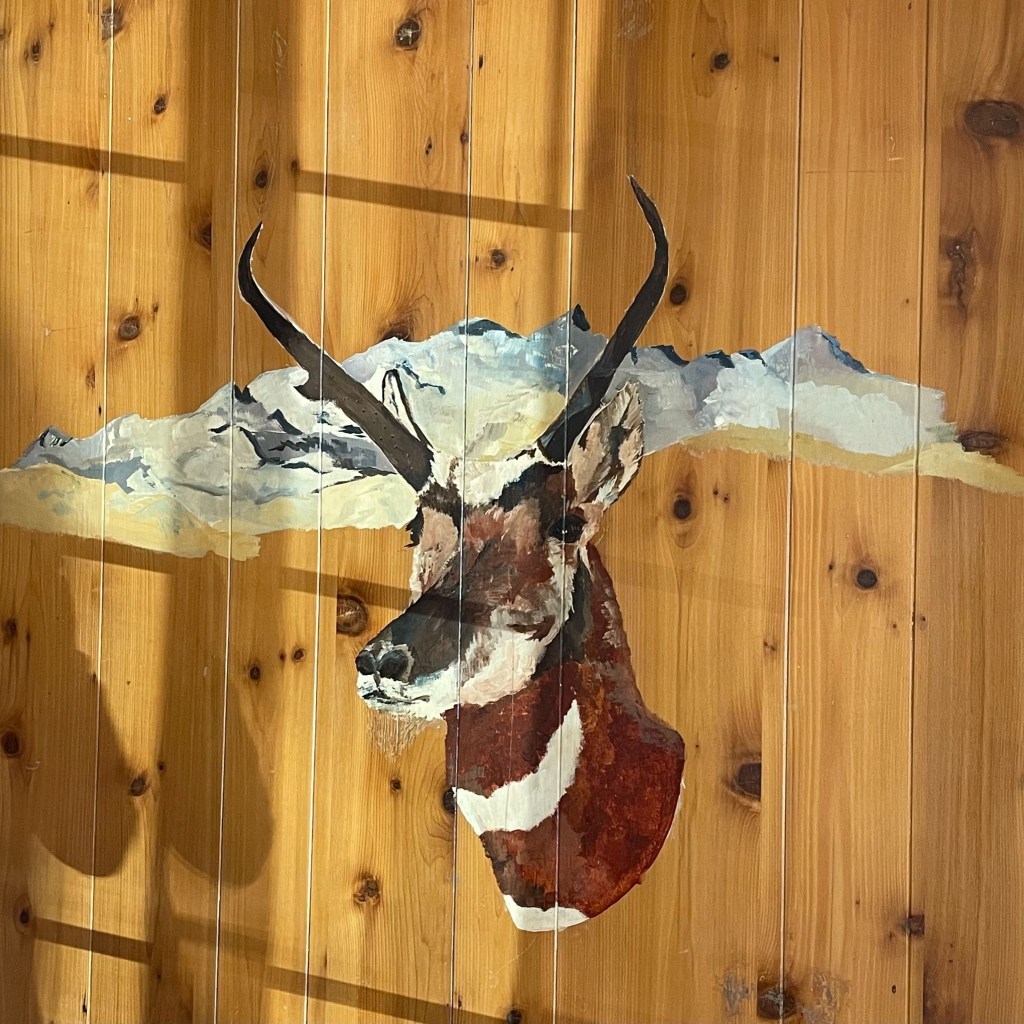
The Pronghorn Suite, with original pronghorn artwork painted on the wall above my bed, easy to see
US-20 → Juntura →Vale → US-26 → OR-201 → Ontario, OR → US-30 → SW-18th St → SE-2nd St → US-30 → OR-72 → Hamilton Corner → OR-52 → along the Payette River → Horseshoe Bend → OR-55 → Banks Lowman Rd → over Grimes Pass → Lowman → ID-21 the Ponderosa Pine Scenic Rt → Stanley, ID → Mountain Village Resort
There’s More to Idaho than Potatoes
Leaving the high-desert hub of Burns, the route rolled east on US-20 through a vast landscape of sweeping sagebrush plains and dramatic rimrock cliffs. The highway hugs the Malheur River canyon, passing the quiet outpost of Juntura before opening up into the ranching valley of Vale. From there, a quick transition onto US-26 and OR-201 lead straight into Ontario, the final border town on Oregon’s eastern edge.
After navigating Ontario’s local grid via US-30, SW 18th, and SE 2nd streets, the journey crossed the state line into Idaho. Jumping onto OR-72 through Hamilton Corner and transitioning to ID-52, the terrain shifts dramatically. The road wound along the lower curves of the Payette River, trading the arid high desert for lush green riverbanks, whiteish-water rapids, and irrigated fruit orchards, alfalfa, and potato fields. The route followed the river canyon to Horseshoe Bend (not the Utah one), briefly heading north on ID-55 to the rafting hotspot of Banks where some 31 years ago I along with several knuckleheads doused ourselves on a brutally hot bicycle ride across Idaho under the bridge over the Payette River.
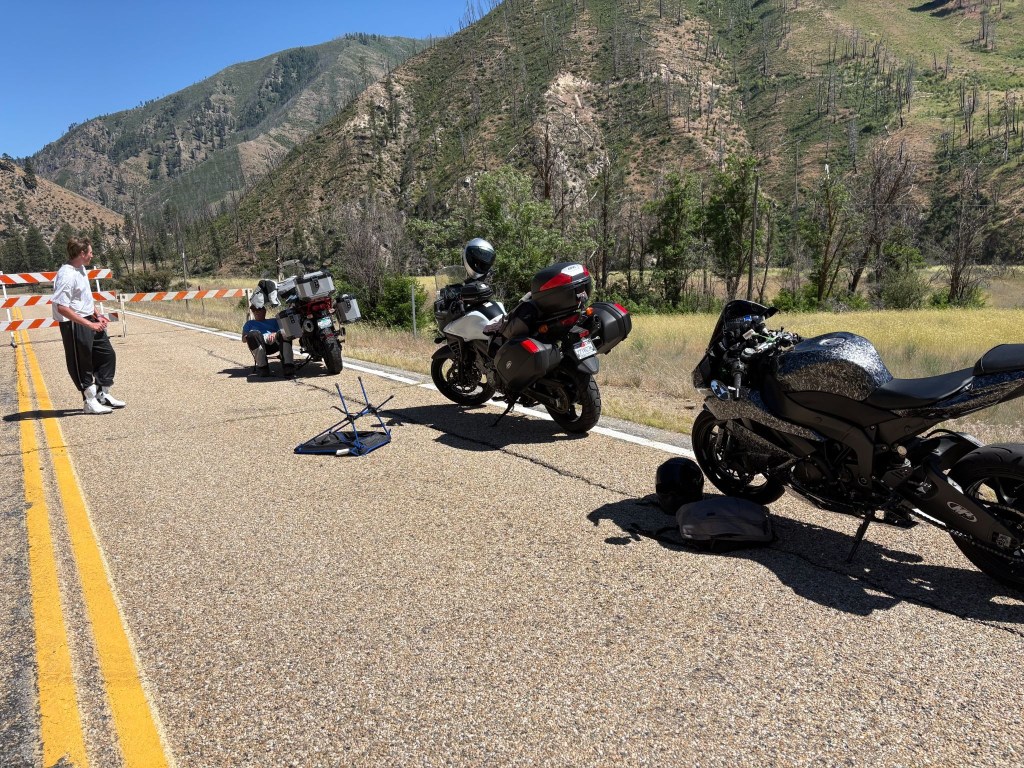
Here, the journey turned onto the twisting Banks-Lowman Road, taking a rugged backcountry detour over the historic, winding heights of Grimes Pass. But not before we encountered a delay. A portable, variable message sign warned of a road block. It had been placed a quarter mile down from the actual road block, some 15 miles from where the one-way only route to Stanley intersects with ID-55 WHERE SUCH A SIGN SHOULD HAVE BEEN PLACED! It was a Boise County project doing shoulder maintenance. You’d think they would have thought about the signage placement. Maybe they had…
We were the third group who had just missed the golden lunch hour transit window. The electronic messaging sign indicated that the road was closed from 8:00 am till 12:00 pm. It was open for one hour 12:00 till 1:00 pm then closed from 1:00 till 5:00 pm. Of course, we arrived at 1:15 pm. Besides the sign, virtually at the location of the road block, was obscured by being on a curve. There was no way to read the closure schedule, even at legal speed. We witnessed several vehicles that had to engage ABS to stop at the road block, apparently not seeing the signage either.
Pete and I decided to kill time and return to a small village on the Payette River, Garden Valley, to get fuel and a snack for the final push into Stanley. When we returned to the roadblock at 3:00 pm, several dozen cars, RV’s, and trucks were queued up awaiting the 5:00 pm opening. We did the only sensible thing and headed to the front of the line. We were certain of not inciting hostility since we would not hold up any traffic following us when the road did eventually open. Several of the stranded motorists came forward to chat and use the small adjacent pull out for answering a matter of internal urgency in an unscheduled pit stop to water the sagebrush.
Donovan, our fellow stranded self-described, squid and my feeble shade structure
We met Donovan who rolled up after I had constructed a shade structure. Since it was just after Father’s Day and Donovan was young enough to be my son (if I had a son in my mid 50’s), I thought about my Dad and had one of those “Let’s compare our lives” conversations I often invented. “So pops, what did you do when you were younger?” He would say something like, “I survived the depression and WWII.” I would reply, “I once built a shade structure.” Feeble shade at that.
Donovan was a recent high school graduate from Boise who was headed to Stanley to join a group of friends for some summer fun at Redfish Lake Since he had no plans to continue his education beyond graduation, he seemed excited to be heading towards and endless summer.
Donovan had just acquired his Kawasaki Ninja and his only protective gear was a helmet and the boots that came with the bike. He was a nice kid and we shared lots of laughs about his being a jack Mormon, new to motorcycles, and the uncertainty of the friends he was ostensibly meeting at Redfish Lake, wearing nothing more than a tee shirt and sweatpants, boots and a helmet. Fortunately for his sake, there would be no frost on our motos the next morning.
After several false starts over the next couple of hours as the crew doing the shoulder work one by one departed, a county Sheriff rolled through the roadblock. He said he had ticked several impatient travelers who went around the roadblock. That made sense. It was a collaborative project involving county road maintenance and local law enforcement. Maybe that’s how they paid for the road maintenance. It was likely the reason for the electronic message sign placement…
The last County Road Maintenance truck finally pulled up and retired the road blocks at precisely 5:00 pm. From the preceding stream of worker’s vehicles, I’m sure they were done by 4:00 but the pickin’s for the Sheriff were too easy. Donovan, SMAP, and I jumped on our bikes and headed up the road, only modestly in excess of the speed limit for we didn’t want to hold up the parade behind us, hoping there would be no automated message boards that we might miss before encountering another road block or a second Sheriff in waiting.
Dropping down into the mountain pocket of Lowman, where in 1995 on that bicycle ramble mentioned earlier with that bunch of knuckleheads, there witnessed this shameful spectacle.
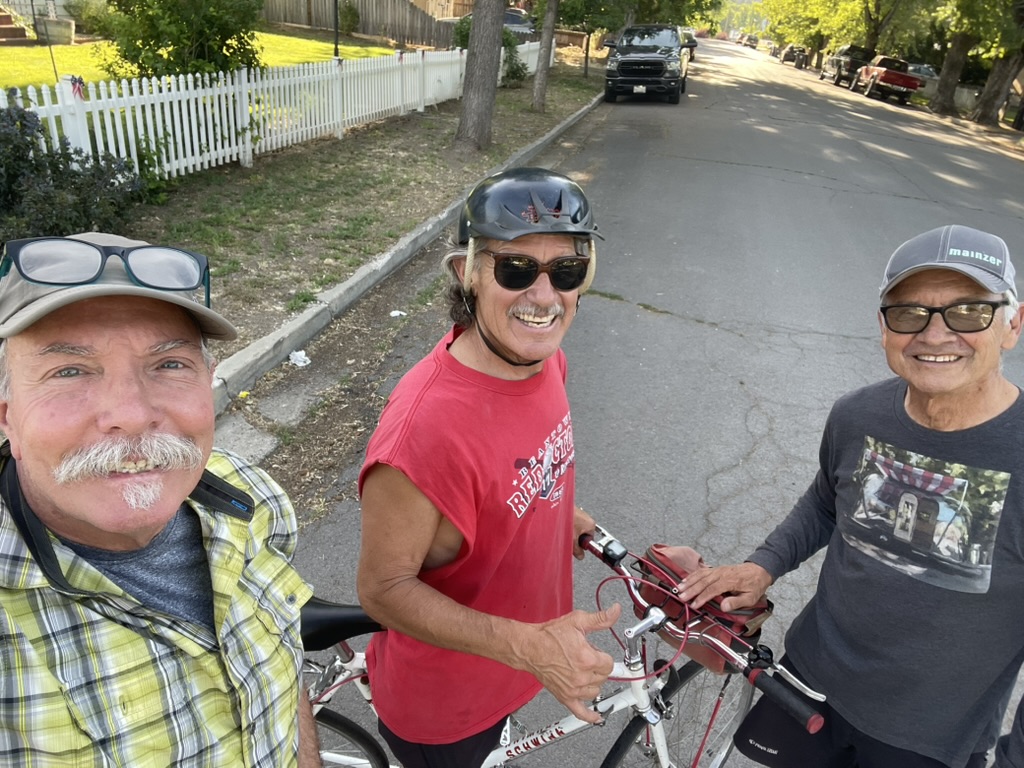
L to R, the perplexed investigator Don, Mike the victim, and Dale the violator
From Lowman, the route joins ID-21—the Ponderosa Pine Scenic Byway. This stunning road climbs deep into pure alpine wilderness, cresting the 7,056-foot Banner Summit before descending into the spectacular mountain basin of Stanley, where the jagged wall of the Sawtooth Mountains rises sharply behind the Mountain Village Resort. We had lost contact with Donovan around Lowman, but saw him whip by as we were unpacking. He must have stopped for fuel. Hopefully not for a Sheriff.
The Rodeo Comes to Stanley
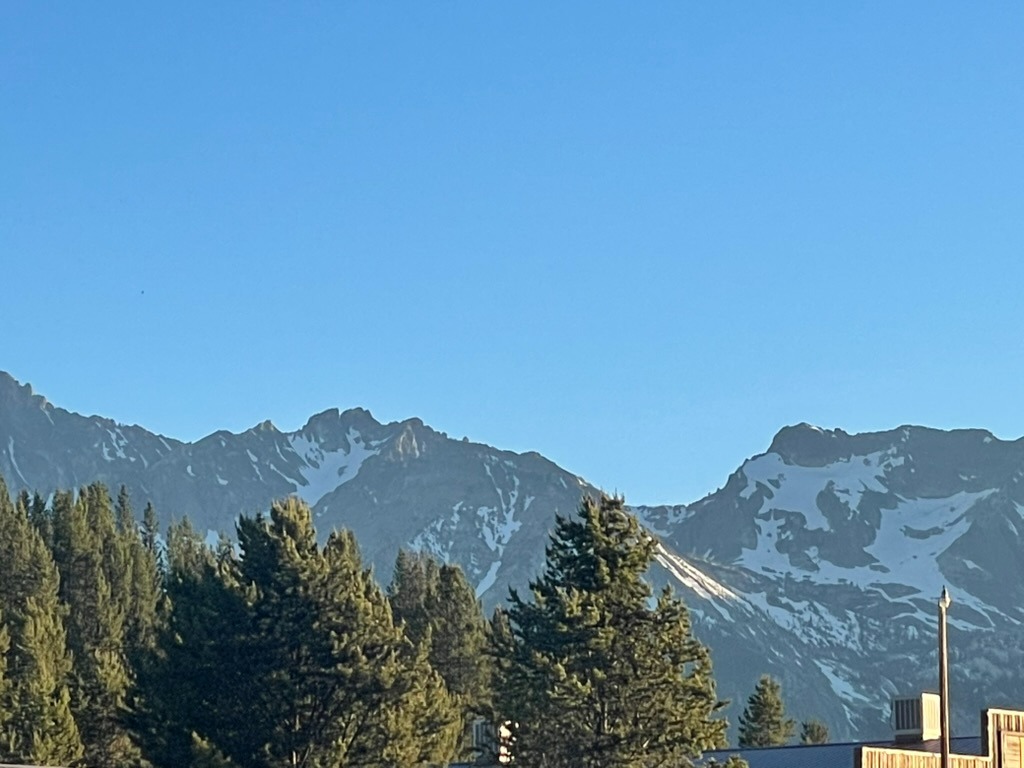
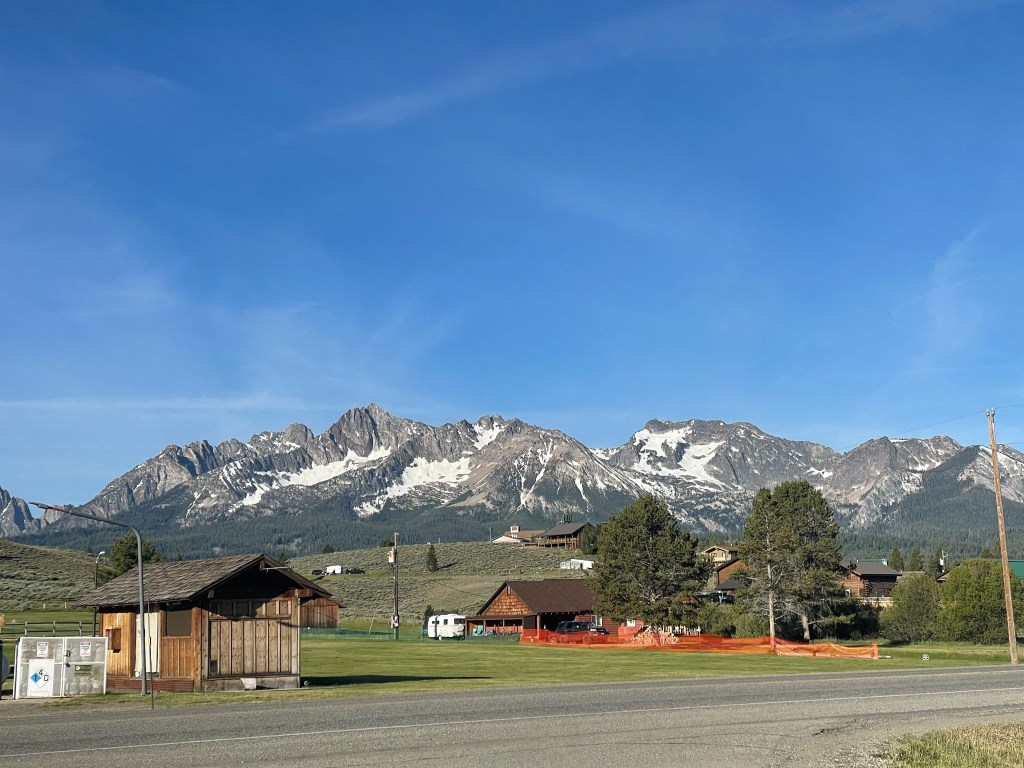
The Sawtooths (Sawteeth?)
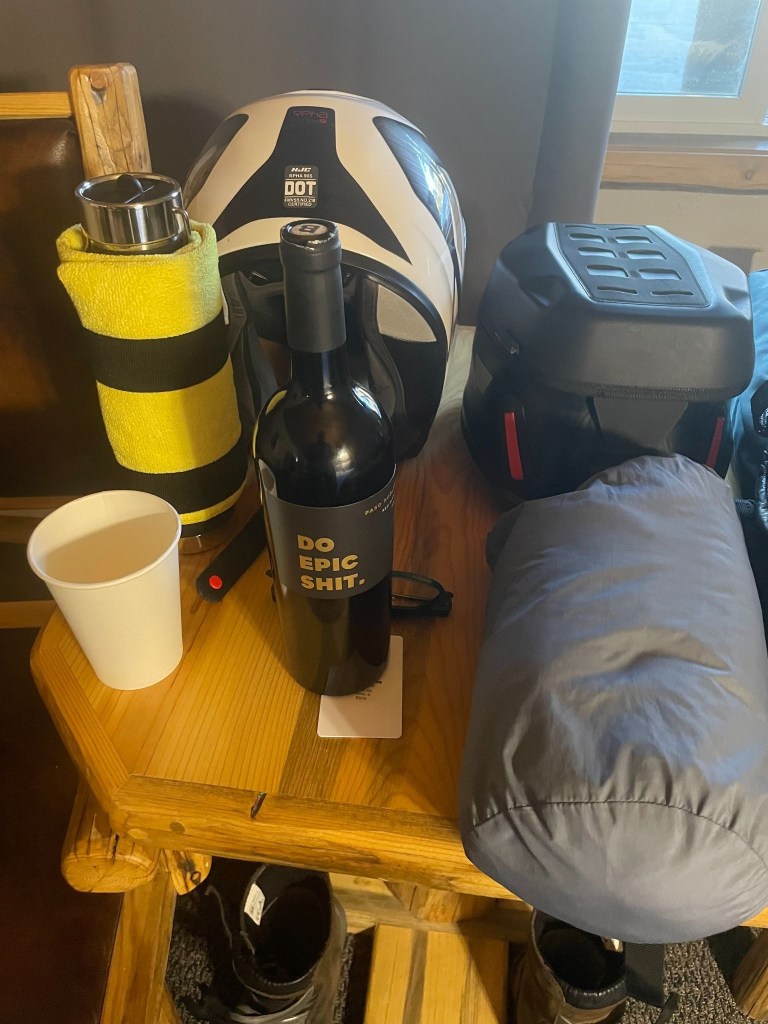
Remembering the much more modest accommodations back in 1995 where the Knuckelheads spent the night stoked by the epic climb over Banner Summit and now inspired by a wee bit of California viticulture…
… it was rodeo time in Stanley, time to raise a glass to the past, and embrace the future.
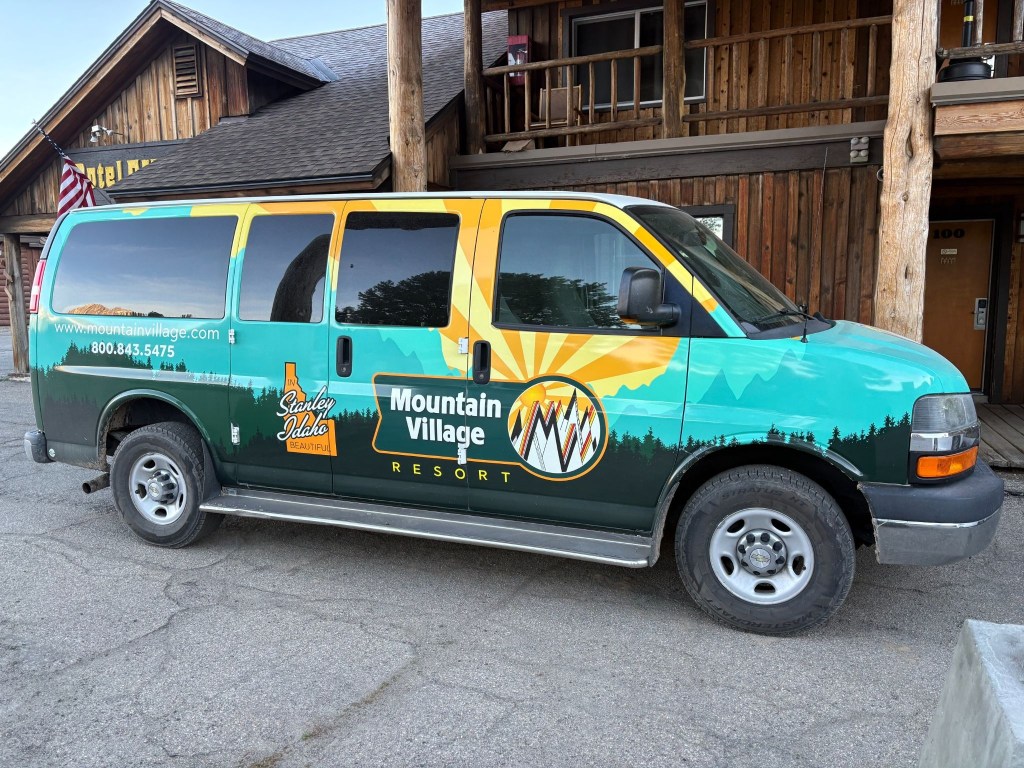
Dino seemed to enjoy my spirited, back to the future arrival in Stanley Sadly, I departed with no buckle and my parents remain married in perpetuityThe Sawtooth Mountains in reality look nothing at all like their depiction on the van
The following morning was clear and coolish, not cold. Several groups of motorcycles were traveling through Stanley mostly “adventure” types, with a smattering of Harley baaaaggggerrrrs. Demographically, we pretty much fit the mold of the two-wheeled geezer “adventure” ramblers suited up in ATGATT resembling the Michelin Man. Even the Harley guys had traded their leather vests for jackets. A couple with fringe.
The resort was also the launching point for multi-day raft tours of the Salmon River. Given the volume of gear each rafter was hauling, I began to feel as though the additional 50 pounds of camping gear I could have brought wasn’t that much of a big deal. Except it was.
ID-75 → Challis → US-93 → Arco → US-26 past the INL → US-20 → Idaho Falls → E-49 N → US-26 → along the Snake River and Palisades Reservoir → Alpine, WY → US-89 → Thayne, WY→ Swiss Mountain Motel and Lenny
The Salmon River Canyons to the Volcanic Desert
Our journey began on ID-75, carving northward through a dramatic, steep-sided canyon carved by the Salmon River. Several hot springs lie adjacent to the river. The terrain here is highly vertical, defined by rocky cliffs and the towering peaks of the Salmon River Mountains.
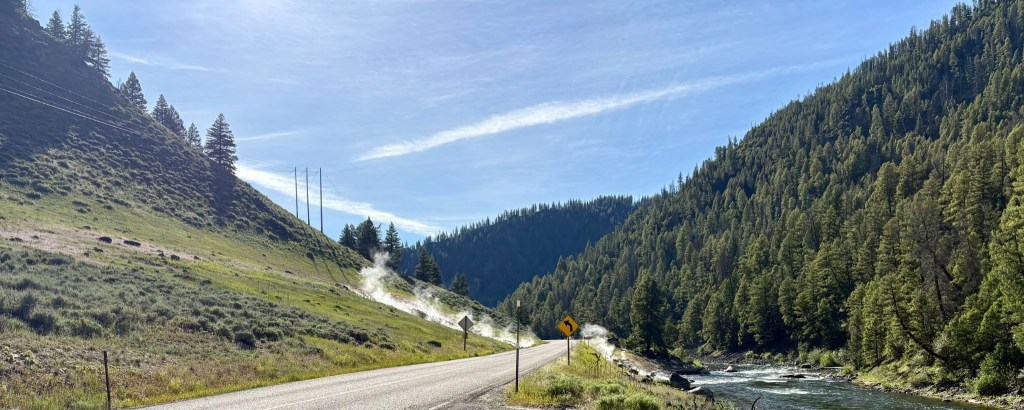
Sunbeam Hot Springs on the Salmon RiverSalmon River Mountains and one of tens of thousands of acres of irrigated ag
As we reached Challis, the landscape began to fracture and turning southeast onto US-93, the narrow canyon abruptly opened into the sweeping, wide-open expanse of the Round Valley. To your left and right, massive mountain walls hem you in, with Idaho’s highest peak, Mount Borah, dominating the eastern horizon. Continuing south toward Arco, the rugged mountains begin to recede, flattening into the northern fringes of the Snake River Plain.
Willow Creek Summit with Mt. Borah in the background
Leaving Arco on US-26, the terrain transitions into an otherworldly, barren expanse as you roll directly past the Idaho National Laboratory (INL). This segment is characterized by vast, flat sagebrush desert, underlain by ancient, black basalt lava flows that stretch out seamlessly toward the horizon.
What is now Idaho National Laboratory in southeastern Idaho began its life as a U.S. government artillery test range in the 1940s. Shortly after the Japanese attacked Pearl Harbor, the U.S. military needed a safe location for performing maintenance on the Navy’s most powerful turreted guns. The guns were brought in via rail to near Pocatello, Idaho, to be re-sleeved, rifled and tested. As the Navy began to focus on post-World War II and Cold War threats, the types of projects worked on in the Idaho desert changed, too. Perhaps the most well-known was the building of the prototype reactor for the world’s first nuclear-powered submarine, the USS Nautilus. Form the kiosk display.
Idaho National Laboratory info kiosk, lavatory, and layer removal station The perfect place to develop nuclear submarines
The Upper Snake River Plain
As US-26 merges into US-20, the road carried us straight into Idaho Falls, a bustling urban hub built over the roaring-ish waters of the Snake River. Leaving the city, we transitioned onto E-49 N (locally known as the Bone Road or Hitchen Cemetery Road), rolling momentarily into rolling, agricultural benchlands. These irrigated, high-elevation farmlands feature sweeping fields of grain and potatoes and an occasional antelope, undulating gently before dropping us back down to meet US-26 East.
The Caribou Mountains and Snake River Canyon
Heading east, the terrain transforms dramatically. The flat plains vanish as US-26 enters the Snake River Canyon, tracking the path of the river as it cuts through the heavily forested Caribou Mountains. By the way, we saw no caribou. The road huged the contours of the canyon floor, squeezed between rushing water and steep, pine-covered slopes. Soon, the river widened and calmed, opening up into the spectacular Palisades Reservoir. For several miles, we rolled along a shelf carved into the mountainside, looking out over a massive, deep-blue body of water framed by timbered ridges.
The Palisades Reservoir along the Snake River looking south from US-26
The Star Valley Descent
At the southern tip of the reservoir, we crossed the state line into Alpine, Wyoming, where the Snake, Greys, and Salt rivers all converge. Picking up US-89 South, the canyon walls fall away entirely, revealing the pristine alpine floor of the Star Valley. Known historically as “Little Switzerland” due to its lush green summer pastures and dairy farming heritage, the valley floor is wide, flat, and remarkably pastoral.
SMAP pointing out the obviousThayne, WY, aka Little Switzerland
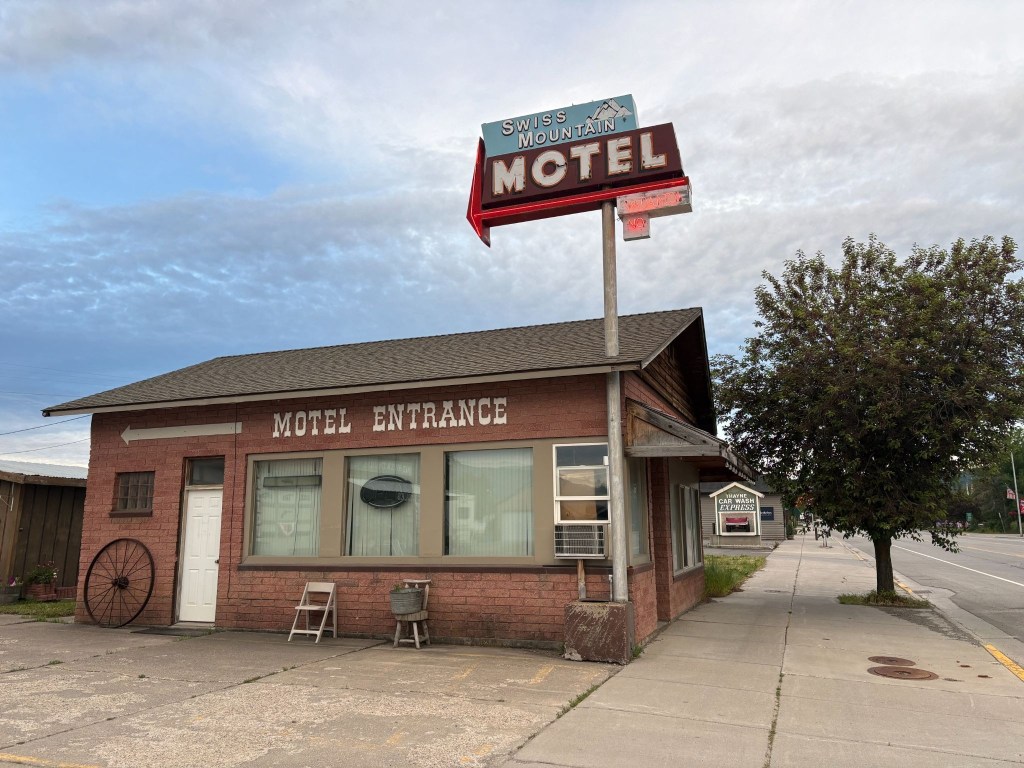
We cruised south along the vibrant valley floor, flanked symmetrically by the dramatic crest of the Salt River Range to the east and the Caribou Range to the west. The terrain remained a smooth, scenic flatland all the way into the quiet town of Thayne. On the north side of town, set against the backdrop of these towering green mountains, day four concluded at the vintage, ground-floor property of Lenny’s, Swiss Mountain Motel.
Our original plan was to stay in Jackson, WY that night. After contacting eleven motels in a 50 mile radius of Jackson, none of which had an available room, it was recommended that we try the Swiss Mountain in Thayne. “Remember that sometimes not getting what you want is a wonderful stroke of luck.” ~ Dalai Lama.
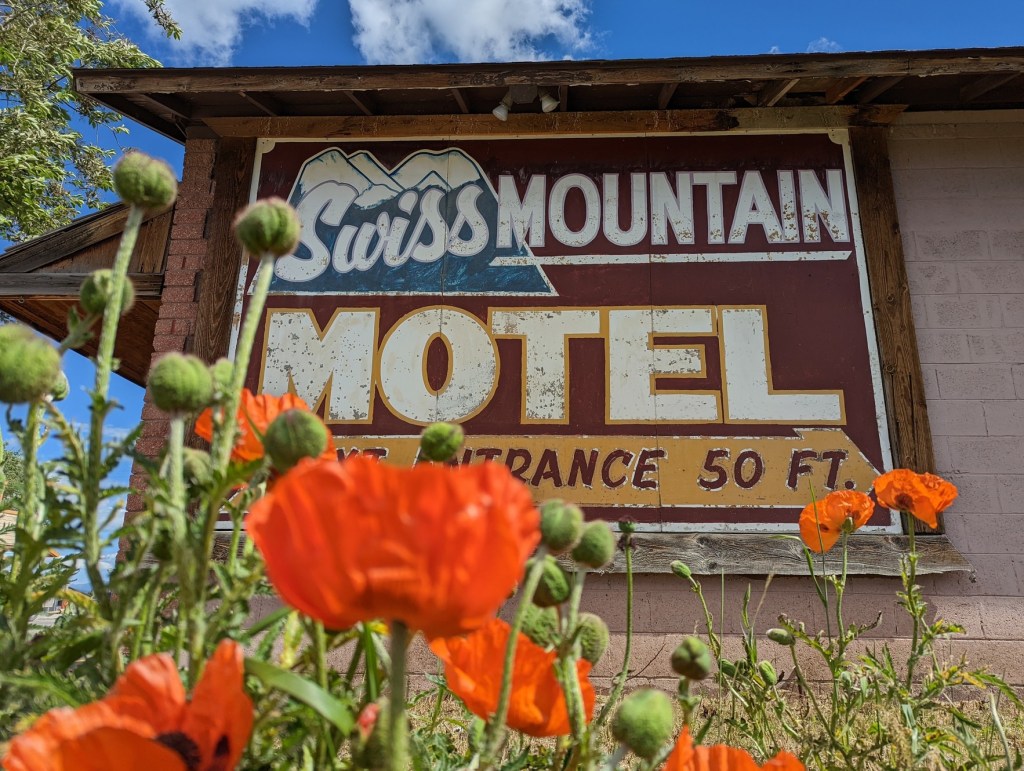
No Vacancy at the Swiss Mountain Motel in Thayne, WY, population 389
We’ve learned, having rambled through two dozen of these adventures, that the landscapes speak deeply to our appreciation of the natural beauty of the West — but it is invariably the folks we meet along the way who resonate long after the mountains, rivers, plains, and forests have blurred into one.
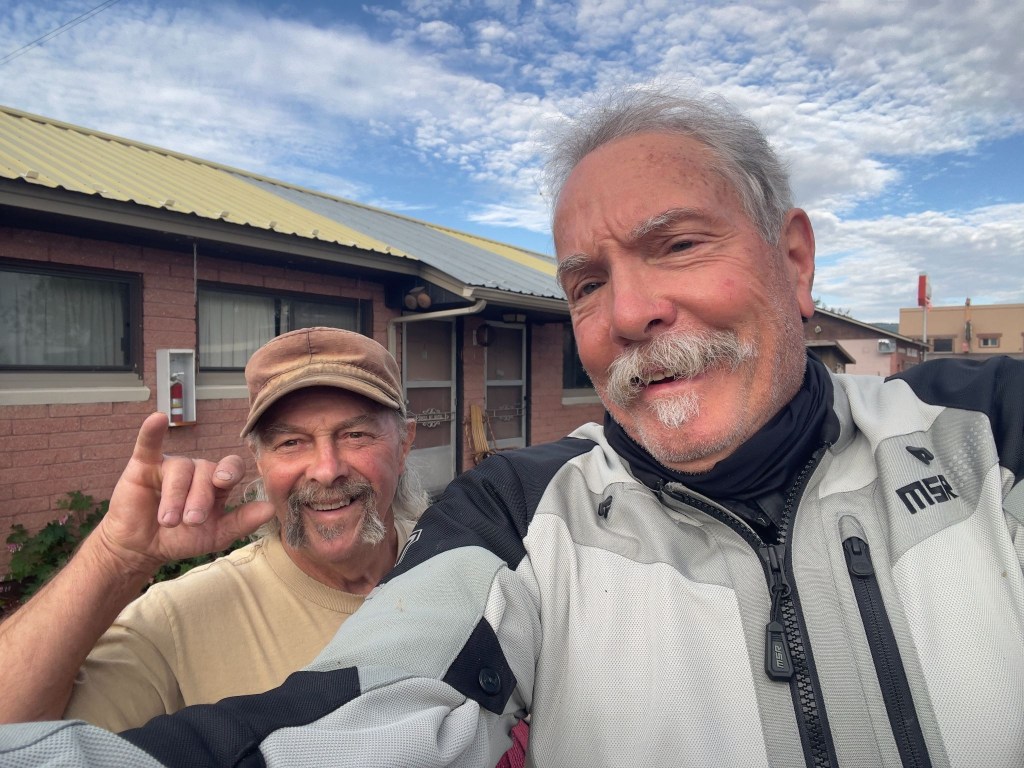
Lenny and Sisyphus neither of whom know where the lens is on the phone
The owner and operator of the Swiss Mountain Motel is Len Roman. He originally purchased the vintage property in 1995 with his late wife, Cindy. Following her passing in 2019, Len has continued to run the day-to-day operations. He’s the room servicing maid, the front desk attendant, gardener, and general maintenance man. It’s a one man show. Unlike Ming, he didn’t retreat to the laundromat when I attempted humor.
He frequently interacts directly with guests as the primary host and property manager. Lenny, as we came to know him, was a fellow biker. Short in stature, tall in opinion, large in generosity, and plentifully, yet cordially sarcastic, Lenny is my kind of motellier.
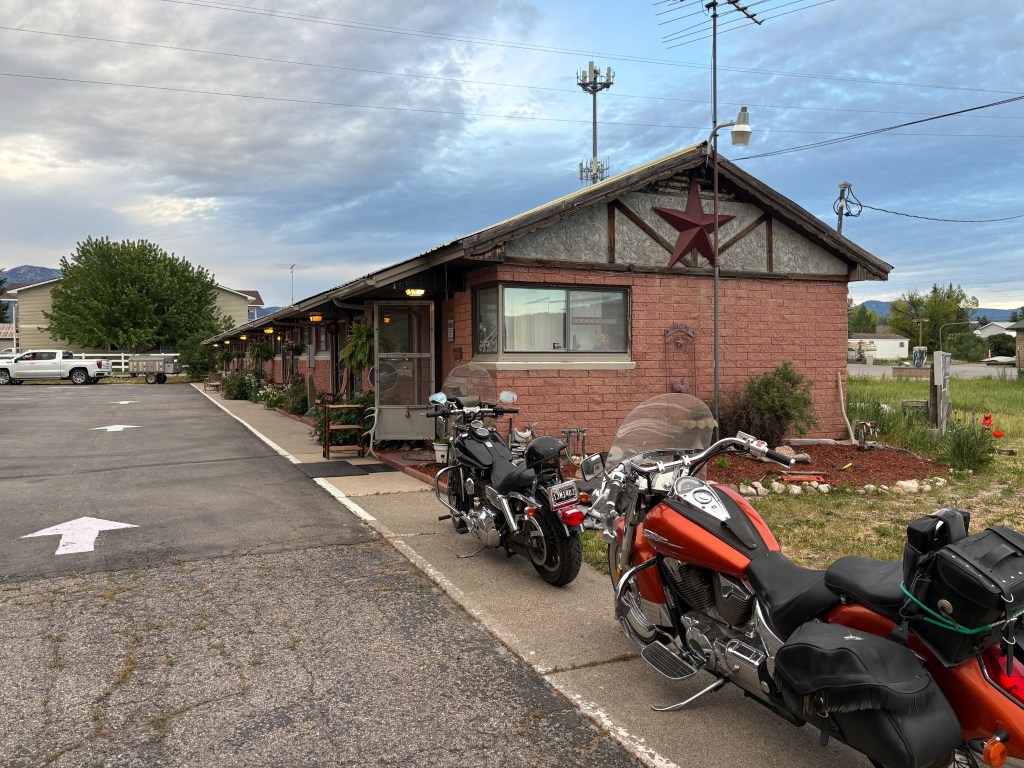
Lenny’s pride and joy, a Honda VTX and a Harley V-Rod low rider, and the Swiss Mountain Motel
Besides being an affable host, Lenny had something of a snarky vein too. Not much slack was cut for the pretension of a Moto Guzzi. After losing the ATGATT and donning my yellow plaid button up shirt and khaki shorts, Len stops me and points north saying, “That’s the way to the golf course…” I later convinced him of my authenticity as a khaki shorted moto-rambler, in a yellow plaid button up shirt, beer drinker by lifting my pinky as I brought the can to my lips.
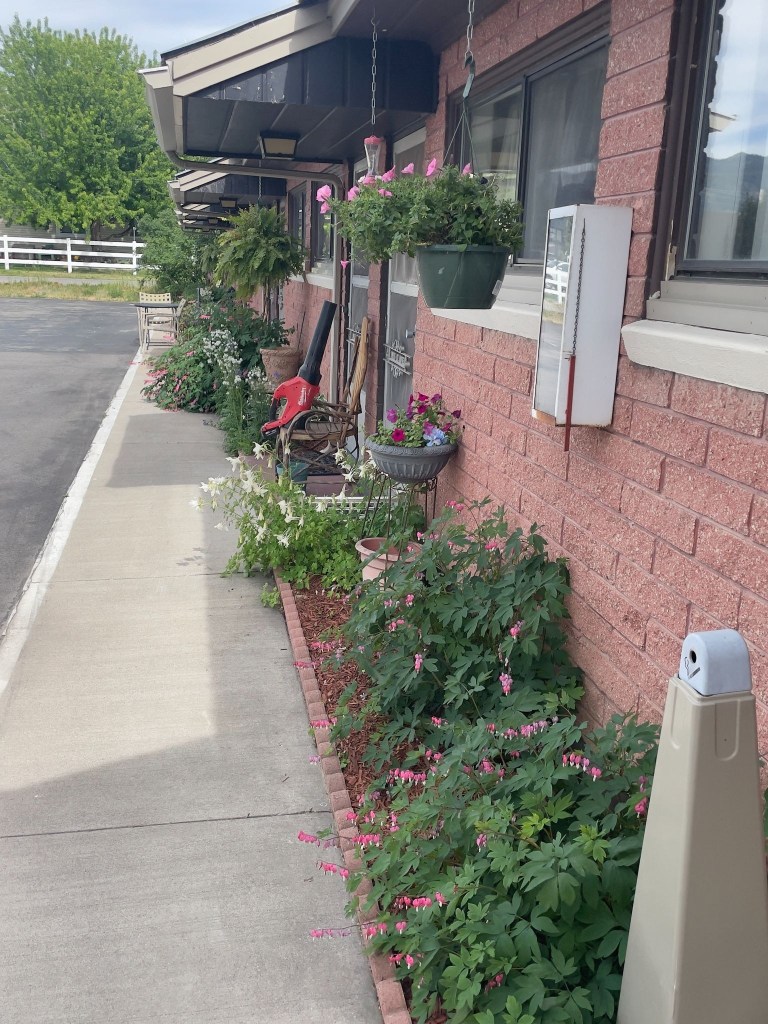
Lenny’s Swiss Mountain Gardens
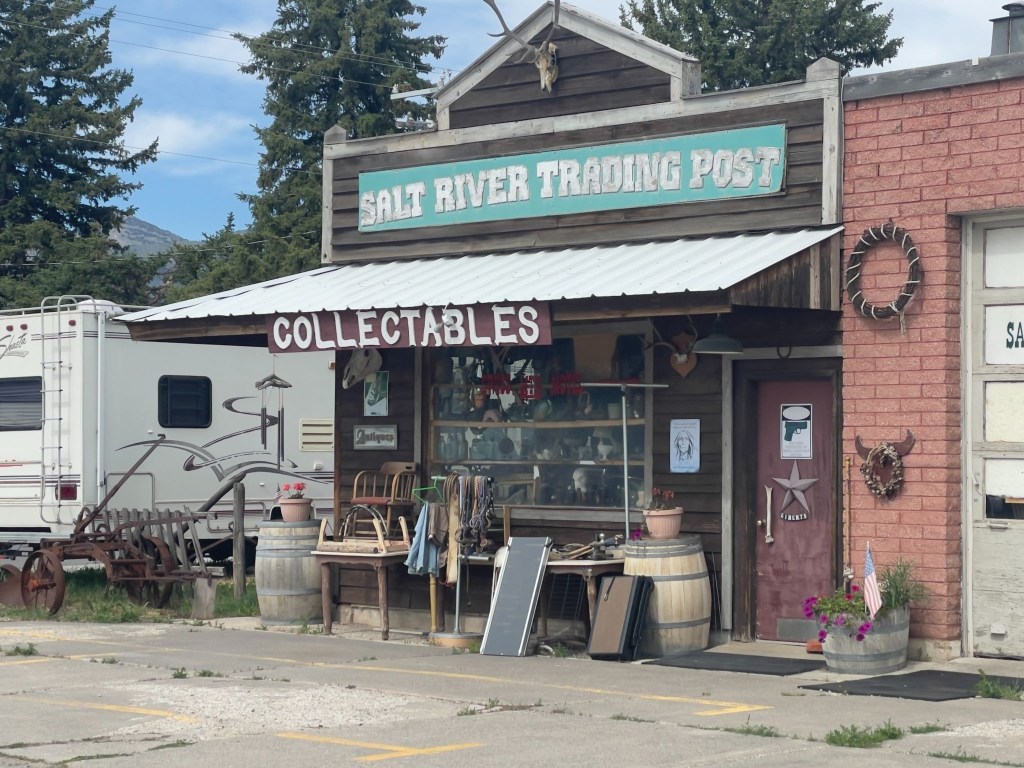
Lenny is also something of a collector on the verge of being a hoarder. He operates The Salt River Trading Post as he tends to his motel garden of bleeding hearts, petunias, hostas, and columbine with obvious care, then runs a floor-to-ceiling emporium of organized chaos open by appointment only. The garden says curator. The Trading Post says accumulator. Lenny himself seems somewhere in between.
One man’s collectables is another man’s objets d’art
In researching background, I found a scathing review of the Trading Post that was posted on the local Chamber of Commerce website back in 2022:
So junky most items cannot be easily seen or viewed. The owner does not deal on prices at all even though by his own admission he’s not been open due to family illness. His things are overpriced for condition and he talks to customers like they know nothing even when it is clear from conversation that they do. Take home-junky overpriced and impossible to navigate to see anything. Stop to look but don’t expect decent prices. He’s selling to tourists.
The Chamber review was written by someone who, besides having grammar issues, wanted to buy something and couldn’t, or wouldn’t at Lenny’s price. That’s a transaction that failed. Their Lenny is a difficult vendor with inflated prices and a chaotic inventory. Every complaint is probably accurate. I personally found the collection to be worthy of awe. Now my wife would have made some disparaging comparison to our garage. IMHO, ours is a garage filled with objets d’art.
Our Lenny is someone we weren’t trying to buy anything from. We were just two road-worn bikers who passed the pinky test and got the private tour. That Lenny — the one who tends bleeding hearts outside every room door, who knows exactly where the 1957 Hamm’s Beer sign is buried under the Roy Rogers lunch pails and the taxidermied badger and changes sheets and towels — that Lenny is a genuine eccentric, not a shyster.
A hoarder thinks everything is precious; a collector knows why everything is precious. Lenny sounds to me like the latter. It takes one to know one, eh? He talks to customers like they know nothing because, in his estimation, they usually don’t — and he’s probably right about his inventory if wrong about his bedside manner. (I hope my wife doesn’t read this…)
Wyoming has interesting rules regarding 3R’s beverages
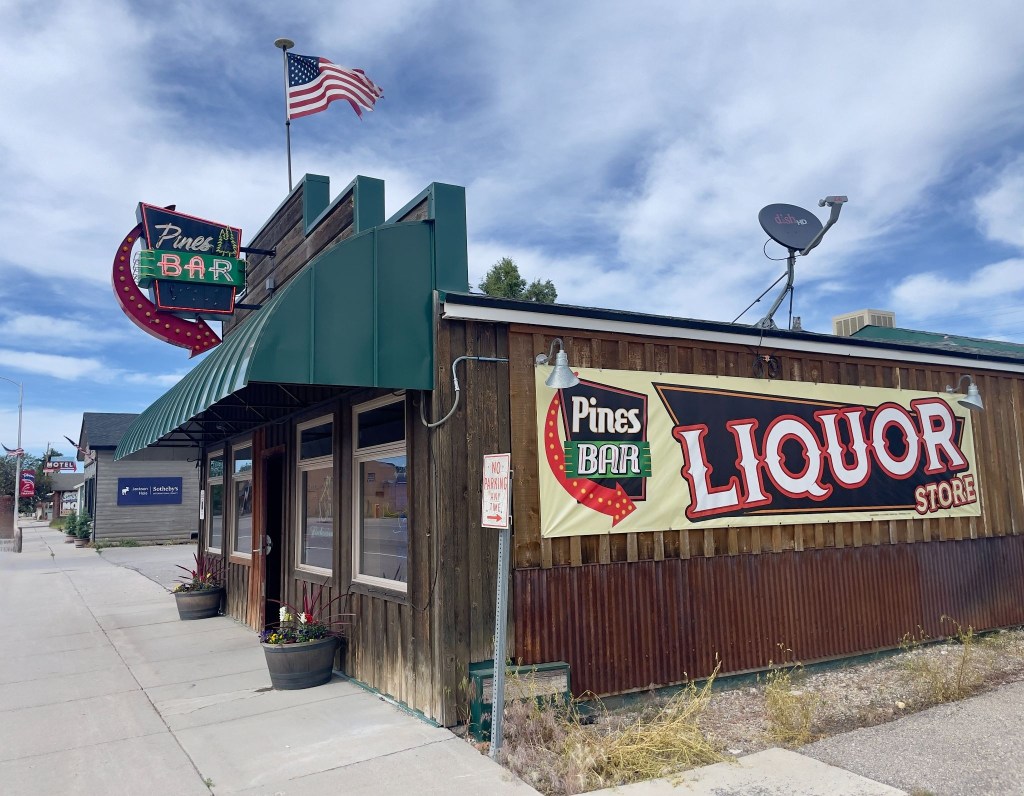
The Pines Bar is the only place in Thayne that one could procure 3R’s beverages that could be taken out. So, we sampled the merchandise before entering the beer cave to procure our rehydration, relaxation, and reflection selection for the evening.
😋
The barkeep, Liz, upon learning we were staying at the Swiss Mountain, asked us to remind Lenny that he needed to come by and get a smoothie (upper right above). In fact she then asked if we would take him one, on the house. That tells you a lot about the good folks in Thayne, looking after one another. We dropped off the smoothie and Lenny, in fine curmudgeonly fashion, expressed his gratitude by complaining that it wasn’t his favorite berry, but coconut…
Both Liz and Lenny recommended Dad’s Bar and Steakhouse for dinner, right across US-89 from the motel. Each recommended getting in early as the place fills up pretty quickly around the dinner hour.
Khaki shorts, yellow plaid shirt, and Big Buddy Ben
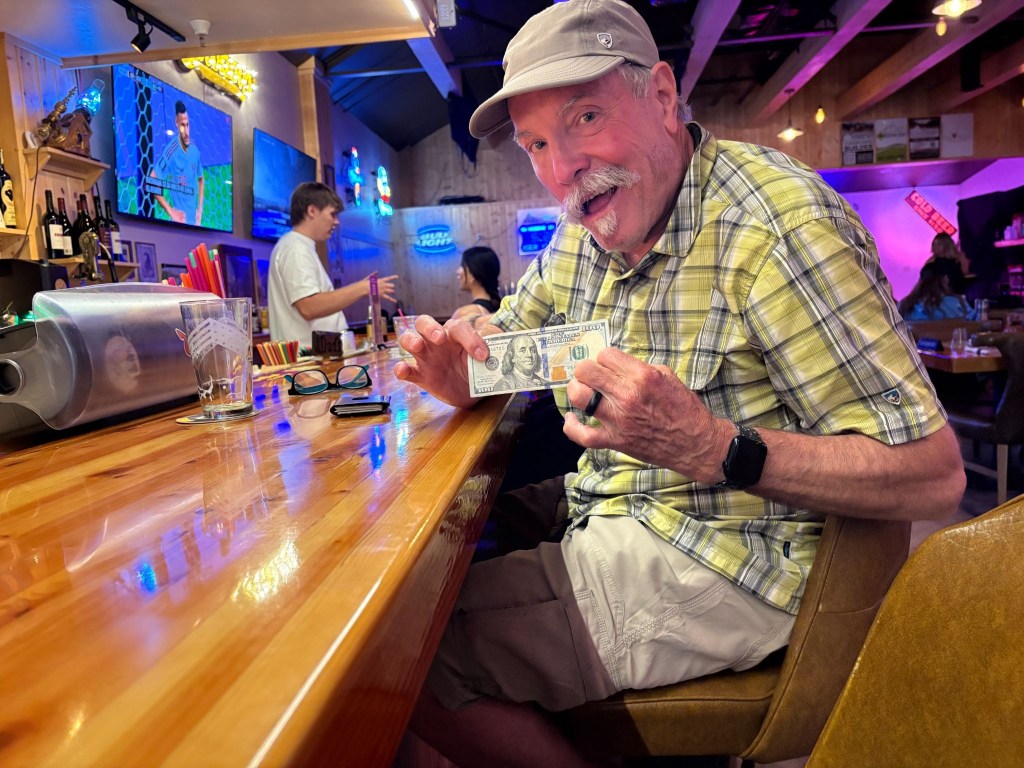
SMAP had a burger and I had a Lil’ Buddy prime rib sammy from the bar menu. Even though I was flashing a Benjamin, we opted for the modestly priced bar menu rather than the full on steakhouse menu. One doesn’t exactly burn a full measure of calories sitting on a motorcycle all day. Dad’s bar menu was also recommended by Lenny.
Our dinner mates at the bar were a fellow and his wife who had sold their property in Sonoma, CA, purchased a large motorhome and trailered their Kawasexy Vulcan bagger around using it to visit sites of interest in the vicinity of their chosen RV park for the day, week, or month. They too had chosen Thayne rather than Jackson for reasons similar to ours.
Nomads on a Kawasexy Vulcan
Back at the Swiss Mountain après dinner garden gathering we enjoyed trading stories of our travels in the company of a couple from the Midwest who had checked in to the Swiss Mountain on their way to National Park points north. Around the Swiss there were always chores to be done. Lenny was mowing the lawn.
A group of six or so young men piled out of a car, one of whom mistakenly entered our room thinking it was his. His friends berated him and apologized profusely. I suggested a $20 fine, citing obscure Wyoming trespass law. They hastily made their way to their actual room next to ours. A pickup pulled into the lot towing a commercial dog trailer. Seems that in Afton, down the road, a big herding trials competition was happening and this Wisconsin couple, though not competing, had brought beautiful border collies, perhaps to watch and learn. They are smart K-9’s. Probably bored watching K-9 trial YouTube videos.
As the sun was setting, Lenny joined us having finished his yard work. The conversation began to warp a bit as Lenny described his conspiracy mindedness. Once again evidence of the pervasiveness of doing one’s own research on the internet. It was mostly innocent and those of us less inclined to subscribe to some of his notions, in good cheer, listened respectfully, suppressing our scepticism, only allowing for an occasional chuckle so’s not to offend. Indeed, there was no vacancy at the Swiss Mountain Motel.
Wait, just what kind of poppies is Lenny growing? Could that be the source of his conspiracy mindedness? Tee, hee…
WY-89 → Smoot → Geneva → US-30 → Cokeville → Diamondville → US-189 → WY-412 Carter Cutoff Rd → WY-414 at I-80 → Mountain View, WY → Lonetree → Wyoming/Utah border and UT-43 → Manilla, UT → UT-44 → US-191 S Flaming Gorge All-American Road → UT-44 Red Canyon → US-191/US-40 → US-6 Price Canyon → Patriot Stay Motel
The route from Thayne to Vernal wasn’t complicated. Since my phone was virtually useless as anything but a phone with text, both important functions to keep my wife posted of our location and well-being, and then only intermittently, with no functional navigation or internet search. I won’t get into SMAP’s use of maps. He’s an Apple Maps guy. I’m a Google Maps guy. It’s like he’s a Dodgers fan and I’m a Giants fan.
Full disclosure: I’ve reconstructed the following, as most of the preceding, from memory and our photos and have post-trip internet capability to check the maps and routes I’ve noted for accuracy. Yes, I did my own research and it is factually accurate. SMAP is my fact checker. So much for the Giant-Dodger rivalry.
The Mountain Valleys & High Deserts (WY-89 to Diamondville)
Our journey began on WY-89, winding through the Star Valley—a green, high-altitude alpine haven hemmed in by the Salt River Range. Passing through the quiet community of Smoot, the road climbed and dipped past pine forests and rolling pastures. As we crossed the state line near Geneva, Idaho, and headed east onto US-30, the scenery began to dry out. The lush valley gradients slowly gave way to the rugged, sagebrush-speckled hills of Cokeville. Following the path of the old Oregon Trail, the terrain stretched into wide-open Wyoming ranch land, flattening into a vast, high-desert plateau of stark beauty as we approached the historic coal-mining town of Diamondville.
Open Pit coal mine tucked away near Diamondville (courtesy of Google Maps street capture)
The Sagebrush Steppe & Badlands (US-189 to Manila)
Turning south on US-189 and cutting across WY-412 (Carter Cutoff Road), we entered an isolated, wind-swept landscape. This is classic Wyoming basin country: wide horizons, oil rigs, and rolling hills blanketed in low brush. At I-80, we picked up WY-414, heading south toward Mountain View and Lonetree. Here, the flat plains began to ripple. Striated badlands and red-dirt bluffs peeked out from the soil, signaling our approach to the Uinta Mountains. Crossing the Wyoming/Utah border onto UT-43, the expansive ranching country dropped down into the small, oasis-like valley town of Manila, Utah.
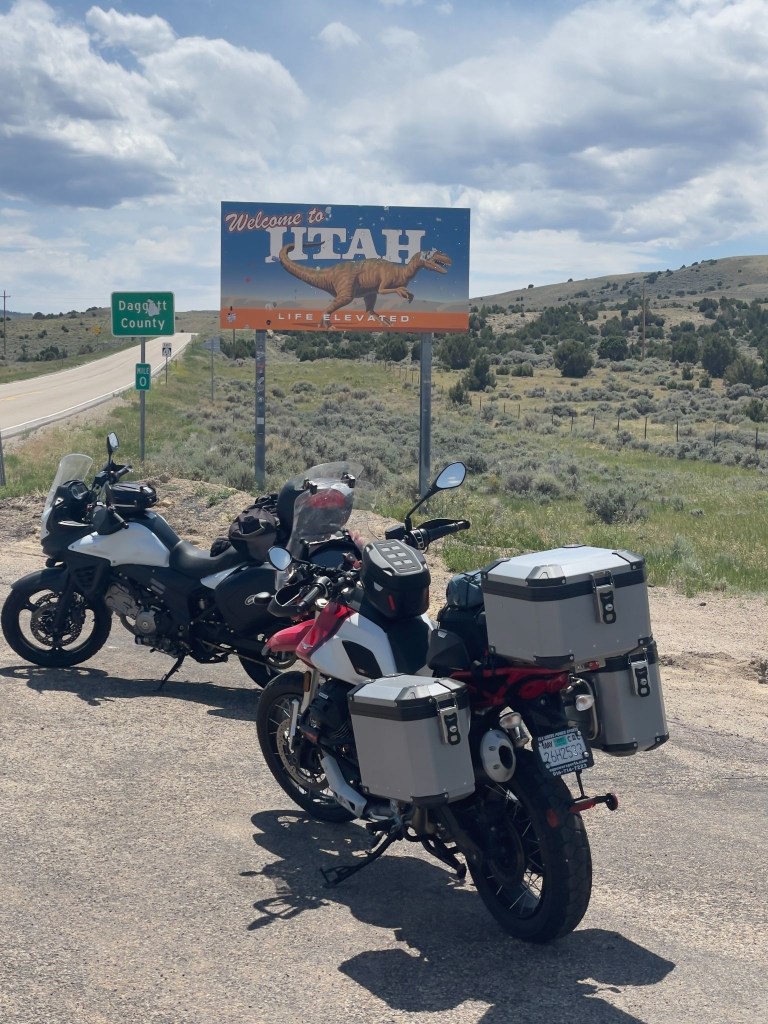
Yes, those would be bullet holes in the “life elevated” sign
The Flaming Gorge & High Uintas (UT-44 to Red Canyon)
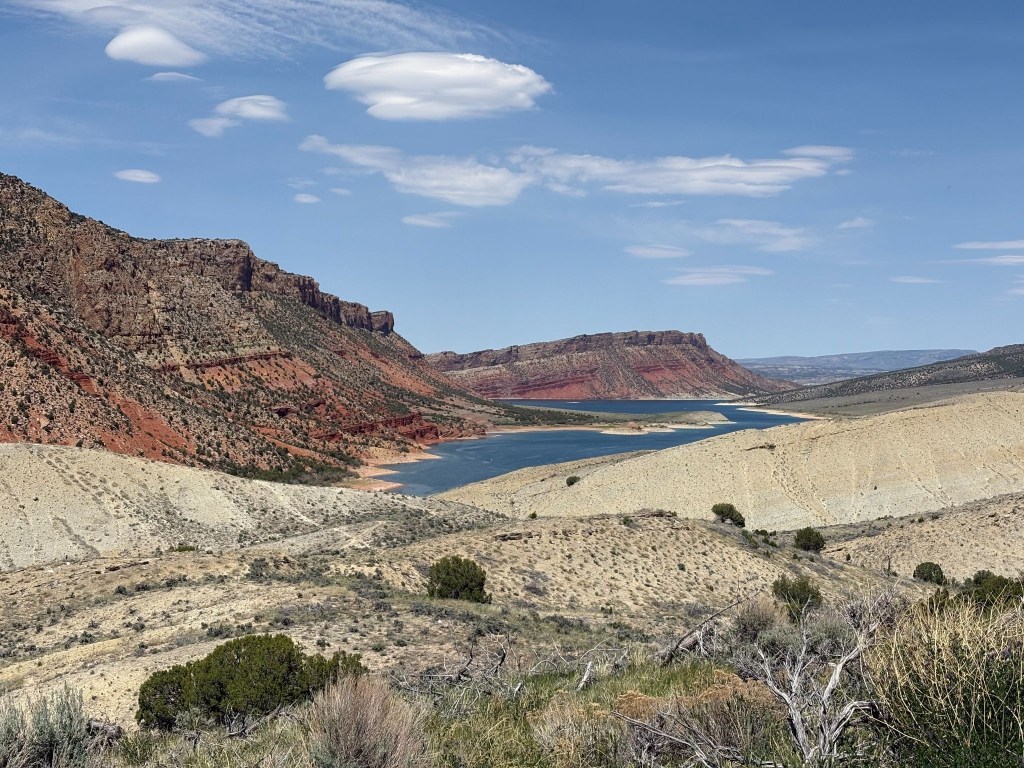
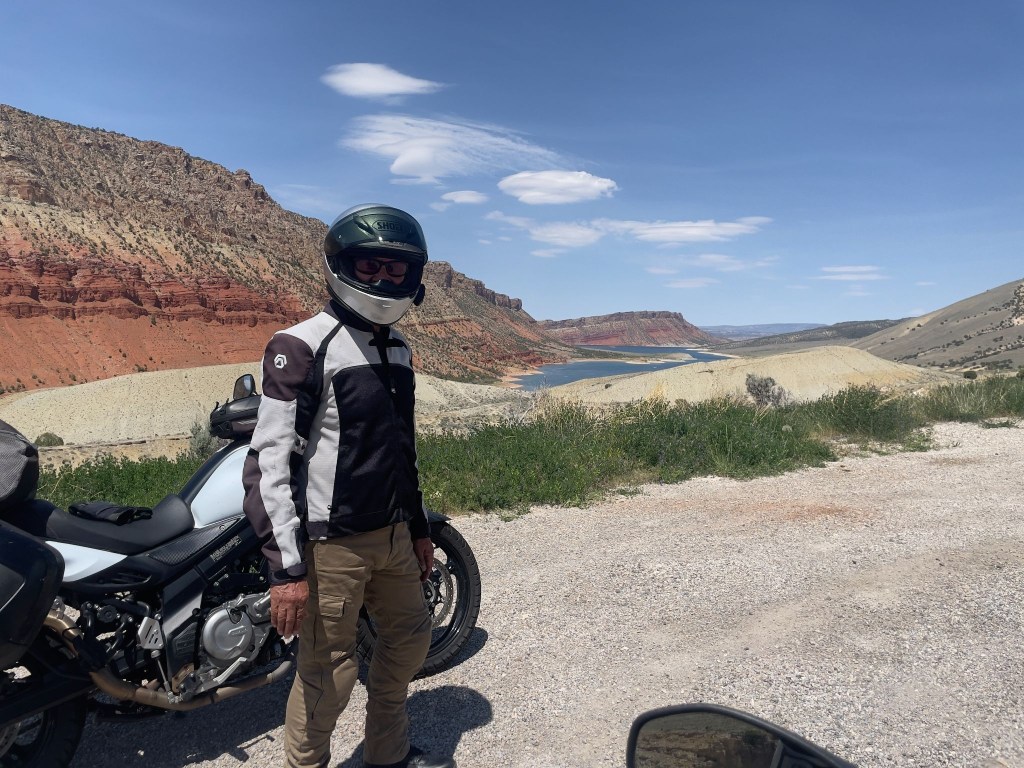
Leaving Manila on UT-44, the landscape shifted dramatically as we climbed into the Ashley National Forest, now on the US-191 Flaming Gorge All-American Road, surrounded by thick stands of ponderosa pine and Douglas fir. The climax of this stretch is Red Canyon. The forest suddenly dropped away into dizzying, vertical cliffs of vibrant, fiery-red quartzite. Below, the deep green waters of the Green River and Lake Flaming Gorge snake through the bottom of the chasm, creating one of the most stunning color contrasts in the American West.
Red CanyonLake Flaming Gorge, blue and not green like the river or red like the canyonSMAP posing bullet free (and not pointing at the obvious)
The Uintah Basin to the Desert Canyons (US-191/US-40 to Price Canyon)
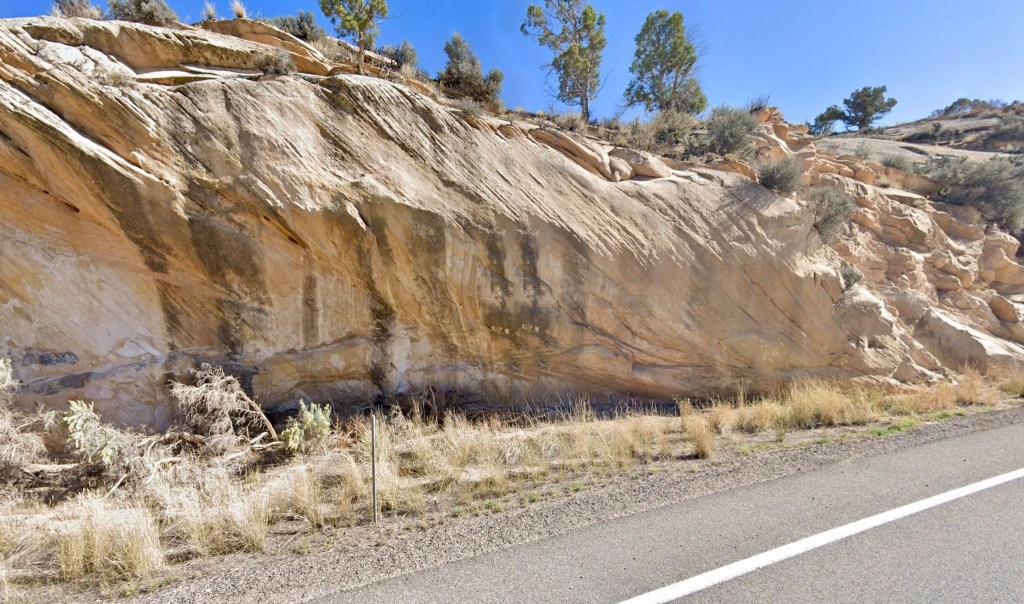
Descending the southern slopes of the Uintas, the pines vanished, and we spilled into the arid Uintah Basin. Traveling the shared stretch of US-191 and US-40, the landscape turned into a sun-baked desert of exposed sandstone and gray shale hills.
Sun-baked sandstone road cut on US-40
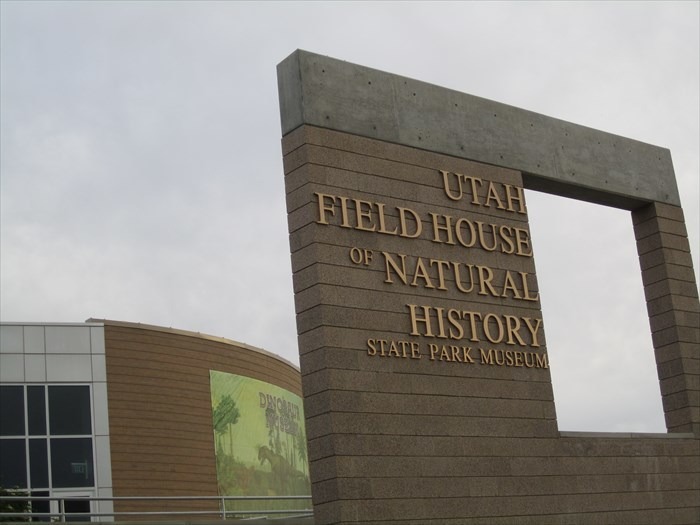
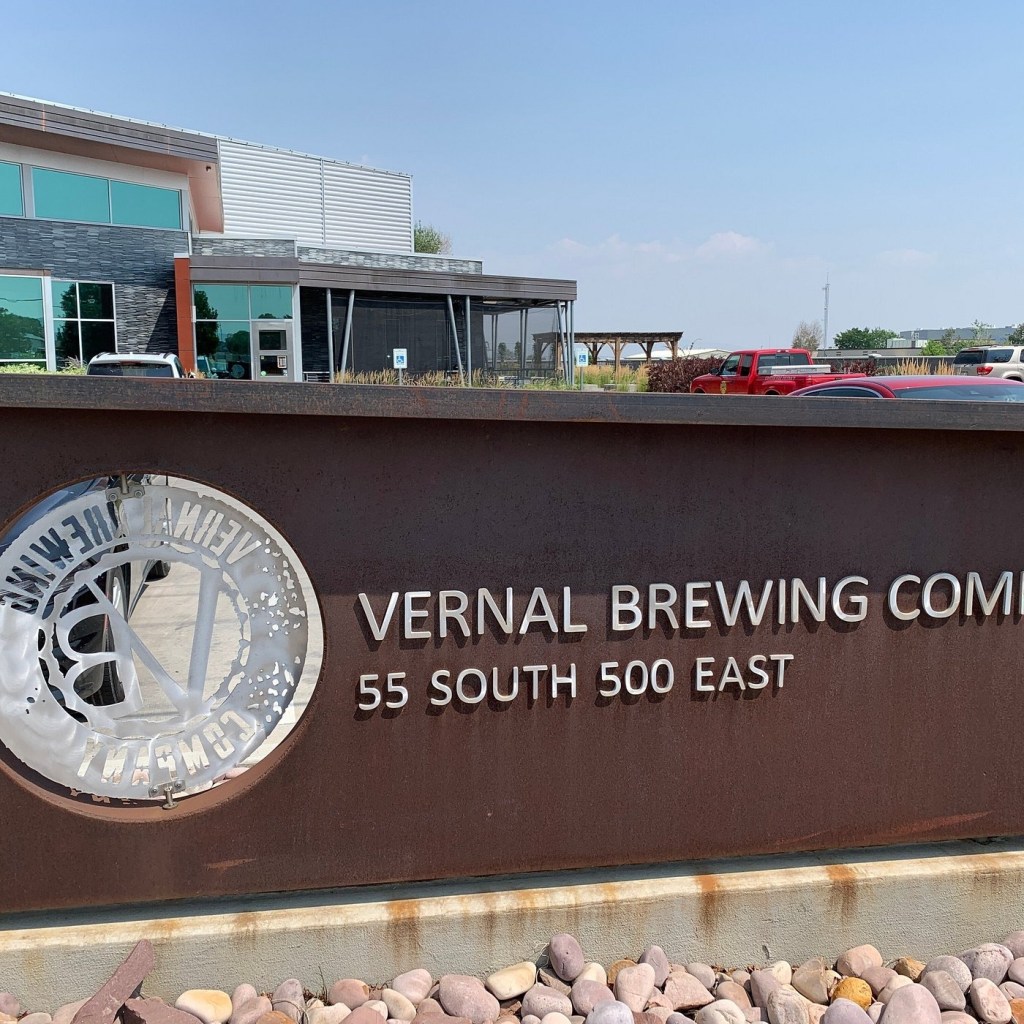
On to Vernal, the first leg of our Utah ramble looped back into the heart of the Uintah Basin, concluding on the historic Main Street of Vernal at the Patriot Stay Motel. This family-owned property features a distinct patriotic theme and puts you just steps away from the heart of the Right Petunia Triangle of the Patriot Stay Motel, the Utah Field House of Natural History State Park Museum, and the Vernal Brewing Company.
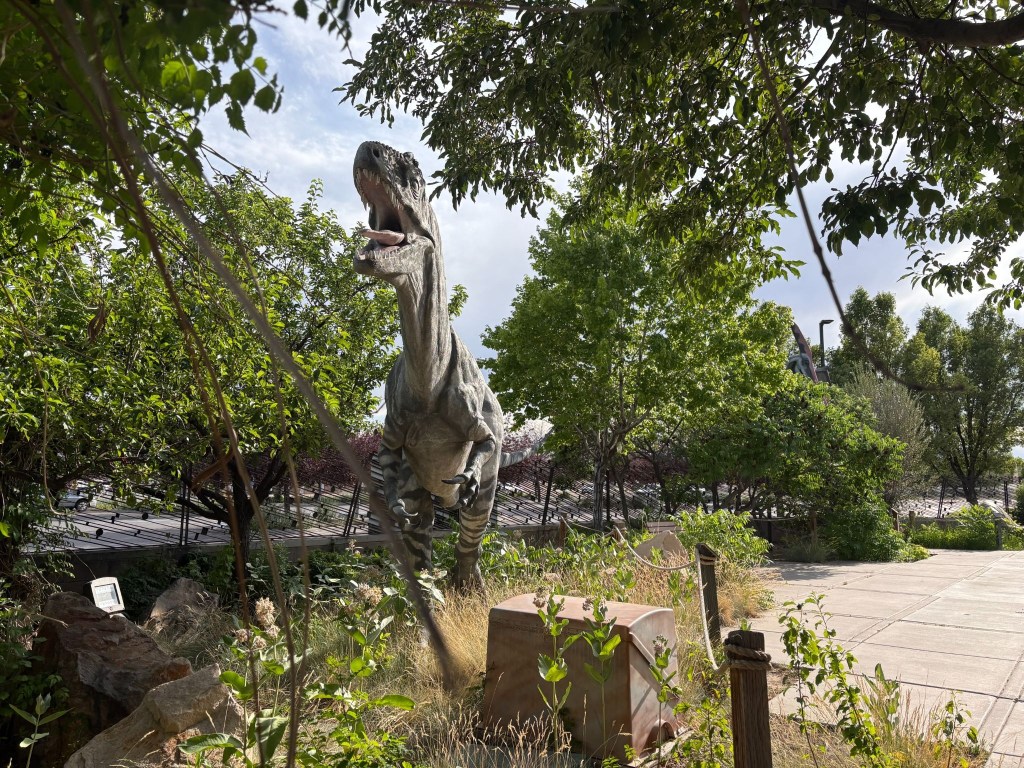
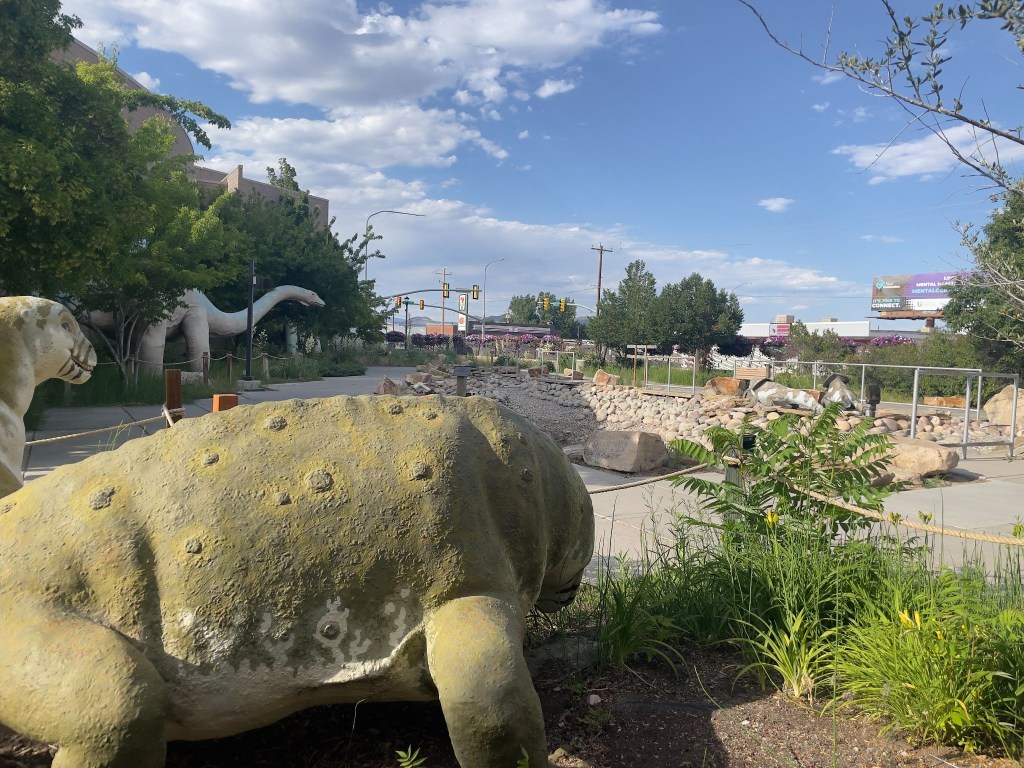
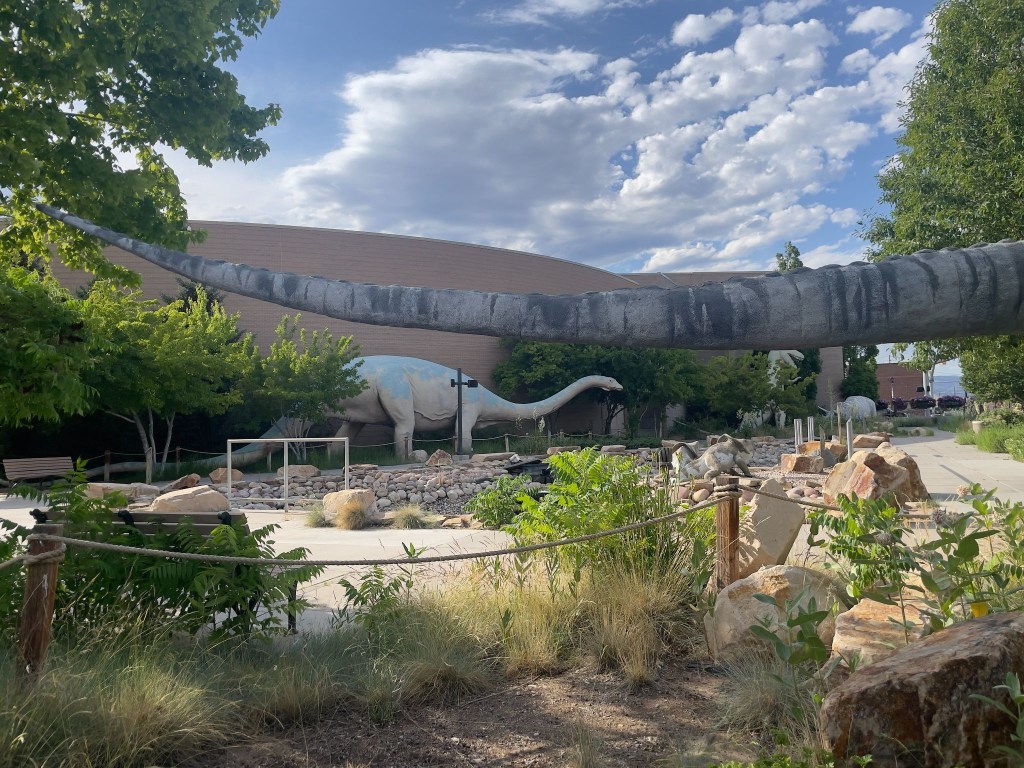
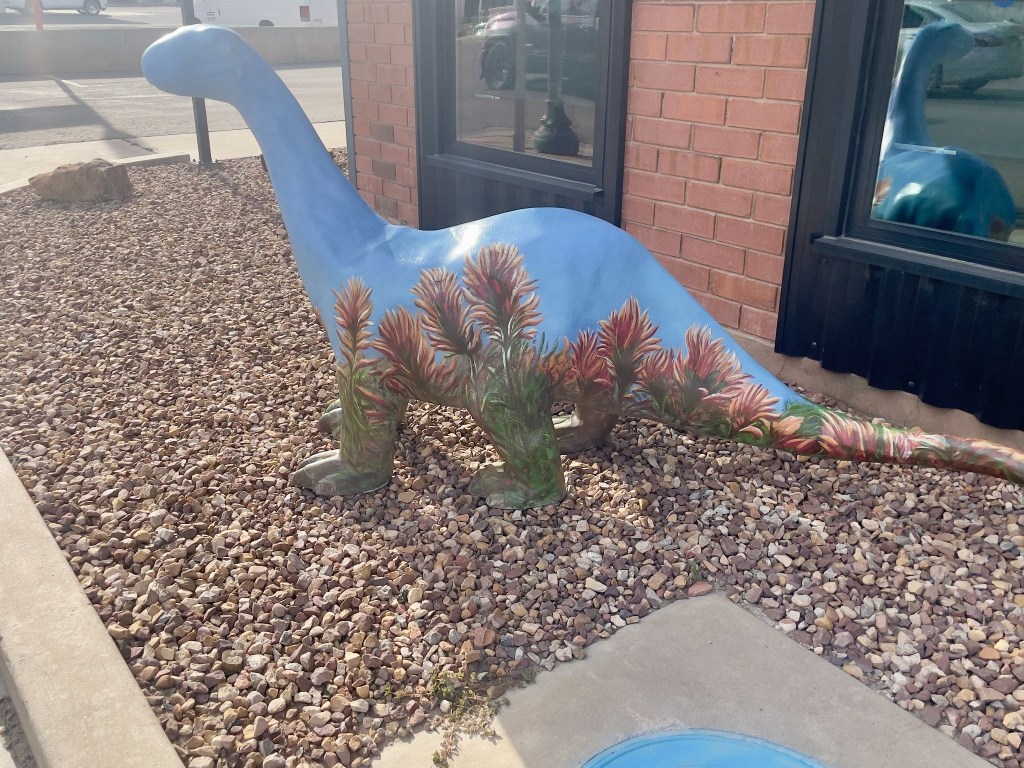
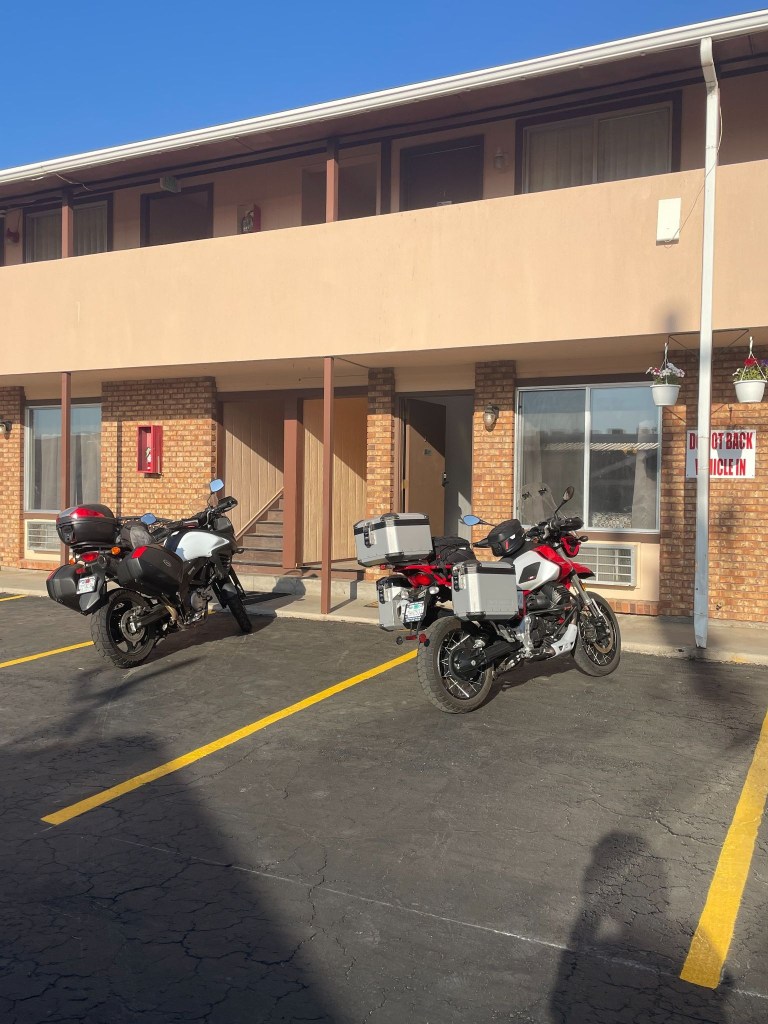
The Patriot Motel, located in one of the vertices of the right Patriotic Petunia triangle of Vernal, Utah With a side of what many Utahns believe to be antediluvian critters, some brightly painted
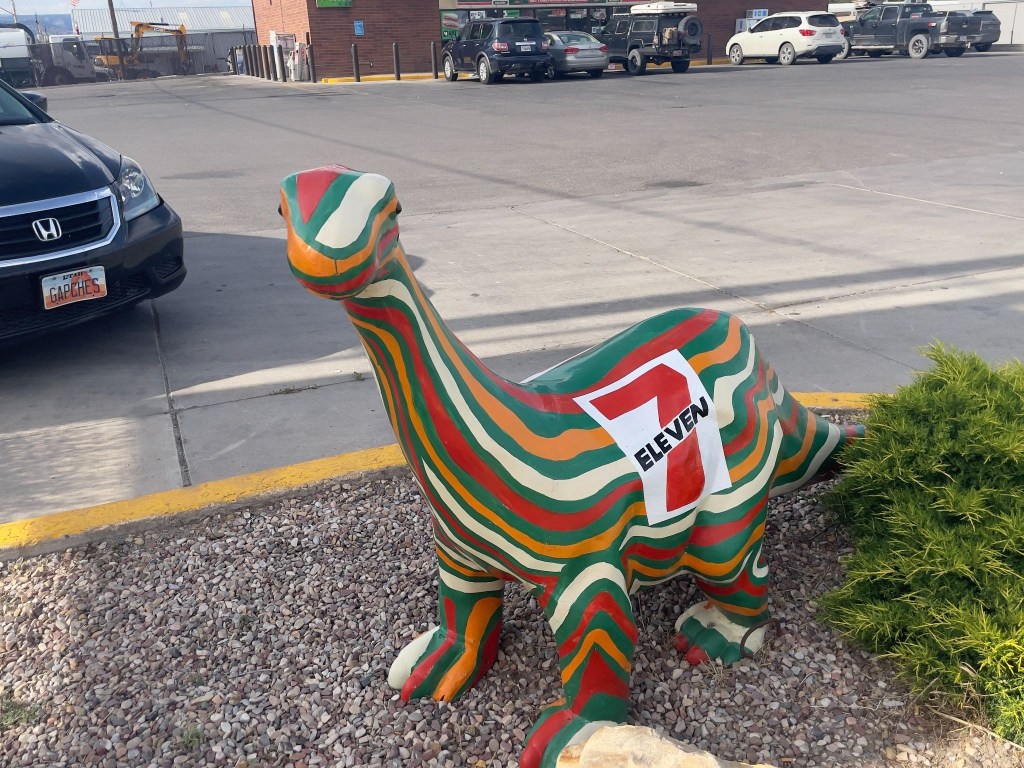
The folks who market Utah’s natural history have definitely done the deep dino dive. Utah is deeply, single-mindedly obsessed with dinosaurs, treats them like local celebrities, and practically makes them the state’s entire personality. It is the only place where you can drive down a highway, spot a massive fiberglass Triceratops, and not even blink because you just passed three others outside a gas station.
The state boasts the highest concentration of Jurassic bones in the country, and locals treat these ancient fossils less like scientific anomalies and more like treasured family members. In fact, Utah loved dinosaurs so much they designated the Allosaurus as the official state fossil, because apparently, having a state bird just felt too mainstream.
From roadside dino parks with roaring animatronics to actual towns named “Dinosaur,” the state’s prehistoric fixation proves that while the beasts may have gone extinct millions of years ago, Utah is doing everything in its power to keep the spark alive.
Here are the more evidence-based recreations of these spectacular beasts…
And those the Chamber of Commerce distributes about town…
Dinosaurs have NIL contracts?
Apparently the rodeo was happening on our Vernal day through the weekend. We opted for procuring nourishment, a beet salad with chicken for moi and a salmon salad for SMAP at the Vernal Brewing Company, across from our motel, and a return trip across US-191, the Main Street, to the 7-11 for 3R’s beverages thus completing the Patriotic Petunia Triangle of Vernal, Utah. Since the Stanley Rodeo was a bust I wasn’t going to take any chances in Vernal.
Patriotic petunias and dinosaurs…Jurassic Park could have avoided the mess with petunia power
The Sisyphean Ramble Planning Criteria (SRPC) gave the Patriot Motel a three of five star rating. The air conditioning, luxurious towels, and proximity to mangia e bevi and the Utah Field House of Natural History State Park didn’t quite live up to the gold standard of motels, the Y in Chama. Because it wasn’t raining, there were point deductions. The parking lot cancelled the rain deduction. Hence, a 3 out of 5 star rating. It’s a complicated system.
Note the sign on the wall in the parking lot We assumed it meant for each parking spot
US-191 → Ft. Duchesne → Duchesne → Castle Gate → Price → UT-10 → under I-70 → UT-72 → Fremont → UT-24 → Lyman → Torrey → Rim Rock Inn
The Uinta Basin and Energy Corridor (Vernal to Duchesne)
The journey on Day 6 began in Vernal, a green valley oasis, somewhat less green because of persistent drought, famous for its dinosaur history. Leaving town heading west on US-40, the landscape opens up into the vast, arid expanse of the Uinta Basin. To your right, the distant, pine-covered peaks of the Uinta Mountains rise along the horizon.
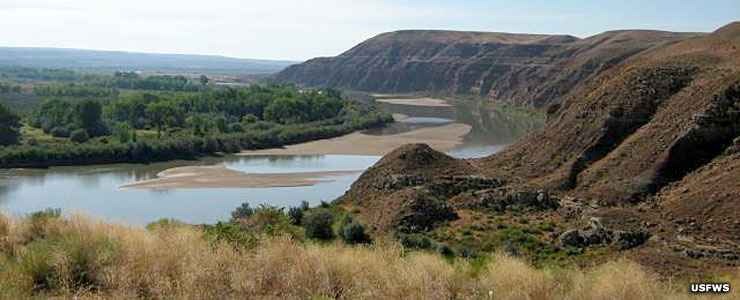
We passed through Fort Duchesne, the tribal headquarters of the Ute Indian Tribe, marked by sprawling ranch lands and cottonwood trees along the Whiterocks River. By now the digital (Google Maps/Apple iPhone) navigation was completely kaput. Taking out the paper map (California State Automobile Association) we made a slight error in taking the road to Ouray. It would have been one of those serendipitous errors had we gone on to Ouray. Just northeast of the community lies the Ouray National Wildlife Refuge, an oasis established in 1960 that covers nearly 12,000 acres along the Green River.
Ouray, Utah (photo courtesy of USFWS)
Once we discovered we were headed away from Torrey, after a quick CSAA map check discovering that the turn we wanted was down the road a bit further at Duchesne (without the Fort prefix), we continued west as the highway cut through rolling clay hills and oil-field country until we reached Duchesne, a quiet river town sitting at the junction of the Strawberry and Duchesne rivers. With no fort.
Through the Canyons to Coal Country (Duchesne to Price)
From Duchesne, we turned south onto US-191, beginning a steady climb out of the basin. It was here that the magnetic clasp on my tank bag let loose and that was that for the paper map. It went flying off to the side of the road. At that point, it was fate that we would navigate from fading memories and road signs. Until SMAP purchased a map in Torrey. Maps, once prolific in gas stations, have conceded to the digital world.
The road wound through Indian Canyon, where Sagebrush flats gave way to juniper trees and eventually thick groves of aspen and pine as we crested the summit. Descending the southern slope, the canyon narrows significantly. We emerged at Castle Gate, named after the famous, towering rock formation that resembles a medieval fortress guarding the canyon mouth. Turning onto US-6, you enter the rugged Price River Valley and arrive in Price, a historic mining and railroad hub dominated by dramatic, book-cliff mesas.
Castle Gate in Price River Canyon composed of the Castlegate Sandstone of the Cretaceous Mesaverde Group ( Photo courtesy of Utah Geological Survey)
Over the Volcanic Plateaus (Price to Fremont)
Heading south from Price on UT-10, we traveled through the Castle Valley corridor. To our right, the massive, flat-topped wall of the Wasatch Plateau kept us company for miles. We passed quiet farming communities like Huntington and Castle Dale.
As I was turning onto the I-70 on-ramp our hunch to make it to Torrey based on SMAP’s Apple Map, he urgently demanded I STOP! over the comms. He then investigated an underpass eventually diving south under the concrete spans of I-70 near Fremont Junction. Again, comms compromised by the concrete underpass, he’s shouting for me to STOP, STOP! I was stopped. Against my better judgement, I made a quick U-turn going in the wrong direction off the on ramp.
I then joined SMAP on the route that transitions to UT-72 and ascends the high, windswept expanse of the Wasatch Plateau. This section is a dramatic wonderland of alpine meadows, deep forests, and black volcanic boulders, offering expansive views of the San Rafael Swell to the east before dropping gently down into the high valley town of Fremont.
Old school navigationSan Rafael Swell from Hogan Pass
Into the Red Rock Country (Fremont to Rim Rock Inn)
From Fremont, a short roll connects you to UT-24, where the scenery changes instantly. The green mountain pastures vanish, replaced by irrigated fields and the brilliant, sun-baked red dirt and white sandstone of Wayne County. We passed through Lyman, a peaceful valley community where on the last Knucklehead bicycle ride in 2015 we had breakfast before tackling the road up to Hogan Pass.
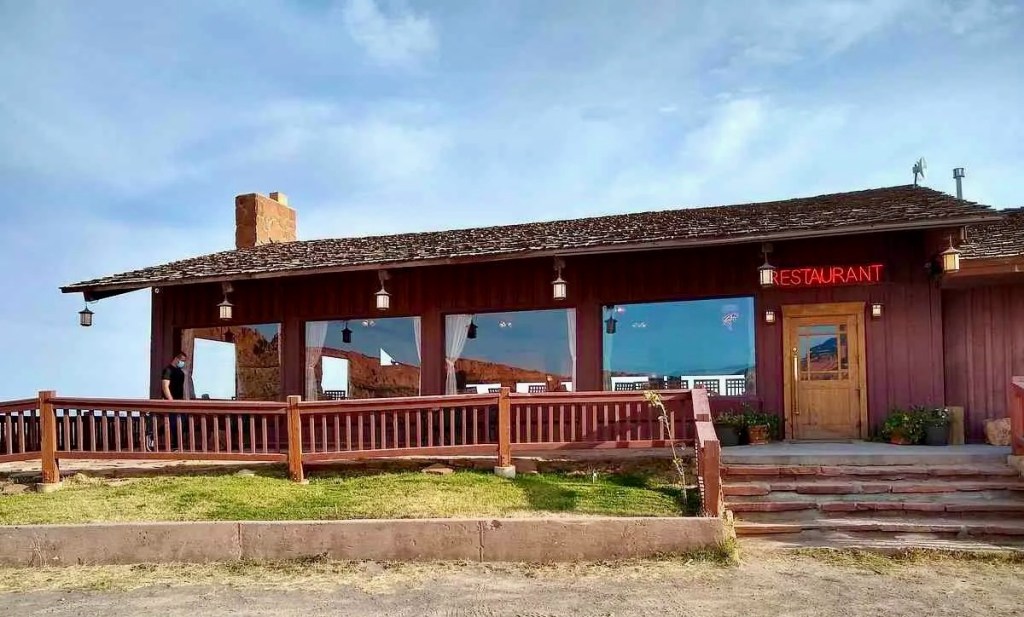
We followed the Fremont River as it carves its way toward the spectacular Waterpocket Fold. The road leads into Torrey, a tree-lined gateway town shaded by massive historic cottonwoods. Just east of Torrey, sitting high on a panoramic plateau with unobstructed, jaw-dropping views of the towering red cliffs of Capitol Reef National Park, our journey concluded for the sixth day at the Rim Rock Inn.
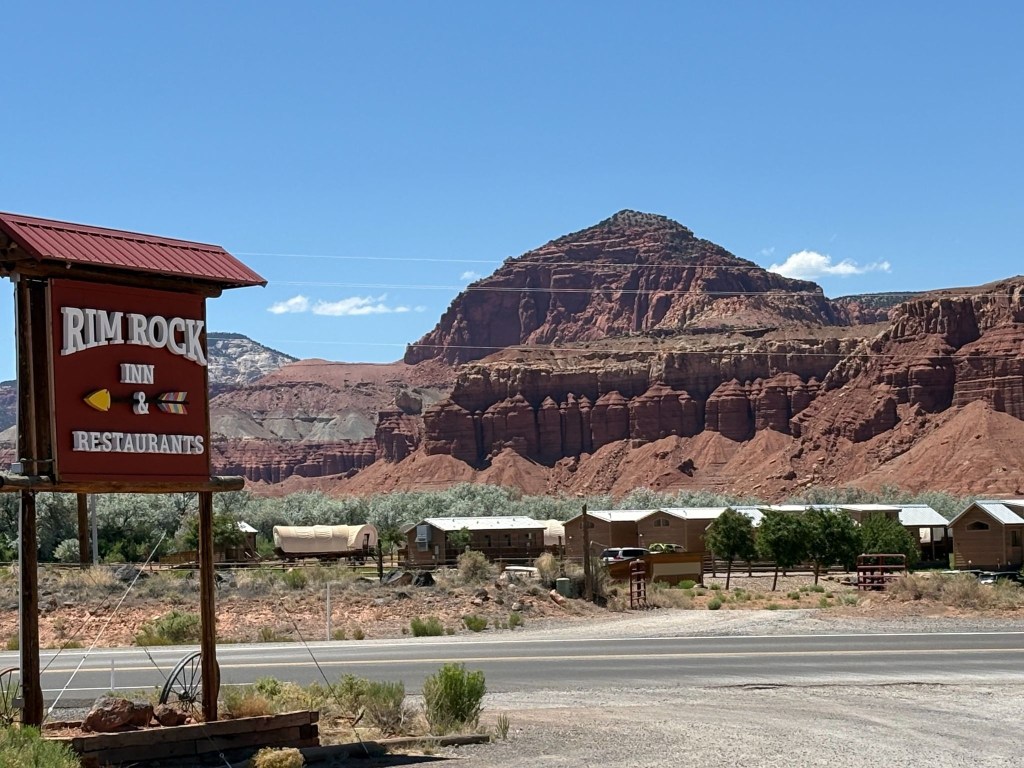
The Rim Rock, near the entrance to Capitol Reef
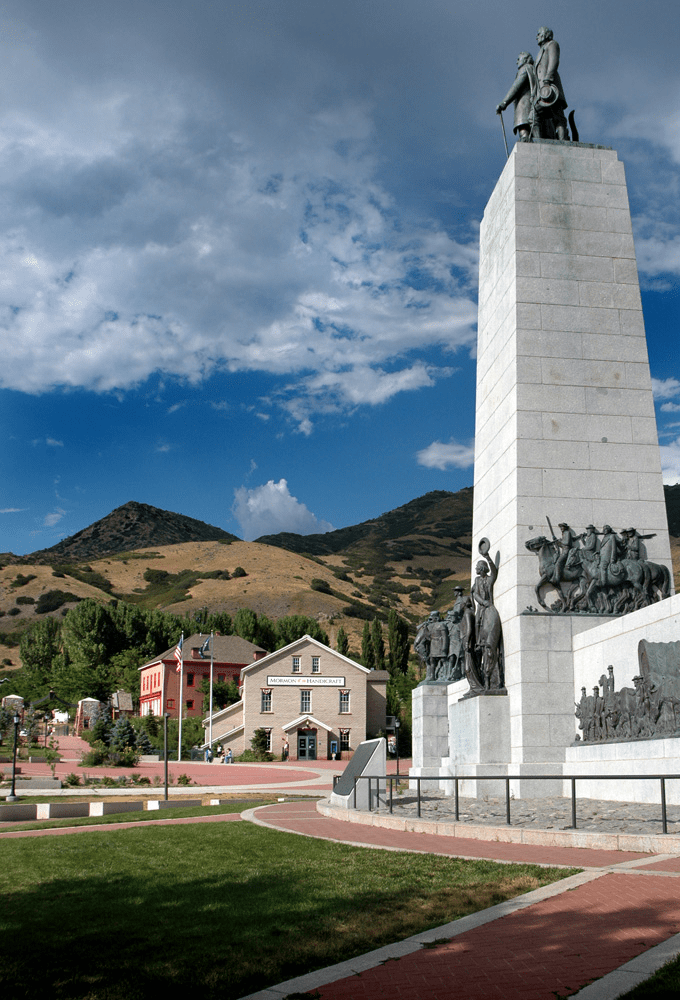
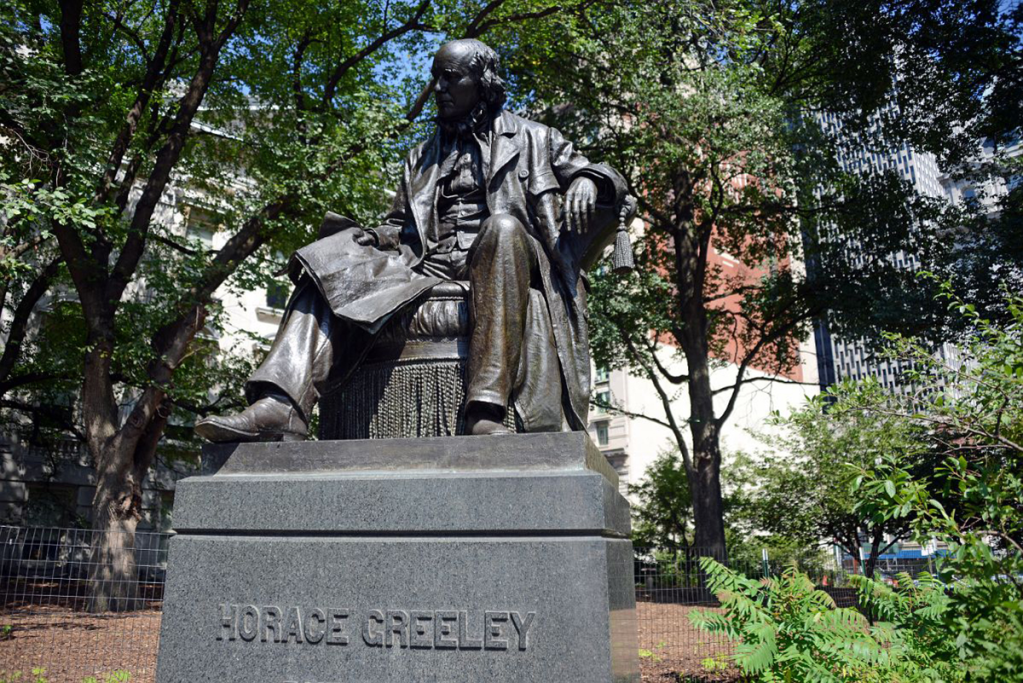
The arrow on the sign points to the Rim Rock Inn. The buildings pictured in the background, given the conestoga wagons, must be a Latter Day Saint pioneer dormitory. “Go West young man and grow with your country!” Wait, that was Horace Greely and not Brigham Young who famously said, “This is the right place, drive on” about the Salt Lake Valley.
There seems to be something of a “reverence gap”
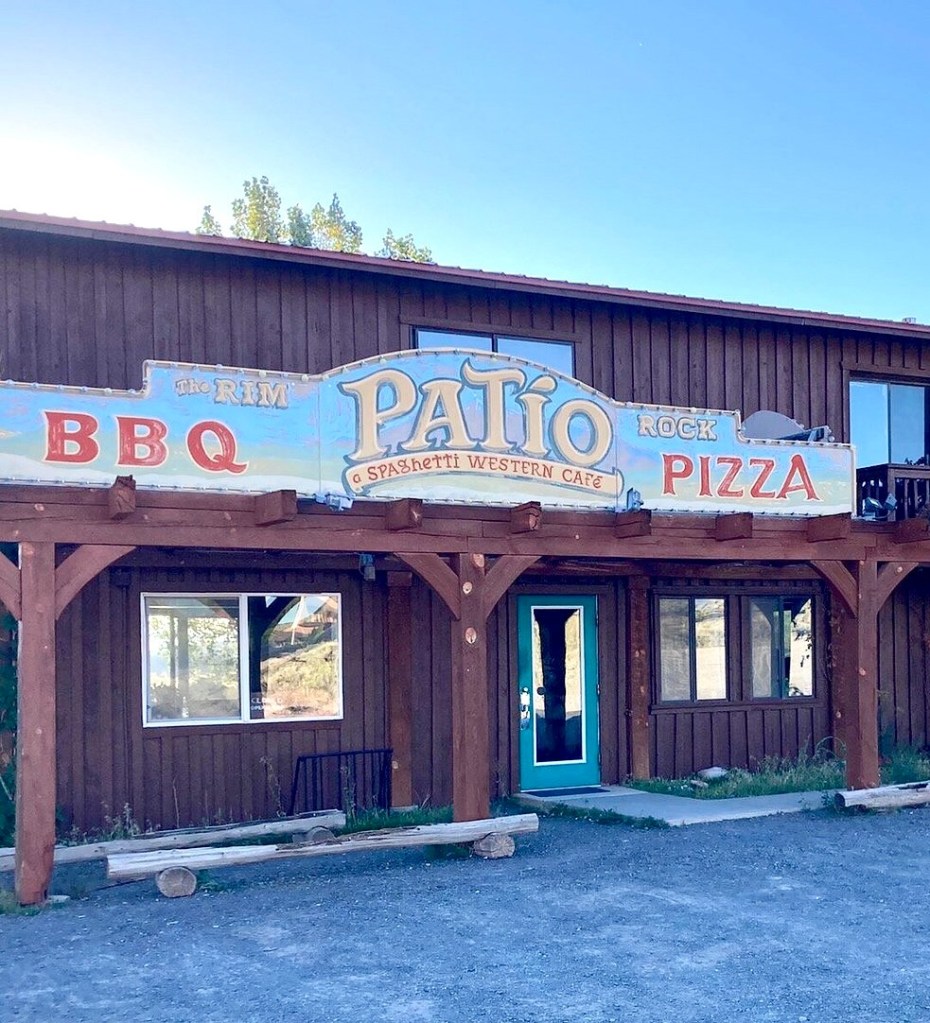
After checking in, we ambled down to the Rim Rock Patio for a well-earned whistle wetter—cold, crisp, and exactly what seven hours of Utah highway demanded. From there, a quick errand into Torrey for the 3R provisions, before we drifted back to the Patio and let a wood-fired pizza seal the day. Following the tip Lenny gave us in Thayne, we opted for the “bar” menu of the Patio pub, a decidedly less formal restaurant than the fancy steakhouse attached to the motel.
Fine dining in Torrey
The servers were as spicy as the pizza. Well, as spicy as Utah pepperoni permits. Maybe that’s what’s meant by SPAShetti Western Cafe.
Dining just fine in Torrey
The evening turned into one of those rides-within-the-ride: red rock fading to purple-is alpenglow, then black, while we nursed our refreshments and let the desert sky do the rest. A waxing crescent moon hung low and thin, with Venus, Saturn, and Jupiter keeping quiet company beside it—the kind of sunset that makes us glad we stopped riding when we did. We still couldn’t see Mercury.
In my best anthropomorphic rabbit voice: “Goodnight Moon!“
UT-12 → Boulder, Escalante, Cannonville, Bryce Canyon City, → US-89 → UT-14 → Cedar City → UT-56 to the Nevada Border → NV-319 → Panaca → US-93 → Caliente NV → Shady Motel
Our day began as the asphalt was calling, and our tires were about to get a serious workout. Only a little disconcerting since my front Micheline Anakee had upwards of 12,000 miles. This exact route is a legendary mix of twisties, high-altitude sweeps, and pure desert throttle. Here is how that stretch of blacktop felt on two wheels, of the moto variety and a nod to the pedal variety.
The Apexes and the Abyss (UT-12)
Croissants and coffee in Boulder
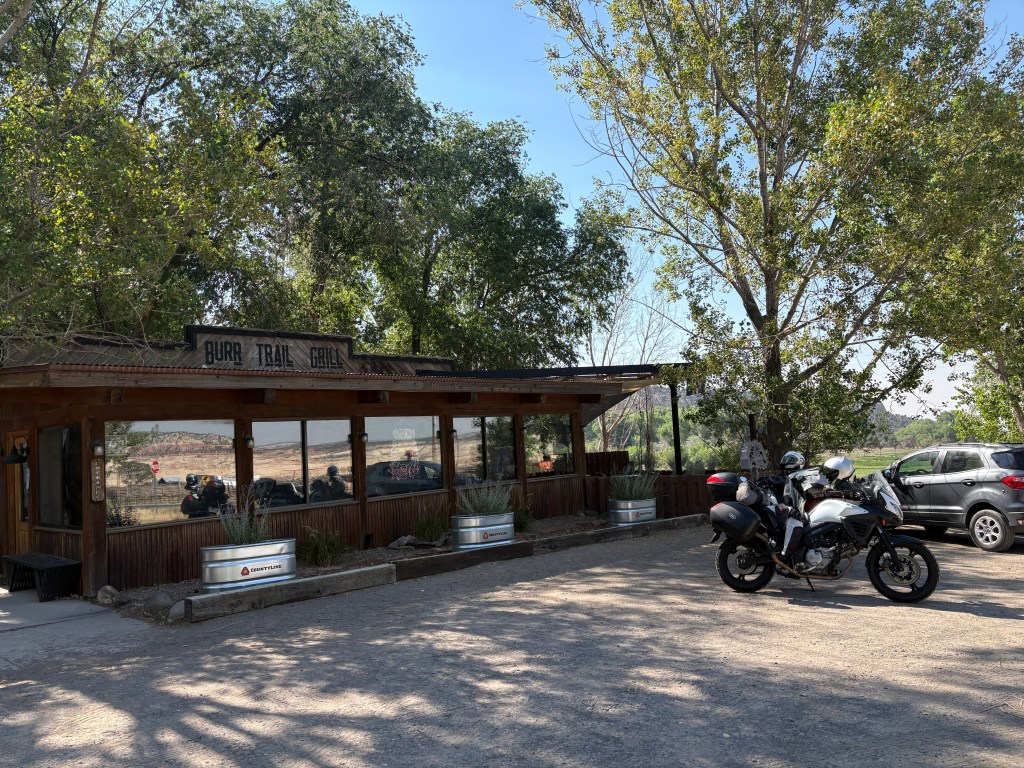
Boulder is at the intersection that leads to the Burr Canyon from UT-12 on the E. Burr Trail Rd. Featured in yet another Knuckleheads’ bike across Utah post and a previous moto post about our ramble through the canyon, there was no time for a revisit as we were headed west. Leaving Boulder, our tires were barely warm before we hit “The Hogback.” Not to be confused with Hell’s Backbone road (Hell’s Backbone with DJI Mavic) a few miles northwest of Boulder.
On a bike, The Hogback isn’t just scenic; it is an adrenaline shot straight to the heart. You are riding a knife-edge of asphalt with a 1,000-foot drop on either side and crosswinds that love to test your counter-steering. The challenge is to keep your eyes on the exit of the turn, not the canyon floor.
Highway 12 — A Journey Through Time Scenic Byway
In 1997 I found myself pedalling for life as an afternoon thundershower struck while crossing The Hogback on the Tour de Ute. Channeling Tennyson:
The smell of ozone hung in the air, lightning to right of them, lightning to left of them, hail in front of them volley’d and thunder’d; Some one had blunder’d: Theirs is not to make reply, Theirs is not to reason why, Theirs is but to do and (hopefully not) die: Into the valley of the Burr Canyon rode ten Knuckleheads…
Since 1997, the weather subsequently crossing The Hogback has been benign. The drop on either side, not so much…Smokey skies over the Escalante
We dropped down into Escalante, shaking the tension out of our wrists, before leaning into the sweeping curves toward Cannonville. The temperature climbed as we carved through the red rock canyon walls. Finally, a steady twist of the throttle up the climb into Bryce Canyon City, where the air got crisp, SMAP grabbed a sammy, and the tourist traffic got thick. Watch for rental RVs drifting into your lane.
Read the signThe Outlaw Trail (photo & description courtesy ofvisitutah.com)
The trail is the same one the notorious Utah-born Butch Cassidy used to evade the law, and it would become part of what was known as the “Outlaw Trail.” The area was also the primary filming location for the 1969 movie “Butch Cassidy and the Sundance Kid,” with Robert Redford and Paul Newman. Redford himself followed the Outlaw Trail in 1976 for a National Geographic piece.
Local legend has it that Cassidy, whose real name Robert LeRoy Parker, got into a fight over a woman at a dance in nearby Panguitch. Having thought he killed her jealous lover, Cassidy fled along the trail. But the injured man was simply knocked out, and upon regaining consciousness he organized a posse to chase Cassidy through these hills. After successfully evading his pursuers, Cassidy would later return to this area — with his the Hole in the Wall Gang and later his Wild Bunch — to hide from the law after a stagecoach robbery or other heist.
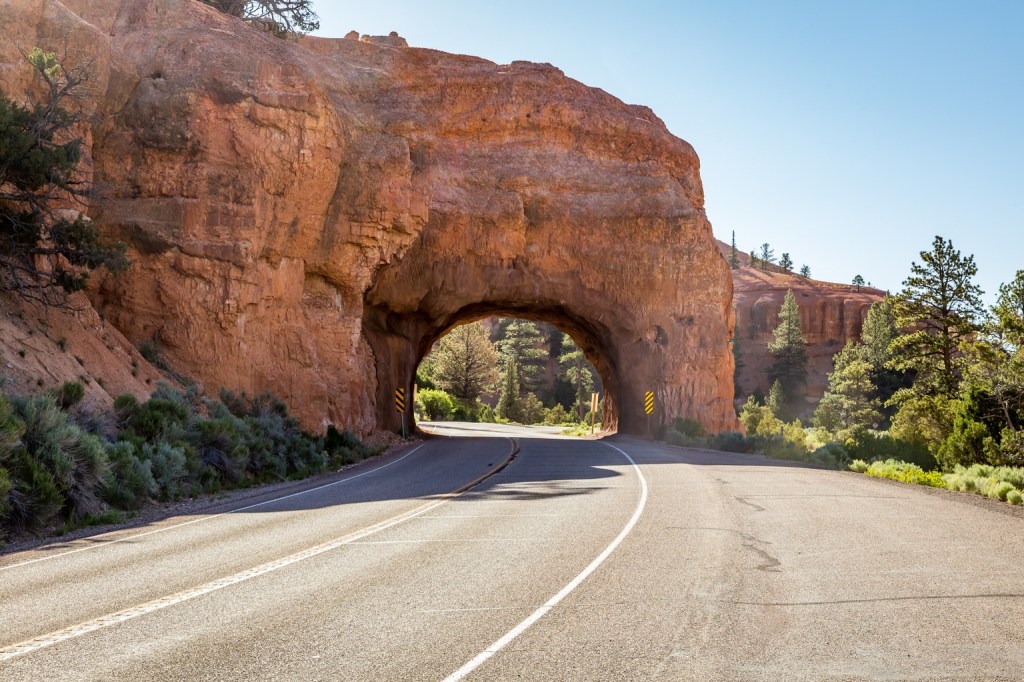
Red Canyon Arch
Lava Fields and Brake Dust (US-89 to UT-14)
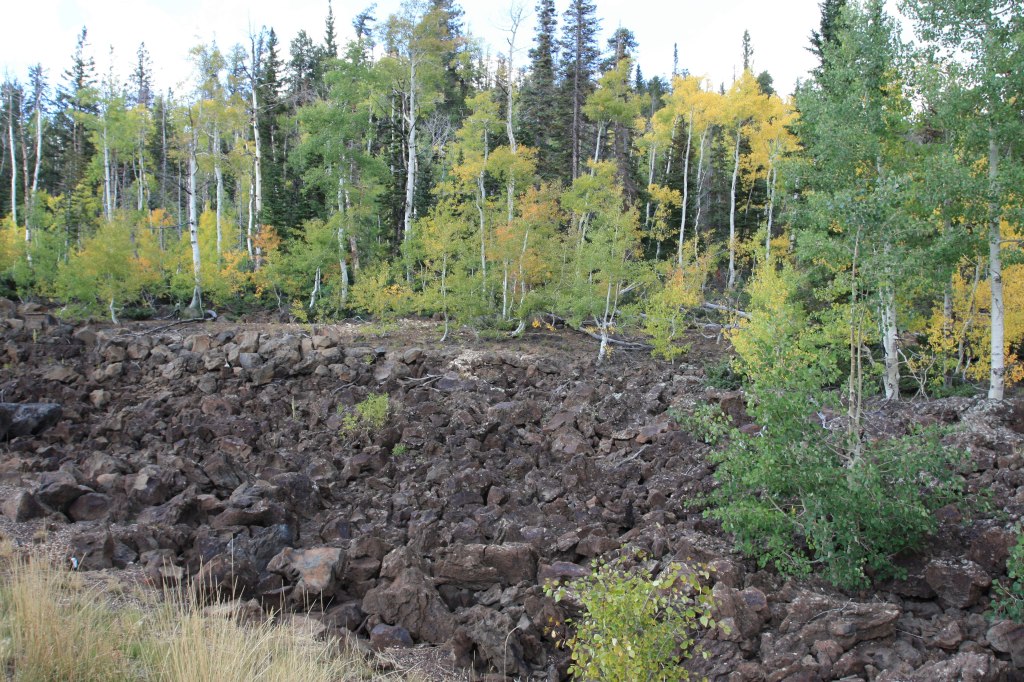
After a quick, straight blast on US-89 to shake out the kinks, we leaned hard into UT-14. This is a sport-touring paradise. You lean the bike left and right through tight canyon switchbacks, climbing rapidly up to nearly 10,000 feet. You will definitely feel the chill as you cruise past pitch-black lava fields of the Markagunt Plateau. Then comes the descent into Cedar City. It is a steep, brake-burning drop through Cedar Canyon. Keeping an eye out for loose gravel in the corners and deer standing on the shoulder is right there with inattentive tourists stopped on the roadside, taking pictures.
Pitch-black lava flow along UT-14 of the Markagunt Plateau
The Big Throttle Open (UT-56 to NV-319)
After a slight navigation error (despite the map acquired in Torrey, go figure), we stopped in Cedar City for something to give us wings as we were approaching Nevada. It was time to shift into sixth and set the cruise control. UT-56 out of Cedar City is a straight, lonely shot through the high desert. The wind will buffet your helmet and the June heat will have you looking for the nearest water faucet to soak your cooling vest.
And yet more signs to read
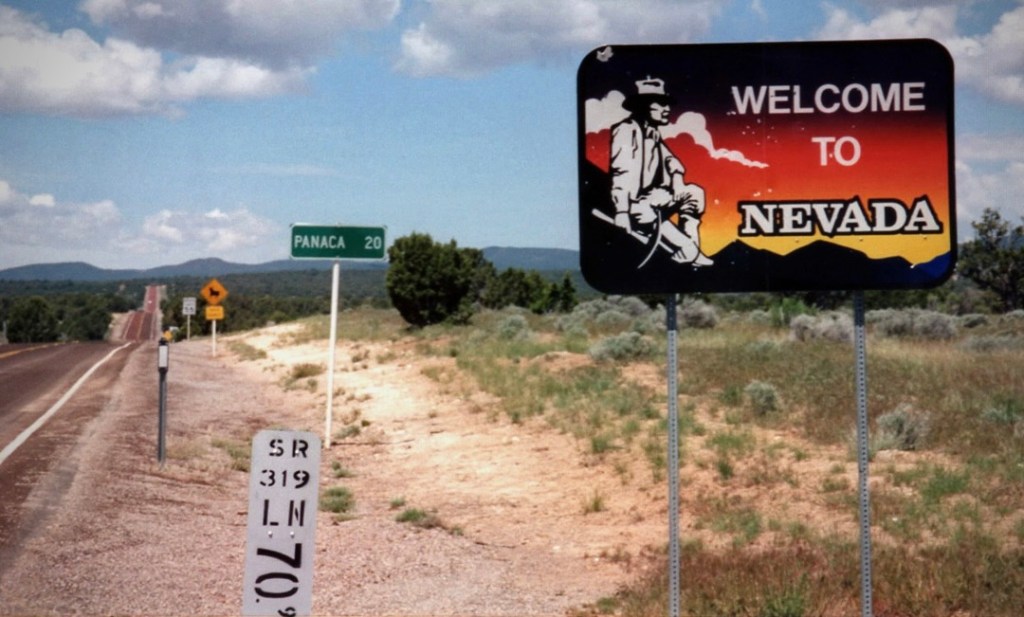
We crossed into Nevada as the road became NV-319, rolling past the stark, white clay spires near Panaca. The pavement here is wide, empty, and fast. It is just you, the drone of your exhaust, and seeing a small patch of shade in front of the LDS church, a place to stop and stretch the nalgas. Ah, across the road from the church, a Post Office with a spigot and hose. Worthy of the likes of an inspiring Greely or Young quote, from Sisyphus: “Soak me with your hose Panaca!”
Cooling vests were now charged for the run into Caliente, Spanish for HOT.
Our oasis has a Zip CodeSMAP enjoying the evaporative cooling vest charged from the Panaca Post Office hosing
Fueling up at the Shell station on the outskirts of Panaca, we met a couple, two up, on a Harley Roadglide, Streetglide, Road King or one of those badass HD-Baaaaggeeeers… They were from New Jersey and had rented the bike in Las Vegas and were on their way to Yosemite. They were “hard core” riders, not by way of appearance, but miles, each on their own bikes back home and two-up touring. They had come from Zion and we recommended Tonopah or Ely, masters of navigation that we are, for their Sunday destination. Another chance meeting with curious like minded ramblin’ folks with stories to tell and good cheer.
The Cool Down at the Shady Motel (US-93)
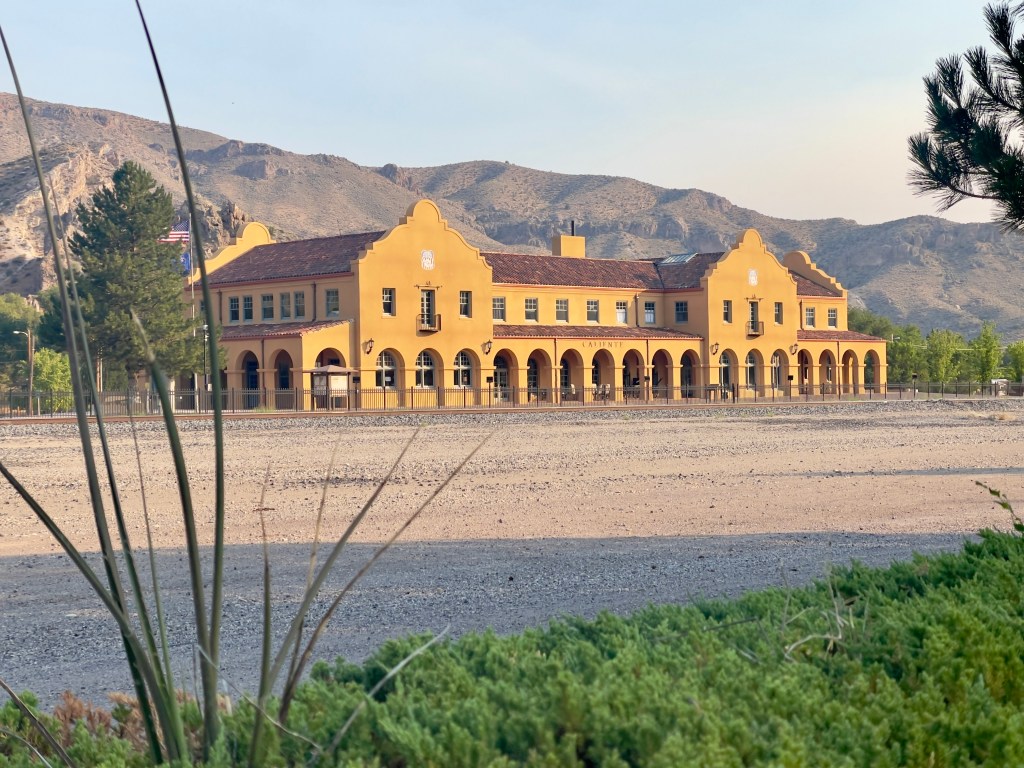
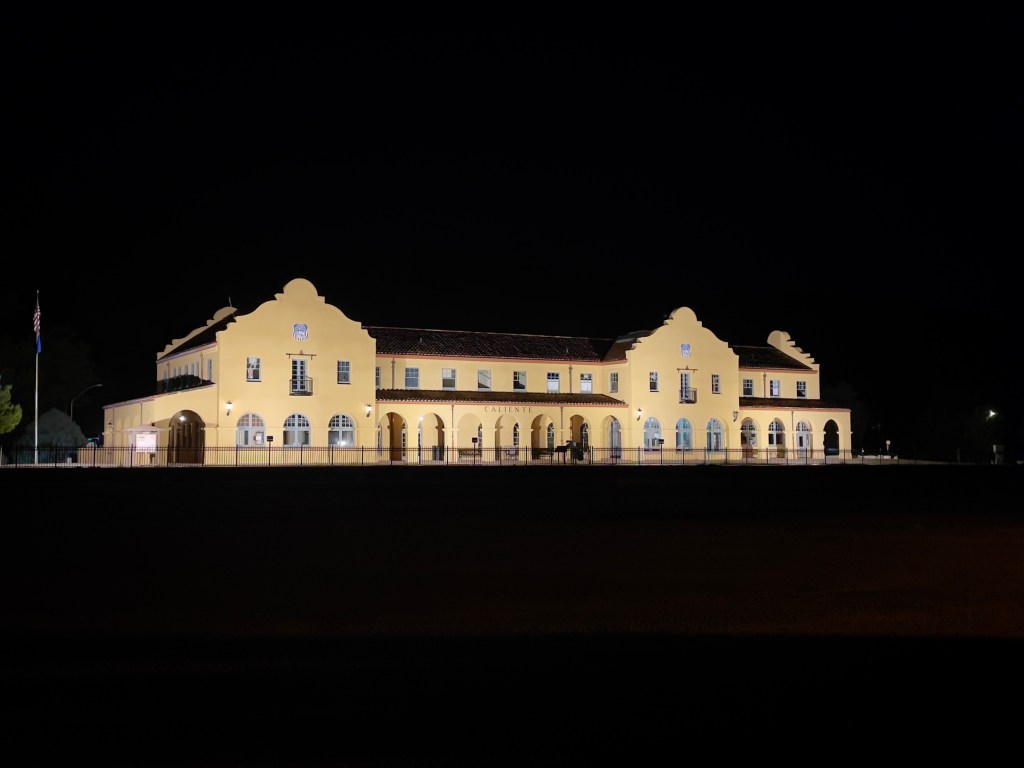
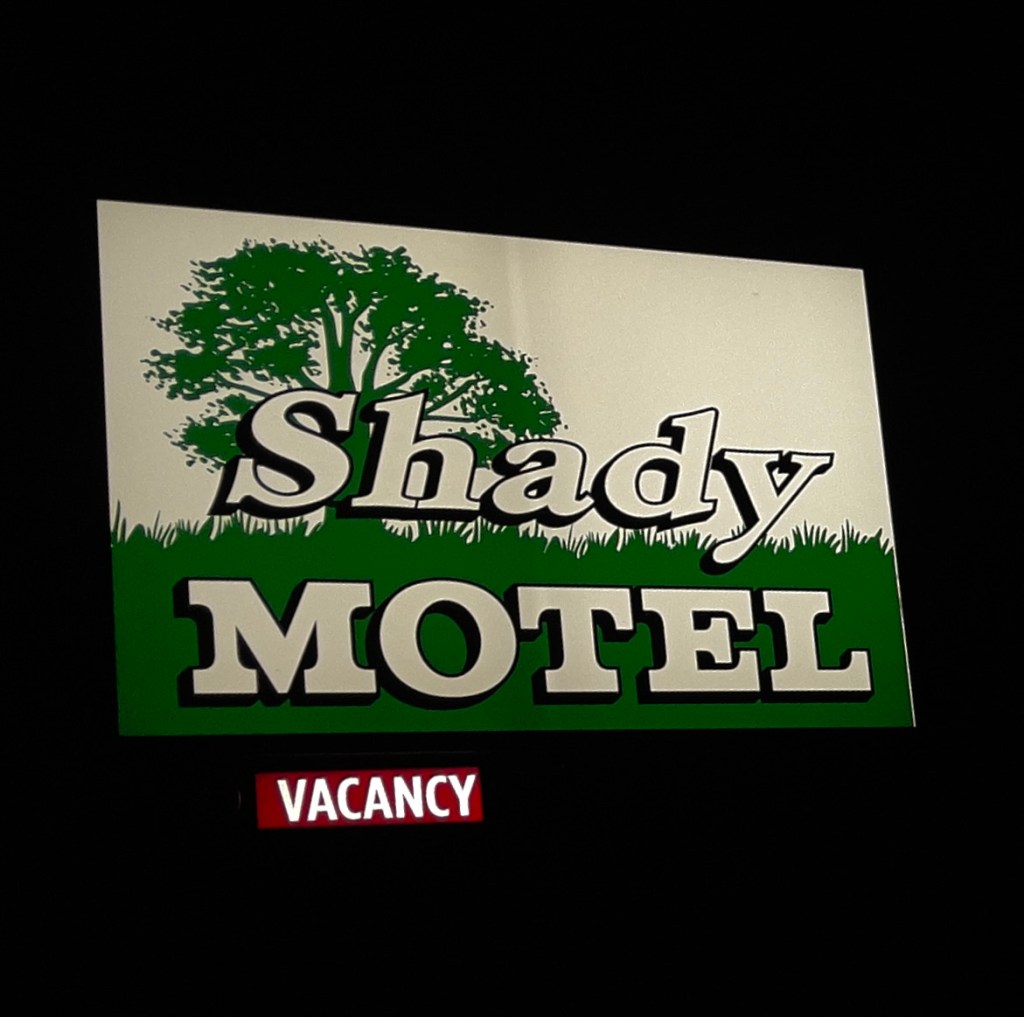
A sharp left onto US-93 brought us down into Caliente. After hours of gripping the bars, the historic shady streets (at least one side of the street) of this rail town felt like a sanctuary. It was warm, in the 90’s, but the Shady Motel had top-shelf air conditioning. Kickstands down, helmets off, and jackets unzipped, soon the afternoon heat would abate. There is nothing quite like the feeling of peeling off riding gloves and boots after conquering the Hogback and the high passes of Utah and sagebrush plains of eastern Nevada.
The perfect perch for watching Caliente culture
As we finished checking in, a fire truck showed up with Utah licence plates. A young firefighter entered the office. We had noticed smoke in the air from earlier in the day and were in fact rolling into more dense smoke enroute. Curious fellow I am and a proud papa of two firefighters, I asked if the smoke in the air had something to do with their showing up in Caliente. The young man said that they were dispatched from Utah to cover the Caliente area that had earlier dispatched engines to a couple of wild fires, the Grapevine and Kane Spring fires south of town. They were anxious to see fire and not just the smoke.
Screen shot from the app, Watch Duty captured on July 9, 2026
I imagine our Utah firefighters got their shot on the Cottonwood fire back home.
An early dinner at The Side Track, spaghetti and meatballs for SMAP and a well executed fettucini alfredo for me at one of our all time favorite ramble restaurants. Cold rehydrating beverages were procured next door at the All Aboard Liquor Store, and we returned to the motel, set up our camp chairs facing US-93 on the walkway, and watched the locals cruising the main. Curiously a bus roamed up and down a couple of times filled with students, with whom we exchanged waves. This is how one enjoys the small town vibe as the desert sun set.
The economic engine of Caliente near smokey-sundownThe golden hour looking west in CalienteFree Biker, Free RiderChair ✔️, ice ✔️, an R ✔️The Caliente Station at sunsetThe Caliente Station in darknessIt’s not that something was missing, we had achieved “vacancy” a desired form of relaxation (From the archaic: absence of activity; idleness)
US-93 N → NV-375 Extraterrestrial Highway → US-6 Tonopah → Benton, CA → CA-120 → Lee Vining → CA-120 → Tioga Pass Crane Flat → CA-120 → Smith Station Rd → Coulterville, CA-132 → Merced Falls Rd → Snelling Rd → Merced → Home Sweet Home
Two Bikes, Two Nalgas, and One Intergalactic Highway
The odometer told us we had 466 miles to cover to get back to Merced. Another day was planned for somewhere between Independence and Bridgeport on the East Side of the Sierra. We talked about it. On a motorcycle, 466 miles is not a distance. It is a dynamic physical test of how long a human being can tolerate vibrating metal between their thighs before their spinal column permanently fuses into a solid rod. We were also feeling the other 2,000+ miles of the previous six days, the most recent in heat and now smoke. Besides, SMAP had to be back before Wednesday for a memorial service. That’s it, let’s iron-butt it home and save the East Side for the fall when temps have relented along with the smoke.
We pulled out of Caliente, me on my Moto Guzzi V85TT, a bike built by Italians who clearly believe that adventure should involve a lot of character, a six gallon fuel tank, and an exhaust note that sounds like a sophisticated tractor. SMAP was aboard his Suzuki VStrom 650, a machine engineered by the Japanese to survive a tsunami, an alien apocalypse, 85 mph all day on deserted Nevada highways, even a skipped oil change. Although, I must say, SMAP religiously attended to his chain lubrication daily, prior to dinner and the 3R’s. With my shaft drive and his superb chain maintenance we had nil issues with our bikes.
A’Le’ Inn Territory
Once over the border on the previous day, we pointed the front wheels toward US-93 North, which quickly dissolved into NV-375. This is officially designated as the Extraterrestrial Highway.
The Scenery: Dirt, sagebrush, and a horizon so flat you can see the back of your own head. The Physics: The crosswinds here do not just blow. They try to slap you across the face and throw your bike into a ditch full of radioactive tarantulas. The Aerodynamics: On the naked-ish Guzzi with boxy panniers, I was a human sail. On the VStrom, SMAP sat in a pocket of calm, Japanese-engineered serenity, looking entirely too comfortable.
Like the Bagdad Cafe, everyone is welcome at the Lil A’Le’Inn
More cattle die on this godforsaken road from being hit by vehicles than by all the alien mutilation attributed to the unidentified flying objects (AKA unidentified aerial phenomenon) common to the Rachel area. In fact, we rolled through the graphic tractor-trailer-highway- jay-walking-mutilated-cow art, that had been committed earlier in the day. Perhaps it wasn’t a tractor-trailer, but something from Area 51…
The latest themed kitsch at the Little A’le’Inn
After a fine breakfast at the Little A’Le’Inn Cafe, we set off on the next uninterrupted basin and range, mile-after-mile of nothing more than mile-after-mile landscape.
Eventually reaching Tonopah, we conscientiously observed the speed limit through town on US-6. Tonopah is famous for a hotel filled with terrifying clown dolls and as a Nevada State Patrol speed trap. Our only stop was for fuel. We weren’t entirely sanctimonious. If a clown tried to steal the Moto Guzzi, nobody wins.
SMAP had to have a pic of the VStrom in front of the Tonopah Test Range entranceThe California Welcome sign kind of pales next to Nevada’s “see ya” sign (Both relatively bullet-hole free)
Up, Up, and Vertigo
Eventually, we crossed into Benton, California. The landscape changed from “barren moonscape” to “vertical wall of granite.” At the Benton Station Store energy drinks were procured for wings to make the whoops enroute to Lee Vining before the hump over Tioga. But not before appreciating Boundary Peak to the east, from where we came, the highest peak in Nevada.
We merged onto US-395, 70 miles south of where we joined the Three Flags Highway earlier in the week, so named to recognize its role in linking Mexico, the United States, and Canada.
Rolling into Lee Vining, a town that exists purely to sell gas to motorcyclists who suddenly realize their low-fuel light has been blinking for 30 miles. That and the Whoa Nelly Deli where packages of meat can be purchased (SMAP is evidence of someone wanting a protein boost with nitrites) that cost almost as much as a gallon of 91 octane, (Guzzi’s favorite). I had sunflower seeds.
Shade, at a premium at 6,784 feetNegit (left) and Paoha (right) Islands in Mono Lake
Then came Tioga Pass
The Elevation: 9,943 feet. The Temperature: Dropping faster than my investment portfolio. The Curves: Sweepers that would make a track-day racer weep with joy, followed by sheer drop-offs that make you pray your brake fluid doesn’t evaporate. The Guzzi loved the thin mountain air, chugging up the switchbacks with its vertically opposed twin cylinders thumping happily. The VStrom 650 just whined its predictable, ultra-reliable whine, carving through the corners like a surgical instrument. The only thing slowing SMAP down was an APS (Arizona Pork Sled) trudging its way up the pass.
We summited the pass, five bars on the fuel gauge and bypassed Crane Flat. From there, more sluggish traffic and temps were rising by a degree, every 500 feet of elevation loss. Normally on this long descent your front brake lever becomes your closest personal friend. A brief stop at the Coulterville Public Pool to dunk our evaporative cooling vests for a somewhat muggy, but cooler final push to conclude the ramble.
Back Home and a Couple of Weeks of Reflection
Sisyphus, as the myth goes, was condemned to push his boulder up the mountain for eternity, the futility being the point. Sisyphus and SMAP, by contrast, spent eight days pushing two motorcycles across six states (seven if you count California twice) with unreliable technology, navigation largely by fading memory, hunch, and road signs after losing a paper map, and no plan beyond the SRPC and a shared faith that the next fuel stop, motel marquee, or roadblock detour would sort itself out—and it always did, which either disproves the myth or confirms that Sisyphus’s boulder was never the point either way.
The other two-wheelers in our stables
What lingers isn’t the mileage, though 2,500-plus miles is nothing to scoff at from a saddle. It’s Ming’s bewildered “What a president?”, Donovan’s sweatpants-and-a-helmet optimism, Lenny’s coconut-smoothie curmudgeonry, and a busload of pine-cone harvesters saluted with raised tallboys in a Susanville parking lot under a bank of security cameras that captured, more faithfully than any GPS could have routed us, exactly what this ramble was actually about.
The Hogback, that tried to kill me 29 years ago, tried gently, the way it does if you take your eye off the center line; Tioga Pass reminded two aging knees and chaffed nalgas why long distance (and elevation) is a young man’s game; and somewhere on the Extraterrestrial Highway, there’s a graphic tractor-trailer-highway-jay-walking-mutilated-cow art and a ditch full of radioactive tarantulas.
We came home sunburnt, saddle-sore, no more technologically literate, and thoroughly rehydrated, relaxed, and reflected upon—three-R’d into a vacancy most evenings by sunsets that made the whole exercise feel less like punishment and more like the reward Sisyphus never got.
Same time next ride, boulder willing.
July 9, 2026
All photos unless otherwise noted were taken by Sisyphus and SMAP. AI was used in planning the ride, with modest accuracy and edited frequently once on the ride. Unless AI learns to ride a motorcycle and enjoy the 3R’s, Sisyphus will have employment indefinitely…
Where we find Sisyphus, the old dog, learning a new trick—and then checks the trick’s math.
Day 1–SisyphusDW7 and SMAP leave Merced in the cool blue of early morning, the San Joaquin Valley still quiet, and within an hour you’re climbing into the Sierra foothills on CA J-59 to CA-108 where the road tilts and coils through oak-studded hills the color of dry wheat. As we climb, the mountain towns— Sonora, Twain Harte, Long Barn, and Strawberry will be filled with summer tourists seeking relief from what will likely be summer’s emerging torridness. Then it’s up and over Sonora Pass down to Bridgeport— unhurried, the kind of place where the hardware store has been open since 1887 and the diner still has a pie case. By the time you drop into the basin and range topography of Nevada passing through Yerrington, at the end of Day 1, you’re already in a different California than most people ever see. New Pine Creek Campground puts you lakeside under the pines, quiet enough to hear the water.
Bizarro, Wayno & Piraro, King Features, 5.28.26
Adventures in AI
That’s how Anthropic’s Claude conceived the first day of what would come to be known as “An Epic Western States Ramble.” This would be on my Moto Guzzi, with SMAP on his Suzuki sometime in mid-June. In the event you don’t know what a Moto Guzzi or a Suzuki are, they are motorcycles and not an Italian/Japanese boy band, Moto Guzzi and the Suzukis. I was impressed by Claude’s idyllic sketch of the first day. But there was something fishy about the day beginning in Merced and ending at the California/Oregon border. That’s a long day…
Though I had dipped a toe in using ChatGPT’s LLM, for planning the Anza-Borrego/Salton Sea ramble last March, this was my first full-on foray into AI planning for a moto ramble. In March, I was still wedded to my old school approach whereby I first begin by looking at maps, using Google Maps (digital), and CSAA/Butler (paper) for determining routes, preferably on secondary roads or state routes. Then slogging through Google search for campsites or lodging. Lastly, I’d scour the interwebs, particularly YouTube for curated content about landscapes, terrain, and interesting features about the people, places, and things we might encounter on an “epic” ramble.
Evolution of the SRPC
I envisioned using AI to confirm the route, compliment me on my stellar planning, complement the less stellar aspects of my planning, and offer lodging options and noteworthy local attractions to explore along the way. I was, somewhat naively, excited that this technology would increase the efficiency of planning while cutting down on the time it takes to conjure a ramble by calculating mileage and time.
So I developed the Sisyphean Ramble Planning Criteria, (SRPC), to employ when scouting routes whereby freeways and interstates are intentionally avoided insofar as an alternative to the “slab” can be found. Recognizing that Google Maps can be frustrating when once on the road, that carefully planned selected route is overcome by the in-house on-the-fly algorithm that selects a more “efficient” routing. This despite checking the “avoid highways” box in Options. Damn algorithms.
The Robert Frost Dilemma, or, RFD and DAP
Given the Damn Algorithm Phenomenon (DAP), paper maps reign in planning, at least initially, but I find them deficient when riding. A phone mounted on the handlebar is much more convenient than stopping at a busy fork in the road. Speaking of forks in the road, let us enjoy a tease of good ole ‘Merican poetry as our 250th anniversary looms. It seems Robert Frost solved this problem long before GPS.
“Two roads diverged in a yellow wood,
And sorry I could not travel both”
In taking out and unfolding the paper map, refolding to 6” x 9” content specific Origami, getting out glasses to be able to see the 3 point font graphics, noting and trying to remember all of the intersections and interchanges needed making in the next 50 miles, then attempting to fold the map up properly, especially if it’s windy. GPS sort solves this problem.
You get the picture. Each navigation option is compromised, especially the free ones and I’m willing to admit that it could all be the result of user error.
My Dog Understands Some Words
Is it asking too much of this AI machine that converts words to numbers, shakes those numbers in some unknown dice cup, and slams out numbers that roll into words coming up with reliable numbers for, say distance on a map? Claude seems to have scrubbed enough literature (travel writing) to approach describing the route with a Rick Steves, je ne sais quoi. At least my dog perceives something of my intent based on her instantaneous reading of my emotional state. I imagine SoBe contemplating, “Does he know it’s time for eats? I’m staring, trying to see if he is acknowledging me,” Then again, she’s a dog and only reacts to the clock inside of her stomach.
SoBe, the ACD human wrangler
In the opening featuring Claude’s Day 1 narrative, Claude mentioned passing through Yerington (Nevada) and arriving at New Pine Creek Campground at the end of Day 1. The route I provide in the Google Map link, had that as the primary option, however, those two places are about 300 miles apart and from Merced, New Pine Creek is some 457 mi distant. Yerington is southeast toward Reno; New Pine Creek is on the California/Oregon border, northeast of Lakeview. While that is a legitimate route, it would require a break, somewhere in between, like say, Susanville to satisfy the SRPC.
Did I explicitly identify the number of days with a variable, x, and let Claude determine the number of days it would take based on my prescribed mileage and not some machine hallucination about how Merced and New Pine Creek is a day ride or that Burns, OR is 250 miles from Jackson, WY by way of the Bighorn? Those were the first of the “ambitious distances” in the itinerary Claude recommended.
I included the URL in my prompt to Claude to a Google map, based on the supplemental CSAA/Butler maps route I used to make the Google map. It seems like applying the SRPC is something he could do reliably.
Wait, what exactly is Claude’s pronoun? Alexa and Siri have male and female identities. I digress.
Let the Games Begin
My initial prompt to Claude implied for him (I’m going with Claude to be a boy) to use mileage criteria for determining stops for the day. I guess if I doctored that reference up with a little x-rated math representing the length-of-the-day variable, it would have been more code-like. Code, the metabolic equivalent to mitochondria in actual living things, also that which Claude ingests, digests, then regurgitates.
Here’s my initial prompt, finally (my prompts heretofore represented by bold italics):
Here’s your motorcycle itinerary challenge… Take this map and create an approximately 250 mile a day trip with stops for camping and motels at roughly those 250 mile intervals. Avoid interstates as much as possible. State Hwy routes are okay, decent local roads are a plus. Go for it: https://maps.app.goo.gl/1VjVyLQbk9DBFJ5t6
Without laying too much on the Sonnet 4.6 version of Claude by not mentioning anything about specifically identifying camping and motel recommendations, fuel availability/cost, or potential weather, all features of the SRPC, just like that Claude spits out the following proclamation: (Claude’s responses heretofore represented in blue italics):
I can see the full route from the URL. Let me extract all the waypoints and search for lodging options along the way. Let me search for lodging and camping along each leg. Used 2 tools. Now I have everything I need to build a comprehensive guide. Let me put it all together. visualize show_widget
Whoa, that was darn near at the speed of light! Here’s the initial summary Claude produced, encapsulating the whole trip:
Epic western states moto route
Merced, CA → New Pine Creek → Pendleton, OR → Missoula, MT → Bighorn, WY → Hoback Jct → Green River, WY → Green River, UT → Baker, NV → Merced, CA .
As I compare the waypoints of Claude’s map, based on my version of the route, there’s an uncanny resemblance. I wonder what numbers rolled out of that AI dice cup that Claude came up with 2,680 miles when Google unabashedly came up with 3,295 miles.
I am reminded of George Bush in a 2002 quote, “There’s an old saying in Tennessee–I know it’s in Texas, probably Tennessee–that says, ‘Fool me once, shame on… shame on you. Fool me–you can’t get fooled again.” The correct aphorism should be “Fool me once, shame on you. Fool me twice, shame on me.”
I vow to remain unshamed!
Armed with having planned dozens of moto, backpack, cross-country ski, bicycle rambles and 24 student trips to Washington D.C. and Manhattan, being naturally skeptical, I wasn’t willing to give Claude a first or second chance to fool me much less shame me. Compare Claude’s numbers with those of both maps.
Overall, if you open my map you’ll see that Google declared (if it hasn’t already updated to reroute from the back roads to the slab) the route I submitted to Claude that would take 55 hours to travel 3,329 miles, not 2,680 miles on Claude’s summary. I’m not sure how Google arrives at the time, except I know it’s based on speed limits and traffic volume. Claude’s excuse?
Time for a little mathing
A more reasonable average of ~268 miles a day, after breaking down camp, somewhere in the neighborhood of 7± hours on and off the saddle, allowing for fuel, food, scenery, and nalgas (that’s Spanish for what’s in the saddle) relief stops. That tightens up the schedule for locating lodging or setting up the next camp and finding provisions before dark, even as we approach the summer solstice. Claude in fact seemed to use a reasonable distance/day calculus. Google puts us at ~333 miles on average per day. It’s only a difference of 65 miles, a little more than an hour unless we’re in Idaho, Montana, or Wyoming where the speed limit on many roads is 80 mph. We won’t likely be on many of those roads.
Sisyphus and SMAP prefer ±6 hours on and off the saddle as opposed to 8 or 9 hours. The latter reminds us of our pre-retirement rat-race hours. Don’t forget the importance of the 3R’s. ±6 hours would leave time to enjoy the 3 R’s of Rehydration, Relaxation, and Reflection, which is the point of the ramble in the first place. One cannot rush the 3R’s hence the attractiveness of the former. Besides, there’s no overtime pay past 8 hours on a motorcycle. Only nalgas fatigue and diminished focus. I got that latter/former thing right, didn’t I?
Mentally Anchoring
When once again I corrected Claude’s folly, he responded:
The reason for my error was likely that I was mentally anchoring on a “target” of ~275 miles per day and unconsciously adjusted the number rather than trusting the actual map distance. That was wrong of me.
To be fair, though Claude’s geography was often suspect, his travel prose could be unexpectedly lovely. Nearly every revision arrived wrapped in language that sounded as though Edward Abbey had been reincarnated as a tourism intern.
Claude rationalized his errors by claiming “mentally anchoring,” or “unconsciously adjusting,” rather “than trusting the actual map distance.” Huh? Is Claude claiming consciousness by admitting unconsciousness? The next time my wife accuses me of stubbornness, I’ll simply reply that I’m mentally anchoring…
Claude continued:
Would you like me to rebuild the full guide with the corrected mileages across all legs?
Let me get the accurate mileage for every single leg before building anything.
Claude, a captain in the obvious army. But that didn’t stop him. Similar mileage hallucinations continued to appear throughout the itinerary…
The Return to the Bighorn
What follows is another example of the chat Claude and I had for planning the ramble. Despite mistakes made with distances violating the Sisyphus Ramble Planning Criteria (SRPC) and several course corrections for the first three days, I sadly decided to chop off the Bighorn in Wyoming trying to keep the ride under a month long. Also, this time of the year weather can be an issue as I recall from an earlier trip, only on a bicycle.
The Bighorn was the scene of one of the most challenging uphills in my previous life as a knuckle-headed member of a group of erstwhile bicycle-riding-knucklers as we took on the Western States in annual Tour de Life rides. Rides across all of the western states that have inspired Sisyphus, having lived more of his past than he has a future, to mount the moto in search of that youthful spirit and in memory of lost friends.
I’m fifth from the left in this photo of the Knuckle-headed crew at Burgess Junction on the Bighorn in Wyoming, July, 2000
The leader of this group can be seen in the center of the photo above. That was Larry. He traded his helmet for the cowpoke’s sombrero for the photo. These cross state bicycle rides were organized by Larry with a varying cast of characters over a period of nearly 30 years. Larry has since ridden the Burr Trail into the Mystic and my tribute has taken form in my post, No Italics Necessary: The Tour de Life – A Tribute to Our Dear Friend, Larry Johnston.
My first summer cross state adventure with this intrepid though mildly warped contingent was a pedal across Nevada in 1993 and our last together, in 2015, a loop ride in Utah having ridden across California, Oregon, Washington, Idaho, Montana, Wyoming, Utah, Colorado, New Mexico, Arizona, and Nevada. I am eternally grateful to Larry’s spirit, great humor, and generosity for planning and leading these rides and his memory will live with me, and all who were fortunate enough to join in these merry prankster tours, until I take my last ride to some border, which could be charitably described as bleak, dreary, isolated, and forsaken. A familiar feature of the end of most of these rides… Maybe the Bighorn next year.
Claude’s poetic prose in action
By now, growing tired of all of the back and forth with Google Maps to confirm Claude’s mileage hallucinations, I dropped the Alt. US-14 climb to Burgess Junction, the Bighorn 🫤 and decided to go back to my “old school” route planning. I would then use Claude to describe the route, wary of the mileage, and recommend lodging, as it seemed to be more reliable than his mapping.
And so, preserving Claude’s intriguing description of the leg of the trip up the Bighorn on what would have been Day 6 and 7 by his calculus follows:
Chief Joseph Pass at dawn, crossing the Continental Divide into the Big Hole Valley, is cold and quiet and profoundly empty in the best possible way. Wyoming builds toward the main event: Burgess Junction. The Bighorn Scenic Byway climbs to 9,430 feet above the treeline, and on a clear morning with no other traffic, standing on that summit — maybe for the second time in your life, the first on a bicycle with burning legs — the feeling is not easily described. You’ll want to stay longer than you should.
Yeah, burning legs barely kept me from going hypothermic as we rode from Cody, WY (5066 ft el) to the base of the climb in Lovell, WY at (3,835 ft el) up to Medicine Wheel (9,430 ft el), humping up grades of 8 – 10 percent over 25 miles to the top from Lovell. The last 5 miles in a hail and torrential thundershower, complete with the aroma of ozone, capping a 98 mile day. When I arrived at the Bear Lodge Resort at the summit, shivering and on the verge of hypothermia, I jumped into a hot shower then retreated to the bar for a little 3R’s relaxation, rehydration, and reflection with a fine pint of Moose Drool in the company of my fellow survivors. While it was a spectacularly memorable ride on a bicycle, I’d say riding a motorcycle up Alt US-14 would be anticlimactic… Another example of youth, wasted on the young?
The descent into the Big Horn Basin drops you back into warmth and Wyoming’s wide ranching country, and US-191 south through Pinedale carries you toward the Wind River Range — a wall of granite and snow that rises to the east like a declaration. Fremont Lake sits at the foot of it all, glacier-blue and enormous, and the campground on its shore is one of those places that recalibrates something in you. You make dinner in the long June light, the peaks turning pink above the water, and it occurs to you that this is the kind of evening that justified packing the tent.
I discovered on the paper map that Stanley, ID was more “efficient” distance wise than Salmon, ID Claud had proposed. Though Claude ended the day in Hoback Junction, following the descent from the Bighorn, he noted that there is no lodging or camping near there. So Claude, now accustomed to hallucinations, comes up with another 71 miles to Fremont Lake to camp. Why then end the day in Hoback Junction? Add 14 miles to Jackson for a room for the night. At least Claude was looking out for our safety.
Wyoming high desert sweepers, pronghorn everywhere, almost no traffic.
Watch out for those pesky pronghorns.
By now, I accepted that Claude turned out to be less like a GPS and more like that enthusiastic friend who insists he knows the way. He doesn’t. But the stories he tells along the route can be pretty entertaining.
Well, there may be a day inserted somewhere in Utah, maybe Torrey, some 268 miles from Flaming Gorge for a fine night’s sleep. Then on to Ely, NV, coincidentally, 268 miles. Plenty of time for the 3R’s. I did that with Google Map’s assistance and a nice cool beverage.
Here’s what haggling over the course of several chats ended up, in Claude’s wildest dreams, being the remaining days of the ramble:
West from Ely on US-50 W — the whole way to Fallon. Three small towns and an extraordinary stretch of American loneliness: Ely → Eureka (~80 mi) → Austin (~70 mi) → Fallon (~100 mi). Sagebrush valleys, Basin and Range fault-block mountains, wide open sky. Time magazine called it “totally empty” in 1986 — Nevada embraced the label and created an official “Highway 50 Survival Guide” passport, stamped in each town. Pick one up in Ely and collect stamps in Eureka, Austin, and Fallon for your official Nevada survival certificate. Pure two-lane, zero interstates, and one of the great American road experiences.
You’ll come home road-worn, sun-baked, and already planning the next one.
Old Claude tapped into a closing sentiment of which I am totally in agreement. But once again, the distance from Ely to home is implied as a single day.
And if you give me weed, whites, and wine
And you show me a sign
I’ll be willin’ to be movin’
(Lowell George, Little Feat — Willin’, 1972)
BTW, the forecast seems in order with the chance of precip along the route lower, temps higher…
Old School Trippin’
I have since revised the route without Claude’s assistance. It was back to setting up individual maps of each leg of the ramble. The ramble looks like this:
Day 1-Susanville; Day 2-Burns, OR; Day 3-Stanley ID; Day 4-Jackson, WY; Day 5-Vernal, UT; Day 6-Torrey, UT; Day 7-Ely, NV; In opting for US-50, the Loneliest Road in America, Day 8-Fallon, NV; and Day 9 Home. Around 288 miles a day, within the Sisyphean Ramble Planning Criteria met. Well, there are 335 and 307 mile days buffered by a couple of 255 mile days.
I wanted to consider an alternate Day 8-10 option keeping the Great Basin National Park, Baker, Caliente, and Tonopah, all in Nevada, and maybe a last night in the Owens Valley high desert on eastern Sierra at the Taboose Creek campground in the itinerary. I love these places, but it will soon be summer and as at least one of the names imply, it can be hot. Hopefully we’ll not get warped by the rain, or driven by the snow…
That’s not to say Claude wasn’t of assistance. The chap was terrific in running down lodging/camping along the way. The descriptions of the terrain and features of each leg were moving, in spite of their inaccuracies of length and waypoint.
My leash is not 14 days long. It’s more like 7 days long. I’ll be pushing it for a 10 or 11 day trip as it is. I’m not getting any younger and so I want to at least revisit many of the places on the moto that I originally did on a bicycle. Apparently my responsibilities at home are greater now that I’m retired than when I was younger riding bicycles with knuckleheads. Maybe my wife has grown used to having me around as janitor, landscaper, and occasional housekeeper or chef in retirement. I know SoBe likes having me around.
Sometime in June, around my seventy-second birthday, SMAP (Sisyphus’s Moto Associate Pete) will embark on some form and/or fashion of a ride through California into Oregon, Idaho, Montana, Wyoming, Utah, Nevada, and returning to California in 9-12 days of riding. Stay tuned for the ride report that will follow, hopefully, before the Fourth of July. Until then, keep the shiny side up and the rubber side down.
Thanks Claude!
Here’s how I imagine Claude Dudley Do-Right, Jay Ward Productions
A Ramble to the Salton Sea, Anza-Borrego, and Death Valley
Welcome back to my legion of followers. I just looked up “legion” and it is defined as“a division of the Roman army, usually comprising 3000 to 6000 soldiers.” That I have a legion of followers may be a slight confabulation. However, If you’re new or have forgotten (having somehow stumbled on Sisyuphusdw7.com), here’s a little about what’s in store for you.
Summer, Fall, Winter, and Spring along local roads
Planning a Ramble
All of Sisyphus’motorcycle rambles are conceived, considered, and calendared on bicycle rambles. Two wheels are conducive to getting excited about the coming and going of the seasons (see above). Ideas are pitched and affirmed by the calendar subject to family considerations and geezer appointments. And then there’s the fickleness of weather as the West contends with climate change. In spite of all of that, a planned route takes shape, and like a clay sculpture, is worked until it resembles something doable by a couple of geezers intent on remaining vertical, defying the dirt farm hopefully to return to the warm embrace of our families.
This winter after the December deluge, unrelenting fog returned to the Central Valley floor. This was unanticipated because of scant early winter rains of the past few years. Not much fun to ride a bicycle in the fog, even less so on a motorcycle.
On one such ride the subject of a late winter throttle-twisting ramble came up. Tired of the rain and fog interrupted two-wheeled pedal adventures, the desert beckoned. That’s where my love of maps, interest in weather, and curiosity about new places to explore got me into the SPM, Sisyphusian Planning Mode…
Pete (Sisyphus’s moto-associate, henceforth labeled as SMAP) and I enjoy the routine experiences like Mexican food and campgrounds on a ramble and the unique experiences like Box Canyon in 35 mph winds or meeting a fellow Guzzi rider (I’ve only met two since 2023 when I acquired IlBellaosa). Assured of the usual Mexican restaurants along the way, it is California afterall, where had we never been before and will there be another Guzzi out there, somewhere?
Mecca Box Canyon
Worth a return visit in Terra Bella.
That’s when the prospect of another ‘super bloom’ began to suggest a destination. Previously Sisyphus and Associates have attended nature’s splendor on the 2016 Sand to Snow Super Bloom Tour in the TRD, or the 2019 Super Bloom on Two Wheels. Word was getting out that while this season’s bloom might not quite be up to the 2016 version, it would likely rival the 2019 bloom. Ah yes, a super bloom.
You might just be wondering what constitutes a super bloom? There is no official definition (or spelling) of a ‘superbloom,’ the term is usually used when entire hillsides are covered with blooms dense enough to give them a swath of color, exciting Instagram influencers to trample them while frolicing among the delicate blossoms. At least that’s what I learned in my first retirement coursework as a certified California Naturalist.
2016 in the Temblor Range near the Carrizo Plain
Now let’s go find one as later-day influencers…
Day 1 – Merced to Red Rock Canyon State ParkItinerary
Longest day might or might not be the best way to start a ramble
Bright and early on March 2nd we convened at our usual ramble departure venue, the Chevron Station at Yosemite Ave and G St. I was on IlBellaRosa, my 2022 Moto Guzzi V85TT and SMAP was on his unnamed 2014 Suzuki V-Strom. That’s a clear insight into our personalities. Sisyphus is self-consciously flashy, giving his moto an Italian sobriquet, and SMAP is decidedly not on his anonymous Japanese whip.
Flashy or decidedly not
For those not in the know, a Moto Guzzi is an oddball’s choice. First of all, it’s European. Guzzi’s fall somewhere between sexier Italian motorcycles like the glitterati Ducati’s or Aprilia’s and the beau monde BMW’s. It’s kind of a well read, blue-collar moto for those of us who have an affinity for modestly priced pinot noirs (flashy?). SMAP’s more of a bangers and mash fellow (actually carne asada and frijolles), decidedly not flashy.
My moto is red and white, both of his are black and white. His stable includes a 2019 Triumph T120 alongside the VStrom and a 1975 Kawasaki Z900 variously in parts in his garage, a commemoratory from his youth, all motorcycles for Modelo (and Guiness) drinkers. Note, there is no comparing any of them to a Harley. None. Full stop.
Loaded for liftoff… Even SMAP’s ATGAT is bkack and white
In Search of the Super Bloom
As the title implies, part of our quest was to see this alleged, ‘super bloom’ that was shaping up across California. Having made our way to the Carrizo Plain and Antelope Valley, two of California’s most prolific wildflower shows on past rambles, it was time to explore the Anza-Borrego desert bloom while tacking on a loop through Death Valley to witness the alluvial fans around Furnace Creek covered by the ephemeral burst of Desert Gold (yellow blooms) and Phacelia (purple blooms). I had to hit up my 2016 post, fresh out of the Naturalist training, to remember the names of flowers by which the San Francisco Chronicle was seducing its readers in publishing photos of the current super bloom…
Death Valley photos “courtesy” of the San Francisco Chronicle
And so an itinerary began to take shape.
Which Pass?
Crossing the mountains to get to the Mojave leaves us with but two options in the winter: Walker Pass on CA-178 or Tehachapi Pass on CA-58. Walker Pass above Lake Isabella is our go-to winter/spring southern Sierra crossing, and a third, little-known Sherman Pass, is only available in the summer. Tehachapi tends to be crowded with 18-wheeled commerce that makes for more of a “slab” ride than the “scenic route” experience of Walker or Sherman Passes .
Since our first night’s destination was Red Rocks Canyon State Park, pretty much 25 miles (~50 round trip from the campground) from any Mexican restaurants or fuel, this after nearly 300 miles to get there in the first place, I selected the following route: Tehachapi via Wasco Alternative: 297 miles
Thus avoiding I-5 or CA-99, the idea was to minimize the CA-58 slab while making our way through Mojave where we could procure supplies for the night at the isolated campsite after a long day’s ride rather than detouring to California City or Ridgecrest for essential 3-R’s (Relax, Rehydrate, and Reflect) beverages and victuals.
And so, on a sunny crisp Monday morning, we made it to Blackwell’s Corner by way of CA-59 and 33 through thousands of acres of alfalfa, pistachios and almonds all supported by the artery known as the California Aqueduct and a diminishing aquifer. That is where the metaphorical sculpture (mentioned earlier) assumed a slightly different form.
Nalgas relief and some James Dean, Marylin, and a tribute, of sorts, to the Dust Bowl at a gas stop in the Lost Hills. I’m not sure why Marylin is featured except it goes with the whole 50’s vibe of the Dean reference. No shame.
A little bit about Blackwells Corner and my family
Besides being the only fuel for 50ish miles, Blackwells Corner is at the intersection of CA-46 and CA-33 and was the last place James Dean was seen alive prior to his death in a car wreck. Hence the 16 ft likeness next to the Shell sign.
Marketing knows no shame. It was also where many displaced Americans, my grandfather father, his sister, and uncle among them, ended their migration west, the result of the Great Depression and disastrous agricultural practices in the south and southwest.
Grandpa on the left, Dad behind the wheel, and Uncle Dave squatting on the Right.Dad, Aunt Nita, and Grandpa Jones
So much for “meticulous planning’
From there, it was CA-43 to Wasco… We rerouted from the “meticulously planned” route. Navigation is always subject to change as Google does its best to alter a saved route in favor of a real-time faster route. Faster routes usually involve the dreaded slab in the map App’s “Drive” mode despite setting the “Avoid highways” feature.
Instead we headed east through Famoso, home of the March Meet that was taking place at the famous, Famoso Raceway. Past the dragstrip we joined CA-65 south to Oildale. The hillsides were in lush spring green. Seeing the pump jacks of the Kern River Oilfield was only modestly incongruous to the otherwise verdant rolling hills. Besides, we were a little tired of the pistachio and almond scenery. We get enough of the orchard scene on our local bicycle rides.
Zagging and zigging through Oildale we joined CA-58, yes, the slab, abandoning the “meticulously planned” route south of Bakersfield by weaving in and out and around CA-58 on frontages crossing Tehachapi Pass thus missing the Tehachapi Rail Loop vista and several small hill communities dotting those frontages! Likey places my family members would have stopped humping the Model T over the pass. Oh well, by this time the nalgas were crying for relief, the belly a bit peckish, and a more direct route made for an easy compromise.
A bite to eat at the local Mojave Korean fast food establishment, no sideboards on a motorcycle…
… and a quick stop at the market for 3-R beverages and ‘dinner’ snacks for our campsite, likely unavailable in 1930.
Ricardo Campground
We then hopped on to a windy CA-14 to our home-home-on-the-road in Ricardo at the Red Rocks Canyon State Park Campground. Red Rock Canyon State Park with Huell Howser explains the Ricardo reference on the map.
SMAP’s new tentFritos, hummus, pita chips, and a Modelo… Better than caviar and champagne as we commence with the 3R’s
March Blood Moon
We were fortunate to have a full moon that would eclipse, making for a blood moon later in the night. After relaxing and rehydrating, we reflected on a fellow camper’s hike to a surrounding hilltop vantage earlier. We hiked up above our campsite where cell reception and quick check-in with the home fires was complemented by stunning views south to California city and the campground below, all illuminated by moonglow!
The full moon, view from atop the ridge, hoodoos, creosote, and my tent.
I usually make an effort to capture astronomical events on a ramble. We have pursued meteor showers, chronicled constellations, watched satellite launchings and tracked the International Space Station arcing in the night sky. We hope someday to see UAP’s (formerly known as UFOs), all the rage these days in the dark state conspiracy cadres.
We’ve tracked the Wolf and Snow Moons of winter, the Worm and Pink Moons of spring, the Buck and Sturgeon Moons of summer, and the Hunter’s and Beaver Moons of fall. Normally I need to climb out of the tent to see a man about a mule in the middle of the night when and where my eyes open unto the inspirational heavens (as that other thing happens). Not so this night. I slept through the night and had to accept the ole muleskinner SMAP’s, “Ya shoulda seen the blood moon!”
With the blood moon a bust, I was left holding out for a super bloom.
Dang! I slept through the blood moon, but caught Saturn atop the hoodoos when the man and mule finally summoned me just before sunrise
Day 2 – Red Rock Canyon State Park to Salton Sea State Recreation Area (Anza-Borrego)
The next morning was no less visually satisfying. Anticipating rambling to virgin territory for both Sisyphus and SMAP, we packed up early to hit the road, but not without appreciating the first light, sunrise, and our JetBoil foglifter mochas.
Sunrise service in the hoodoo cathedral…
Not exactly a ‘super bloom’, but resplendent nonetheless.
‘Decidedly not’ and ‘flash’, senior Instagram posers…
Days 2 & 3: Red Rock Canyon to the Salton Sea State Recreation Area & Anza-Borrego Desert State ParkItinerary
Our objective for day 2 was to sculpt our way around the big interstates and urban routes through the Coachella Valley opting for long lonesome desert byways.
From the Red Rock Canyon State Park, we rode south to California City and continued east through North Edwards and Boron on frontages to CA-58 to Kramer Junction where we ran out of frontages. Hopping on CA-58, the slab, we continued east to Wagner Rd where we found a frontage just south of Hinkley to Linwood and Barstow.
Boron, the home of the modern, 20 Mule Team The antique 20 Mule Team Borate (borax) tribute can be found in Death Valley Photo “courtesy “of the US Borax Visitor’s Center website
Barstow
We decided we needed something to eat since we got on the bikes and began the ride breakfast free. After not being able to find the famous Los Domingo’s Restaurant billboard and off-ramp, we took the Main St, Route 66 National Trails Hwy exit figuring we’d find a decent Route 66 themed diner, or, because we are in Southern California, a decent Mexican restaurant.
We rode past what seemed like every other business either a tire repair, break shop, or liquor store. I bet planning commission meetings in Barstow for Historic Route 66 zoning codes are a hoot. I thought modern vehicles weren’t as susceptible to breakdowns as those of Route 66’s heyday. The Barstow Planning commissioners must know something I don’t…
We bypassed Robertireo’s, a small outdoor counter service Mexican restaurant, because the name implied it was a combo taco shop and llantera. SMAP also thought it looked “sketchy”.
Past a Dollar General, a couple of motels that didn’t appear to have captured the alluring Route 66 vibe, more liquor stores and more tire and brake shops, we located what appeared to be a Mexican restaurant with indoor seating. Amigo’s Restaurant was sandwiched amidst a Midas Auto Repair, a Route 66 Vape and Smoke Shop, and an Enterprise Rent-a-Car. Interesting layout by planning commissioners.
Maybe it was close to the Amigo’s ranking in Terra Bella on the SMRRI?
We parked the bikes taking anything that was susceptible to being stolen into the restaurant having spied a couple of Vape Shop customers hanging out next to the restaurant, who, being only modestly judgemental, appeared in SMAP’s estimation to be, “sketchy”.
The food was okay, not great, but not bad. This was the second of what would be 4 meals at Mexican restaurants on the ramble and on the Sisyphusian Mexican Restaurant Ranking Index (SMRRI), it was a solid 4th place finisher on this trip. The proprietor was friendly. It didn’t seem to be too busy for a Tuesday lunch hour. There were a couple service truck drivers who came in to order take-out. The fish taco I had was made with fish sticks, Barstow style. Defiantly not a podium finisher.
Gathering up helmets, gloves, tank bag, phones, key, glasses, and jackets, we exited. As we were assembling our gear for departure, one hoodied fellow on a BMX bike, a lass who appeared to be familiar with all of the downsides of meth, and a third hoodied fellow on foot had all assembled near the entrance to the restaurant. They didn’t enter, they just stood by the door and appeared to be conspiring.
As the hooded cyclist disappeared to an alley behind the Amigo’s, the third fellow approached us ostensibly to make some sort of sketchy request. It must be the Moto Guzzi that makes us appear to be uptown. Flashy doesn’t always pay off. Little did he appreciate that the Guzzi is an everyman’s bike. With earplugs in, SMAP later told me his registering a firm “NO!” was in reply to hooded sketchy fellow #3 asking if we’d be interested in purchasing ‘anything’.
Coded language in Barstow isn’t challenging to interpret. I couldn’t understand a word that was said between the two because of the hearing protection, but my assumptions were spot on. Although he was, in a way, exhibiting an entrepreneurial spirit Barstow Route 66 style. We exited without incident.
Some good old Barstow Route 66 vibe, well, except for the broken windows…
SR 247 to Joshua Tree and an oddity or two, or three
The chopper is chained to the sign. There’s sketchy and then there’s fun sketchier… I hear the burgers are pretty good
With a long lonesome stretch ahead, it’s nice to be able to communicate with SMAP without having to stop. Our Cardo Freedom 4X bluetooth comm devices allow us to do just that. However, they are a bit finicky to get comm-ing. We find ourselves having to exhaust the start protocols several times a day to initiate communication, and then, without any warning, rhyme, or reason, the devices stop working. I was able to listen to iTunes and maintain communication with SMAP intermittently. It’s nice being able to have Pat Methenny or Robert Glasper serenade you as you ramble over long lonesome byways. It beats listening to SMAP clearing his throat.
Old Woman Springs Rd
From Amigo’s, it was a zig and a zag through Barstow then south on the legendary Old Woman Springs Rd, CA-247, also known as the Barstow Rd, past the St. Joseph’s Monastery in Lucerne Valley to Cafe 247 to stop for a map check, yet another comms reset, and nalgas relief. Since we had just eaten, it was too soon to try out the cafe’s fare.
Memorial to Col. Henry Washington (courtesy of the Desert Oracle)
Out here in the Great Mojave Wilderness, we’re always talking about Section 6 or Section 33 or Section whatever it is, but how did we get that system, that public-lands overlay? Who did the work? Tonight we tell you about . . . well, not the father of our country, but his nephew. The nephew of our country. Col. Henry Washington, the man who surveyed and plotted the baseline and the meridian back in the 1850s, the defining lines by which all other property in Southern California is measured. He named a lot of desert landmarks, too. Like “Old Woman Springs,” that’s one of his many desert place-names still on the maps and on our minds, nearly two centuries later. (Ken Layne, from Episode #248 Mapping the Mojave with Col. Henry Washington)
East on Old Woman Springs Rd we plowed through Johnson Valley, past the Giant Rock and Integratron in Landers. I hope you’ll excuse the departure from the travelogue for a brief explanation of these desert oddities and a Ricky Ricardo “esplanation” about why Huell and Ken are so inspiring.
The Giant Rock
The Giant Rock
The Giant Rock is the largest freestanding boulder in North America and is purported to be the largest free standing boulder in the world. Now, that’s amazing! as Huell Howser would likely exclaim. Beside being a big Howser California’s Gold fan, I’m an equally big fan of Ken Layne’s Desert Oracle radio show/podcast.
Huell touched on unique features of California culture geography in his decades of exploring the five corners of California. Ken Layne explores more of the extraordinary, strange, uncommon, and peculiar features of Southern California, especially the Mojave.
You can listen to Desert Oracle podcast episodes anytime, and if you’re down in the Mojave, listen to The Voice of the Desert on the radio Fridays at 10 p.m. on Z107.7 FM in Joshua Tree/Yucca Valley/29 Palms/Pioneertown/Wonder Valley… ‘from Amboy to Zzyzx! ‘
Layne, the Desert Oracle, is kind of a modern day Art Bell, but a bit more “intellectual” and way funnier and much less homespun than Huell. I’ve taken to playing his episodes for SMAP while camping in the desert. It gives us the mindset to see UAP’s, formerly known as UFO’s. You might say, Huell and Ken inspire my curiosity for exploring on the moto. Kind of flashy, eh?
I first learned the story of the Giant Rock and Integratron on the California’s Gold with Huell Howser: Giant Rock episode originally aired in 2001. More recently both have been featured on Ken Layne’s Desert Oracle Radio Podcast and in his pocketbook publications.
The Integratron
From Wiki: Van Tassel died, there was a proposal to turn the Integratron into a disco, but that plan was never realized. The Integratron’s new owners operate it as a tourist attraction and offer “sound baths” where groups of people are “exposed to harmonic sound frequencies” produced by quartz bowls, claimed to have a deep calming effect. According to one of the structure’s docents, the Integratron is an “acoustically perfect sound chamber”.
From a desert disco to a sound bath? While that’s not something you see every day, we bypassed a side pilgrimage to get to our destination near Mecca in the adjacent Colorado Desert. Rolling through the southern vestiges of the Mojave, Homestead Valley and Yucca Valley, we hopped on to CA-62 through the Morongo Valley exiting onto N Indian Canyon drive to N Palm Springs. You can get a taste of Ken Layne’s enchanting version of this part of our ramble at The Desert Oracle: Highway 247 Revisited.
South on Dillon Rd we bypassed Palm Springs and Desert Palms winding up in Indio where CA-86 becomes CA-111 and our route to Mecca. Indio, kind of a Mecca in it’s own way is home to Cycle Garden , “where vintage Moto Guzzi’s are brought to receive a full restoration”.
Fit’s with the whole “restoration” vibe of Palm Springs, I guess. Mecca is more agriculture than the sprawling up-scale desert communities we rambled through to get to Mecca. Our humble apologies to the citizens of Mecca, the town sits on the down-scale side of the Coachella region.
After a fuel and provisions stop at the Mecca Arco Travel Center, we made our way to the Salton Sea State Recreational Area Campground passing California date palm orchards. Quite a departure from the orchards in our neck of the valley. I was surprised that we didn’t see a single Instagram influencer on our route into the Salton Sea.
The Salton Sea State Recreation Area, New Campground
There’s down-side and then there’s way down-side… You either love it or find it unworthy. Even Huell Howser had a hard time with the contradictions of the of the current Salton Sea: Salton Sea with Huell Howser. Maybe that’s why we didn’t see any Instagramers.
I was aware that the Salton sink had been historically flooded by the Colorado River watershed in big snow melt seasons through the eons. I paid attention to Mr. Lemmon in my Geology class at Merced College. I was also aware that in 1905 that a temporary diversion of the Colorado River, constructed to replace water from the blocked Imperial canal–an early attempt constructed to irrigate Imperial Valley agriculture– that was breached by floodwaters and that the river, blocked by salt blocks, changed course and flowed unrestrained into Salton Sink.
Thanks to Mark Arax whose books, The Dreamt Land: Chasing Water and Dust Across California, and his collaboration with Rick Wartzman on The King of California; J.G. Boswell and the Making of a Secret American Empire, along with MarkReisner’s Cadillac Desert are must reads to better understand the struggle to cope with water issues in the west, particularly, California.
Birth of the current lake, sorry, Sea
In 1907 the Southern Pacific Railroad closed the breach in the river. Nearly a hundred years later, after 1999, the supply of Colorado River water to the Salton Sea began to significantly decrease. This reduction was due to improved water efficiency in local agriculture (drip, drip, drip), leading to less runoff entering the lake. However, increased use of agricultural fertilizer, herbicides, and pesticides have continued to enter the evaporating body adding to the already toxic levels of salinity today.
To learn more about the troubled history of the Salton Sea check out Timeline of Salton Sea History and to learn how the once thriving beach resort has declined and is attempting a rebound, check out Architecturalafterlife.com. Oh, and Arax’s and Reisner’s books.
Why then, did I select the Salton Sea Recreation Area to camp? Well, when arranging for campsites in California’s State Parks, availability is cataloged and managed online. It so happens that there were no campsites available in the five ‘lux’ campgrounds (with water) in the Anza-Borrego Desert State Park proper. There were another nine primitive campsites available, however, since we aren’t the hard men of our youth, having water available, showers, and flush toilets are as Fred Flinstone primitive as we go these days.
The irony of the death of the Salton Sea is that the State of California maintains a camping facility and Visitor’s Center that is among the newest and best we’ve camped in. There is a natural beauty to the setting that one can only imagine with reflection on the basin’s geologic lifespan. We fit into the “love it” category of visitors.
The “lake” has lost almost half of its volume or about 170,000 acre-feet per year since 2000
We’ve toured or camped at several endorheic basins, basins where a river drains into a sink but does not flow out to the sea. These closed drainage basins feature water that flows into lakes, swamps, or other internal bodies of water. This water typically leaves the basins through evaporation or agriculture, leading to high mineral concentrations, prohibiting further agriculture, and are often found in desert regions or areas with low rainfall. Tulare Lake in the valley, Mono Lake, Owens Lake, and Searles Lake on the east side of the Sierra, Badwater in Death Valley and Pyramid and Hawthorn Lakes in Nevada are a few examples of endorheic basins we’ve visited. Sadly, most of these bodies are incapable of sustaining any degree of water quality much less agriculture.
As of 2024, the Salton Sea salinity is about 60 g/L, which is almost twice that of the Pacific Ocean, at 35 g/L. For reference, fresh water is about 0.2 g/L, 100x less salty. All the salt in the Salton Sea, if extracted and dried, would form a conical pile about a mile across! (Casey Handmer, Salton Sea statistics). I bet that young fellow from Nazareth could dance much less walk across that water. Likely, the disciples, who initially mistook him for a ghost, would not have been terrified to see a dancing savior. Would something like that qualify as a UAP?
The future of the Sea
Recently, lithium extraction has emerged in the Salton Sea which involves mining lithium from the geothermal brine, a hot fluid found beneath the lake bed. This process is seen as a potential way to supply lithium for electric vehicle batteries while also generating geothermal energy, but it raises environmental concerns regarding water use and further pollution. We could use a savior, dancing or not…
Quite the contrast among agriculture, lithium extraction, recreation, and a dead, man-made lake near Niland that doesn’t look so dreadful in this photo from ecoflight.org
Back to the Ramble…
Our campsite was nestled among some ironwood trees providing relief from the harsh afternoon sun, even though the temperature was comfortably in the low 70s with a nice breeze during the day. There are 48 RV and tent sites in the Mecca Beach Campground, one of 12 such campgrounds around the sea. Our section was called the New Camp. There were maybe six campers evenly divided into small RV’s or tents throughout the dozen campsites. We were the only moto-campers.
Across from us was a woman in a nice Casita towable with Texas license plates and her two dogs. We only saw her twice in two days, each time walking her dogs in the morning and early evening. The rest of the time she presumably spent in her air conditioned travel trailer enjoying her Starlink reception.
Another fellow west of us seemed to stay close to his campsite, vigilant, standing alert to any activity in the campground. He dialed us into where we could get tokens for the showers since there was no machine to convert cash into shower tokens in the immediate shower area. None of the other showers-for-pay we’ve visited in State Park Campgrounds limit getting tokens between 9:00 am and 3:00 pm a half mile from the showers.
A common feature of CA-111, just across from our Campsite
Anyway, apparently he’d been there for quite a while and seemed to be a pleasant fellow who spent much of his time between Anza-Borrego and the Salton Sea. He was but one of the members of the chorus of, “Ya shoulda been here two weeks ago for the bloom.” So far, the bloom was a semi-bust.
An Evening Stroll
Day two was breezy but pleasant. As the sun was setting, we set off for a stroll on the beach, but what sounded like a boisterous party was taking place on the path to the shore that suddenly quieted as we approached. The SMAP’s Sketch-o-Meter gave us pause and so we set off for the entrance kiosk to the park to see if there was an external shower token machine. It was a pleasant token-less walk.
Too warm for a campfire, we nevertheless enjoyed the night sky, our 3R’s conversation, and the occasional train that passed by our campsite, just across Hwy 111. CA-111 is the route to Brawley from this part of the Imperial Valley along with the settlements along the eastern shore of the Salton Sea. A chorus of coyotes, from what sounded like just across Hwy 111 from our campsite, was fitting given that Yucca Man, a favorite oddity of the Desert Oracle, didn’t show up to entertain us.
By the time nite-nite came around, the heretofore pleasant trains and infrequent tractor-trailer traffic both became more numerous and frequent as area produce being hauled throughout the night on the adjacent highway and containers from Pacific ports moved by rail, eastward. Bummer. We didn’t see any UAP’s either…
Looking north towards Coachella from Mecca BeachI have apparently lost my ability to sleep serenaded by trains, having once lived next to BNSF tracksJust imagine this throughout the night… The Union Pacific Serenade(daytime video by SMAP)
Calthaleaf phacelia in Borrego-Springs at the Sky Art Sculpture Park
For day 3, Wednesday March 4th, I had planned a route to Anza-Borrego that would take us to Julien on CA-78 and back to Borrego Springs on CA-79 and San Felipe and Montezuma Valley Rds. Having never been there, we didn’t know what to expect. Turns out that once again, we lucked into a great day of riding with much to remember.
The old saw, luck is when preparation meets opportunity, landed squarely in our circumstances. I’ve begun using Claude AI to research roads. Along with Google and Butler Maps (Rever), planning has been made a bit more efficient. We used only a portion of the AI suggestions on what would have been a much longer day. We might as well save something for the return trip henceforth…
Sisyphus has a new associate, Claude
That morning, after tracking down tokens for the showers that were available only at the desk in the Visitor’s Center, which was closed before we arrived on Tuesday afternoon, we set off for Borrego Springs and Anza-Borrego Desert State Park in search of wildflowers. Once again, prolific wildflowers were pretty much a bust.
As the noonish temperatures rose, we only visited a few of the 130 full sized metal sculptures that roam the Galleta Meadows Estates property nearest the pavement. The rising temps and unpaved sandy soils leading to many of the prehistoric Ricardo Breceda figures in the Galleta Meadows were more challenging than we wanted to hazard. As noted, the sculptures compensated for the absence of blooms in the lower elevation Anza-Borrego Wildflower Fields. Ya should’a been here two weeks ago, was that familiar refrain in town.
Blan B: Apple pie in Julian…
Who needs a super bloom when you have mastodons, serpents, camels, and motorcycles blooming from the desert soil
Since rising temperatures caused the collapse of the lower elevation bloom, it was off to Julien. But not before our next Mexican Restaurant, Los Jiberto’s on Palm Dr in Borrego Springs. The huevos rancheros were a solid 2nd place on the Sisyphusian Mexican Restaurant Ranking Index (SMRRI) thus far for the Anza-Borrego Ramble.
Good Mexican food is where you find it… Nice bike!
The Salton Sea is at -236 feet (below sea level). Badwater in Death Valley, the lowest elevation in North America at -282 feet. By contrast, Borrego Springs is 597 feet above sea level. Julian is 4,183 ft above sea level and in those last thousand feet of elevation gain, the Mediterranean chaparral and woodlands bioregion was much cooler than the lower Colorado Desert region. It was nothing compared to the heat warnings issued in the region as I write this after our ramble.
From Borrego Springs we headed out on Borrego Springs Rd to Yaqui Pass Rd that merged onto CA-78 to Julien. Great twisties and superb pavement up Banner Canyon and virtually cager free.
Amazing how desert brown turns green with just a little elevation
The plan was to get a slice of the ‘world famous, Julian Pie’ for dinner since our late breakfast at Los Jilberto’s was sustaining us on our ramble into and out of the State Desert Park. Check out Julian, with Huell Howser.
SMAP has mastered the selfie… Not bad for a an “anti-influencer” with no social media accounts
From Julian we decided to loop on CA-79 through Santa Ysabel to San Felipe and Montezuma Valley Rd back to Borrego Springs.
Views from Montezuma Valley Rd descending into Borrego Springs The Borrego Badlands from Fontes Point, courtesy of the interwebs (Too busy riding to stop for photos)
We stopped in Borrego Springs for 3R’s camp beverages and made haste back to the campsite. We had been living with ourselves for three days on the road and a shower seemed every bit deserving haste. A stroll to the beach followed rinsing off the grime.
Salt and tallapia bone beachWhere are the visitors?Who needs a super bloom with astonishing sunsets like thisWe preferred the coyote yelps to the trains and 18-wheelers. The visuals, however, were breathtaking… Or was it the toxic salts we kicked up taking our breath, breathtakingly?
After exhibiting our lame Instagram senior influencer photo skills it was back to camp for a couple of episodes of the Desert Oracle, pausing as each train averaging 5-7 minutes in duration, rolled past. Sisyphus enjoyed a nice pinot and SMAP enjoyed his Modelo trifecta as we reflected on the day’s ramble hoping to see a UAP. As usual, we only spotted identifiable aerial phenomena. We elected to finish off the Fritos in lieu of saving the Julian pies, Dutch Crumble and Classic Apple like Grandma used to make, for breakfast.
Day 4 – Salton Sea State Recreation Area to Shoshone via Joshua Tree and the Mojave ReserveItinerary
The day began with a lovely sunrise (despite the train). Pleasant and cool, not cold, but the clouds that filled the morning sky indicated a change in the weather. After a fog-lifter and delicious Julian Apple Pie, we began to break down camp as the breeze morphed into a full-blown wind (You like that?). Fortunately, what little condensation on the tents evaporated quickly.
Having decided against getting gas returning from Anza-Borrego yesterday, we had to backtrack 11 miles to Mecca, get gas, turn around, and get lost until finally finding Box Canyon Rd that would take us to Cottonwood Springs Rd and Joshua Tree by way of the southern entrance.
Box Canyon is a must ride road Cottonwood Springs Rd to, well, read the sign…
It was too windy to stop and sight see, except we had to layer up near the entrance to Joshua Tree, as wind whipped temps were quickly dropping uncomfortably as we gained elevation.
Full Blown Wind
How windy was it? I walked over to an information kiosk, hoping to shelter from the unrelenting wind, I struggled to zip my quilted vest and rain layer into my mesh jacket. Always a step-ahead in circumstances like these, SMAP emerged from the double-wide handicap equipped porta-potty where he layered up under his mesh kit to watch the Guzzi nearly tip over as it was buffeted by 40 mph gusts. I rushed over, jacket and liner flopping wildly to prop up the Guzzi.
After a harrowing costume refit, we mounted our bikes and set off on the Pinto Basin Rd across the Joshua Tree National Wind Tunnel to the Utah Trail Entrance in Twentynine Palms. When the direction of the road had the wind at our backs, you’d have no idea of how severe they were. Blasted by a cross wind, the bike handled like a bronco, intent to buck us buckaroos onto the pavement. Not wanting to focus on anything but keeping the bike upright, there was something of a blur of yellow along side the road, a bloom, perhaps? Laying the bike down in a formidable gust is not how I’d prefer testing the ATGAT performance.
We arrived in Twentynine Palms, rattled by crossing the park in wind conditions that were even more tumultuous than a trip out of Panamint Springs the year before. On that windswept day, CA-190 south was covered by sand, making the road disappear before our grit-filled eyes. At least this day we didn’t have to deal with grit and motor homes being blown across the center lines that were invisible…
Fast food? Not in Twentynine Palms
Our appetites needed pleasing and we didn’t want to waste a minute for a protracted sit-down brunch so we opted for a Subway. Because I have all of these fancy camera mounts, phone mounts, tank bags, glasses, and caps requiring my attention, I never win the dismounting contest. So, by the time I entered the shop, SMAP ordered his sandwich and was eating.
Just prior to my entering the shop, an interesting trio of customers had entered and were ordering their meals.
A middle-aged fellow who seemed to be in charge of this crew ordered a Thursday Sub-Club deal. The nice counter service woman said that the Twentynine Palms Subway didn’t participate in the Sub-Club deal (whereby you basically got one-dollar off of the cost of a 6 in. Thursday Turkey sandwich special). She then said that for the same regular price of a 6 in. turkey sandwich, you could have the bonus of a fountain drink and bag of chips. It was Thursday, so it was a Thursday Sandwich special, but not a Thursday Sub-Club deal.
He insisted he didn’t want the drink or chips, but wanted the Sub-Club deal. The cashier finally convinced him that the Thursday special was a better deal than the Sub-Club deal because the chips and soda amounted to more than the one dollar off Sub-Club deal. Reluctantly, he went ahead with the transaction, sort of. After having two credit cards declined, he finally had another patron who was apparently with him, along with the older woman and younger man, who then paid for el jefe’s meal. About ten minutes had transpired. I noticed SMAP was nearly done with his sandwich.
It was then that the older woman who was a member of this group ordered a personal pizza. Then she asked for a sandwich. As the patient counter service woman helped her through determining whether she wanted a pizza or a sandwich, the woman insisted on the pizza. Cheese. By then she was having an ongoing conversation with no other participant apparent. It sounds like she was arguing about whether to have a pizza or sandwich. I didn’t know Subway made pizzas.
Another younger gentleman, though well into his latee 30’s, who appeared to be fashionably attired in skater clothing, also a member of this band, ordered a “sandwich with everything.” The patient counter service person was able to go through all of the options for ‘a sandwich’ including ‘everything’, item by item. The fellow answered, “with everything”, each time the woman listed a topping. This went on for a minute or two because there are lots of toppings at Subway. Oh, lest we forget bread options.
He went to pay for his ‘sandwich with everything’ with a credit card but was confused about the use of the reader. The middle-aged leader of the group then intervened. He was kind of short with the fellow, grumbling about his inability to use his credit card. I thought this ironic since minutes earlier he had just had two credit cards declined. What didn’t he know about how credit cards worked?
By the time I finally ordered the Thursday ‘Not Club’ Special, 6” turkey with iced tea and vinegar chips, and sat down, SMAP was done and ready to exit. I wolfed down my sandwich listening to the fellow who ordered the sandwich with everything remonstrating about the jalapenos bringing tears to his eyes.
After having spent more time than a seven course Mexican brunch would have required, we finally made our way north through the Sheephole Valley Wilderness in the Mojave Preserve to Amboy, Donald Fagin and Nightflight serenading me.
Amboy
Fancy (foreground), meets formerly fancy (sign), meets decidedly not (SMAP)
We opted for a brief nalgas stretch and a ‘Gives You Wings’ beverage at Roy’s in Amboy. If you don’t know about Roy’s I invite you to do your own research by clicking on the link.
We noticed several motorhomes and smattering of classic cars. A group of car show enthusiasts were preparing for the upcoming weekend’s Amboy’s Rte. 66 Cruisin’ Car Show | 2026 | Amboy, CA. The wind was still howling and we wondered about the scale of the show.
One of the organizers we talked to was excited to share the growing popularity of the show where last year over 300 cars attended, despite the venue being in the middle of the Mojave, 50 miles from Twentynine Palms, 74 miles from Baker, and 80 miles from Barstow. Our promoter friend traveled 136 miles from his home in Boron. Here’s a photo of this year’s event from CarCruiseFinder.com. I didn’t count the cars, so I’m not sure they exceeded last year’s gathering.
Now that’s colorful gathering against the neutral desert backdrop
We spoke with the owner of the green Pontiac with the roof patina and the raised hood in the lower right part of the photo. He, his wife, and friend traveled from near Laughlin, Arizona. I didn’t ask, but I wondered if one of the motor homes was his. Otherwise it was a bit windy for setting up a tent. Another YouTuber, Wonderhussy filmed her appearance at this year’s show the day after. Check it out at Wonderhussy Adventures
From Amboy we crossed the Mojave National Preserve passing Granite Peak, the Kelso Dunes, and the Kelso Depot, on the Kelbaker Rd. (a mash-up of Kelso-Baker) enroute to Baker where crossing under I-15 we stopped for fuel. Noting the World’s Biggest Thermometer, one of three major attractions in Baker (the other two, Alien Jerky and the Mad Greek Restuarant), it was pegged at a comfortable 74 degrees as we set off on the remaining 56 miles on Death Valley Rd (CA-127) to Shoshone.
Shoshone
After struggling to set up camp in gusting 20 mph winds upon our arrival around 4:00 pm, by sundown, as we strolled into town population 22, the winds died down a bit. Dinner at the Crowbar is always a treat. SMAP and Sisyphus love Shoshone Village. After clicking on that link, I guarantee you that Shoshone’s appeal will find its place on anyone’s bucket list!
Sisyphus and SMAP, after a lovely dinner at the Crowbar on our way across the street for 3R provisions… We ♥️ Shoshone!
My eyes are red from the desert dryness. We stopped at the Chas. Brown Market to procure our 3R’s beverages and snacks. Pete opted for his usual and I upon the recommendation of the store-keeper, in his sharp navy Chevron shirt, a red blend . A wine that he assured me was “top shelf” though it was on the bottom shelf. The only shelf with wine in the store. Turns out it wasn’t too bad, my expectations somewhat lowered by fatigue.
Hopefully none of those fronds are blown off impaling us in the middle of the night as those gusting wind resumed
A pleasant evening watching the sun fade and the night sky reveal familiar constellations is the cherry-topper despite whatever perceived challenges were on the day that got us here, there, or anywhere on a ramble. Engaging conversation, hopeful that a UAP might be sighted, followed by a comfortable night’s sleep fittingly concludes a day in the saddle. Even when occasionally interrupted by the mule train, tolerated as the middle of the night stroll reveals an entirely different set of constellations above. If we’re lucky, a coyote’s yelp can be heard above the rustling of the palm fronds in the night’s soundscape. Perhaps even a shooting star in the periphery whereupon a wish may be granted.
First light and sunrises, sunsets and last light are favorite times of the day on a ramble. The promise of the next day’s ride perhaps topping the previous tickles our imaginations. Full moon nights are equally enchanting. What the reflected sunlight off of the moon’s surface does to illuminate the night is equal to a new moon’s revelation of the Milky Way. Then there are all of the phases in between, each providing its own unique nighttime profile.
“The moon shines bright. In such a night as this, When the sweet wind did gently kiss the trees And they did make no noise, in such a night Troilus methinks mounted the Troyan walls And sighed his soul toward the Grecian tents, Where Cressid lay that night.” The Merchant of Venice (Act 5, Scene 1)
The fronds stayed put for sunrise as SMAP peeks out at our 4th sunrise
At first light I reach for my camera, set up the JetBoil, and await the sunrise. It’s extraordinarily quiet save for the sounds of awakening birds, a breeze blowing through vegetation, and an occasional jake brake heard from a nearby roadway. I try to find the best vantage from which to capture those moments when the first rays break the horizon. Then I let my phone’s camera do the work that I will later savor as an image, reimagined in this blog.
Day 5 – Shoshone via Death Valley, Panamint Springs, and Walker Pass to Kernville Itinerary
First stop just up the road from Shoshone, the Marta Becket Monument at the Amargosa Opera House in Death Valley Junction
It would not be a desert ramble if we did not pay our respects at the Amargosa Opera House. It’s only a few miles into the day, if departing, or a few miles remaining, if arriving, from or to Shoshone. It has become something of a harbinger of a noteworthy day to come or of an evening of gratefulness that our day on the bike would soon take rest, our safe travels completed.
We have apparently missed our opportunity to enjoy the funkiness of a stay at the Amargosa Inn along with the cafe suffering post Covid decline. I’ve abandoned staying in hotels whose criteria includes see-through, derm-abrasing towels and faux wood paneling. I was cured on our Santa Fe ramble when in Chama, New Mexico we stayed at the Y Motel.
Give the Y a try next time you’re in ChamaThe ghost of John Muir?Arriving in Chama, in the rain, late in October 2021, it beat setting up a tent
The Y Motel was a known crash site for Continental Divide Trail hikers. The gentleman above and a fellow hiker emerged from the storm-battered trail that night, claiming the last two rooms along with us. You can read about our New Mexico ramble at 2021 Fall Moto: Abbey’s Other, On-the-Road Trip, Part 1.
Panamint Springs Resort
Our plan was to have lunch at another favorite desert destination that welcomes motorcyclists.
A destination for motorcyclists who welcome destinations
I’ve written about the “resort” at Panamint Springs in prior blogs. Panamint Springs is no Furnace Creek Inn. However, the restaurant is pub-grub solid with quite an array of adult beverages. Like the Chas. Brown in Shoshone, there is a separate store featuring the usual camping essentials and some interesting gems and of course tee shirts and caps. There are a few casitas and yurts in the campground for the less hearty visitors and a rocky campground for other, heartier visitors. Of importance, Panamint Springs has the only petrol between Stovepipe Wells and Trona or Lone Pine.
There were two other ramblers, one on a KTM 790 and the other on a Tenere 700 seated at the porch of the restaurant dining alfresco. After placing our order inside we made our way to an adjacent table and engaged in the usual banter about where we’re headed, where we’ve been, how long we have been out.
When we mentioned that we had visited the Salton Sea a few days earlier, the KTM owner chimed in with a story that his great, great, great uncle was Kit Carson. He went on to say G, G, G, U Kit had written in his diary (that KTM guy’s family possessed) that he and a pioneering party led by Carson had trekked across the dry desert playa of the Salton Sink en route to Los Angeles. This was before the Colorado River breach. KTM guy then alleged that upon his return east, Carson’s party was disoriented because there was now a sea where before there was only desert causing them to wander aimlessly for days.
Frauds, like good Mexican cuisine, is were you find them
I immediately began to question the validity of his story. First of all because I knew that Kit Carson often exaggerated versions of his exploits where many became the subject of dime novels in his lifetime. Maybe the KTM guy mistook his great, great, great, Uncle’s diary for dime novels as his primary source?
I am an avid reader of California history and the history of the West. I noted earlier in this piece that the present Salton Sea formed in 1905 when the Colorado River flooded the basin, the result of botched flood control. I also knew that before the Salton Sea, Lake Cahuilla, its Salton Sea predecessor routinely formed in the sink. I read that on a kiosk at the Salton Sea campground. The last significant filling of Lake Cahuilla occurred around 1733. By the early 1800s, the lake had already begun to dry up, with historical accounts indicating that it was likely dry by the time of Juan Bautista de Anza’s expedition in 1774.
Here’s my rub with the pompous KTM blowhard dispensing dubious historical claims on a resort porch: Kit Carson lived from 1809 to 1868, and in between 1846 and 1848 he visited southern California guiding military and delivering important messages. That is in the historical record. Also in the historical record, neither Lake Cahuilla or the Salton Sea was in existence during Kit Carson’s lifetime. The bloke on the Tenere, blowhard’s partner, must leave his ear plugs in to preserve his sanity.
Call me a skeptic. If it sounds too suspicious to be true, it’s likely untrue, unless proven otherwise. Drop the mic!
6 Days into War in Iran
Our tanks were showing two bars and so we decided to pay $6.18/gal for premium (flashy Moto Guzzi drinks champagne), rather than make our way south on CA-190 to Trona for 51 miles that we would easily be able to do with those two bars. In Trona I would have paid $5.25/gal of premium. SMAP’s decidedly not flashy Suzuki uses pedestrian grade, in Trona for $4.87/gal. Add a dollar more to each since February 28… I’m a better skeptical historian than I am skeptical of the accuracy of my fuel gauge.
From CA-190 that passes in front of the Trona High School, we were shocked to see it appeared to have been demolished. This is school whose football and baseball fields were turf-free sandlots. You had to be gritty to play football or baseball in Trona. We later learned that The Searles Valley Mineral Company that mined trona, a mineral that is a source of sodium carbonate, also known as soda ash at Searles Lake across the highway was in the process of closing. It appeared that the town was not far behind.
Soda ash is used in various industries, including glass manufacturing, detergents, and chemical processing. It seems that the Chinese have cornered the soda ash market too. The plant is closing and so massive layoffs have occurred.
Trona seems to have bad Karma. The town was heavily impacted by a series of earthquakes seven years ago. One of our favorite Mexican Restaurants, Esparza’s, (a solid 2nd place on the SMRRI tied with Escobar’s in Kanab, UT) occupied the old Trona movie theater that was condemned following the earthquake. The restaurant relocated on Hwy 190 not far from where we stopped for a nalgas break. The future doesn’t look too bright for Trona, likely the next Eastern Sierra ghost town.
Giving the nalgas a break and throwing back a sugar-free Redbull (Ha! Sugar free, like the other soylent green chemicals in the can, are less harmful?) I’m sure we paid as much per unit for the Redbull as a gallon of gas would cost us.
Bob-Phil
Finishing up acquiring RB wings, SMAP noticed there was another Moto Guzzi that had just pulled up to the TIS gas station and General Store. The rider, who we acknowledged, was wearing a full Aerostich one-piece suit with a BMW Club patch sewn onto the chest. After exchanging amazement that we both had run into one another on a motorcycle that is rarely seen, in of all places, Trona, he went into the General Store for some Chester’s Fried Chicken. A full Aerostitch suit is also a rarity.
Bob Phil’s V85TT, proving once again the discordance of books and their covers
When he emerged, the conversation arose about how his 2020 Moto Guzzi V85TT and my 2022 version were similar and different. He was on his way to a BMW meet-up in Death Valley which made sense as we had seen dozens of BMW ADV bikes on the roadways since the Salton Sea.
Phil, who first introduced himself as Bob, shed the full Aerostich suit with a BMW Club patch stitched on the chest. It seemed to me to fit this character whose hand I shook, as I stated my name, to which he replied Bob, assuming that was his, who was going to a BMW meetup in Death Valley on a Moto Guzzi.
He then went on to share his harrowing incident having taken Bowman Rd, a dirt shortcut from CA-14 to CA-178 in Ridgecrest. His character fit again was seamless, like the panels in his Aerostitch outfit. It seems that he hit deep sand in a wash and dropped his bike trapped beneath its considerable weight. Fortunately a fellow short-cutter in a pick-up came along and together they dug him out of the sand, righted his Moto Guzzi, and were able to paddle-push it across the wash. Remarkably without injury. No doubt it had something to do with the Aerostitch suit. Maybe the BMW patch was responsible in some heeby-jeeby way for the Moto Guzzi fail?
More Bob-Phil character: As he’s manhandling a fried chicken thigh, gnashing on the tendons, he asks for me to start my bike to listen to the transverse cylinder exhaust grunt to compare to his modified exhaust. After listening to the jaguar-like growl of my bike, he went to start his bike, for comparison sake, and nothing. Had that been me, I would have cursed as panic would be welling up. For Bob-Phil, he calmly inspected the side stand noting that in the accidental wash-drop, the kill switch feature that won’t allow the bike to start with the kickstand down while the bike is in gear, must be malfunctioning.
After putting it on the centerstand, he remarked that he had a friend in Death Valley at the rally who could rescue him or his girlfriend back in Pismo Beach, also a rider, could bring their moto-trailer out to pick up the bike. Key on, ignition switch engaged, and the Guzzi came alive! His diagnosis of the side stand, confirmed.
A small, but enthusiastic, cheer went up by the small group who had assembled. Just then a scruffy looking desert rat in a bright pink pair of pants, pink shirt, pink shoes walks by with pink sun baked complexion, completely oblivious. As he departed, he looked somewhat disgruntled at this group gathered around the entrance to the General Store. I didn’t think we looked that sketchy.
Without a pause, Bob-Phil looks at him then looks at us and shugs. Character? Heck, he’s an Oracle!
SoCal Biker Dudes, crowding around SMAP’s vintage bike photos and Moto Guzzi Bob-Phil on the left and yes, that’s me pointing to him
As all of this was happening, a group of four guys who were fueling up their pick-up, noticed the two Guzzis. They were as amazed as we were to encounter two same model, different year, flashy Italian bikes in Trona. SMAP, on his ‘decidedly not’ flashy Suzuki, sensing that all of the attention was going to the bewitching Italian beauties, whips out his phone to distract the chopper dudes with photos of his seventies era Harley Sportster and sixties Triumph Bonneville he once owned. Like moths to a flame, they huddled around SMAP, oohing and awing.
Bad to the boneSMAP OBH (Original Bonneville Hipster) Check out his Chucks
Once the chopper guys reacting like Harley guys regained consciousness, they introduced themselves as chopper guys from LA who were taking their friend, a fellow chopper guy from Japan, on a tour of Death Valley. Like us they assumed some sort of motorcycle event was taking place conscious of the number of motorcycles heading in the same direction. One of the dudes explained that their Japanese friend didn’t speak English and none of them spoke Japanese.
Motospeak, the universal language
The Japanese guy and I had a conversation, of sorts. He uttered, “I no speak, English,” “They no speak, Japanese,” “We love motocycle,” “All you need”.
With that and a fist bump, the Japanese chopper guy’s t-shirt back, emblazoned with “Real Life, Real Culture,” made all of the sense in the world!All of this at the TIS General Store and Gas station in Trona, CA… This could have been a scene right out of Baghdad Cafe. Well, maybe the sequel…
As we parted company, I gave Bob-Phil my Sisyphus and Associates card with contact information. We had talked about the Moto Guzzi National Owners Club rally calendar. He said he’d get information about an upcoming event in Nevada out to me. He was as dedicated to the Guzzi as the BMW. Perhaps if we meet at some future Guzzi rally, I can buy him a Moto Guzzi patch for the Aerostitch suit. Perhaps to neutralize the bad BMW patch juju.
Before getting on the bikes to head to Kernville, I asked him which was it? Was it Bob? “No, I’m Phil.” He looked puzzled.
I said, “But when I introduced myself, you replied Bob.” Once again, Phil looked at me and shrugged.
I did get an email (evidence of his real name) from Phil:
Info on mg rally. Hope you had a great ride home. I had a great ride and rally with all the guys at the death Valley rally. The lowest the oldest, the windiest and the dustiest Bmw rally.
His name may be Phil, but “You met in Trona” from Miki Dora? That Miki Dora? <philterez@gmail.com>, continues to elevate the mysterious Oracle, Bob, Phil, and/or Miki from Trona…
Onward to the Kern River Canyon
My head was swimming either from the Redbull wings or the tableau that had just occurred. Without getting turned around in Ridgecrest we continued on CA-14 to CA-178 over Walker Pass. Only a few wildflowers were in bloom on the south facing slopes up the pass. Taking the Sierra Way Rd, a back entrance into Kernville, was unexpected as the road had been closed for years as a bridge over the South Fork of the Kern, just outside of town, was being repaired.
We recommend the Rivernook… Sisyphus needs to construct a campground ranking index, (SCGRI)
We rolled into the Rivernook Campground, and were met by a welcoming staff member who, after exchanging our deep mutual regard for Australian Cattle Dogs, gave us several options about where to pitch our tents. SMAP and I settled on a riverside campsite. We setup then headed into town for grub at the Kernville Brewing Company. SMAP ordered a classic Greek salad and I opted for a Tuscan salad, both were delicious with toothsome ingredients.
It’s Kernville Brewing afterall…Stars and the lanterns of our neighbors
After our only campfire on this ramble and the usual 3R’s, we tucked in for the night, sweetly serenaded by the Kern River, awakening to a frosty Saturday morning.
I often think of the journey of a snowflake when I experience a sunrise from a riverbank…
You should be accustomed to our preference of Fritos as an accompagnement to the 3R’s. Crunchy, salty, and palate cleansing, Fritos help make the medicine go down.
Speaking of Fritos, we awakened at first light to a couple of ravens arguing about something. It appears that ravens have the same taste as do we.
They didn’t bother to leave anything to accompany our morning foglifters In Cambria, it was racoons who took advantage of our inattention
We packed up and got underway for the final leg of the Anza-Borrego, Salton Sea Ramble. Our intent was to take CA-155 into Porterville by way of Sierra Alta. After about a half-mile on Evans Rd west of Wofford Heights, just after our comms fritzed, I spotted a road closed ahead sign ahead. SMAP, who can spot a heron on the side of the road at 75 mph, or a Harley flathead from across the median on an interstate, apparently missed the sign. The Cardo’s weren’t working, but since he lost me in his rear view, he turned around. We then opted for the following route, now inspired as that would take us through Terra Bella: Kernville to Merced via Terra Bella: 267 miles.
When nothing is better than Chef Boyardee
This was a back-track through Oildale by way of Hart Memorial Park where at the entrance we stopped at a Mobile station for a snack. I had a customary Redbull (sugar-free) and SMAP, famished at this hour having worked our way through the Kern River Canyon twisties (sans Fritos) came out of the mini-mart with a can of Chef Boyardee Ravioli. We motored on to the public restrooms in the park because once again, having asked if there was a restroom available, the brusque proprietor admonished us for asking, hastily adding that the restrooms were out of order just as he had in twice, in previous patronages to his station.
I was not allowed to document the ravioli scarf
No Fritos, but salted sunflower seeds paired nicely with my sugar-free Redbull. SMAP was not proud of eating Chef Boyardee Ravioli, cold, out of the can. But, that’s how to handle a hungry man decidedly not interested in culinary propriety.
Welcome to Flavortown, Terra Bella
You might ask, what’s so interesting about Terra Bella? Earlier I noted the Sisyphusian Mexican Restaurant Ranking Index or SMRRI. It just so happens that we discovered what appeared to be David vs Goliath across from one another on Terra Bella Avenue: Amigo’s Restaurant and the enormous Seaton Farms Pistachio Processing Facility. We had stopped there on a previous desert ramble for our typical mid-day meal, the one big meal of the day that would only later be supplemented by Fritos. It was off-season for pistachio processing so the Goliath lay slumbering across the road, hardly noticed.
SMAP and I agree that Amigo’s is not only the first place finisher on this ramble’s SMRRI, but may well be, the highest ever gold-medal-ranking, podium-summit restaurant on the SMRRI–well, since Roberto’s in Taos closed. A silver medal tie goes to Escobar’s Mexican Restaurant in Kanab Utah and Esparza’s in Trona.
When we first spoke with the waitress (co-owner) recalling our previous visit a couple of years back and the outstanding hand made corn tortillas we had at the time, she claimed to remember us. After going over the menu, SMAP ordered the carnitas enchiladas with green sauce, and I the chili rellenos topped with chili verde both served with rice, beans, and corn tortillas as recommended by our gracious server.
Inspired by watching so many episodes of Pati’s Mexican Table, I asked her about the regional influence of the deliciously rendered recipes. She replied that they derive from Tijuana, and it’s all about the preparation of good ingredients that combine to make the flavors so unctuous and satisfying.
Not flashy, but oooohh soooo gooood!
The wooden flags on either side of the door were made by patrons of the restaurant. Through the door at the back is the patio where the Tuesday and Friday buffet takes place
if Guy Fieri ever decides to do a Restaurantes, Autocines y Buceos version of Triple D, Amigo’s is a must visit!
Zagging and zigging on CA-65 through almond, pistachio, citrus, and olive orchards and the myriad small agricultural communities each about seven miles apart, we zigged and zagged even more to our next stop in Friant.
Fortunately the comms and map apps were working flawlessly
After a quick fuel stop and nalgas relief in Friant we ended our ride, safe at home, in the loving embrace of our families with memories of yet another ramble that takes its place on the mantle that if ever asked, “So, what’s the favorite ramble Sisyphus and your Associate, SMAP have taken?” Our reply, “The next one…”
On March 19, approximately 20 Union Pacific railcars carrying 40 containers jumped the tracks near Parkside Drive and Highway 111 in the Mecca-North Shore area of the Salton Sea. The location of the derailment was virtually across from the entrance to where we pitched our tents at the New Camp Campground about a quarter mile away. Trains would lay on their horns approaching the Parkside Dr. intersection throughout our stay. So much for your Prime two-day shipping…
The journey of a thousand miles begins with a single step, a proverbial phrase fittingly describes the writer’s extensive desert adventure. Facing wintry challenges, they embarked on a meticulous journey, blending familiarity with the unfamiliar for an enriched experience. From Red Rock Canyon State Park in California to the Red Rock Canyon National Conservation Area in Nevada, the trip featured unique geological landmarks, encounters with motorcycling enthusiasts, and unexpected surprises along the way. Amidst the landscapes, historical sites, and wildlife encounters, the narrative captures the essence of exploration, camaraderie, and personal reflection. Reflecting on both the joy of seasoned travel and the allure of venturing into the unknown, the writer shares their aspiration for a future adventure, blending nature’s diverse offerings and the prospect of new companionship.
The content provides insights into the challenges and pleasures of the extensive desert trip, offering a captivating blend of personal experiences, historical references, and geographic details.
April 7 – 12
Red Rock Canyon State Park, Kern County, CARed Rock National Conservation Area, Clark County, NV
“A journey of a thousand miles begins with a single step” is a common saying that originated from a Chinese proverb. The quotation is from Chapter 64 of the Dao De Jing ascribed to Laozi, although it is also erroneously ascribed to his contemporary Confucius. (Thanks Wiki…)
This saying teaches that even the longest and most difficult ventures have a starting point; something which begins with one first step.
This spring’s first step took place as the holidays (Thanksgiving and Christmas, 2023) following Austin Bound, Austin Nevada That Is, launched me into planning our next winter/spring desert adventure. Winter’s heavy snowpack was still blocking the familiar Ebbitts, CA-4/Monitor, CA-78, Sonora, CA-108, Tioga, CA-120, and Sherman Pass Rd, Forest Rte 22S05, all passes we’ve taken from our home in the Central Valley of California to cross the mighty Sierra. Late winter/early spring storms threatened closing our more familiar southern routes including Alta Sierra, CA-155, and Walker Pas, CA-178. Tehachapi, CA-58 would only be considered in desperation to avoid defeat.
Timing, as they say, was everything. Variables informing my route planning included setting a week’s worth of time for a journey of a thousand miles with calendar approvals from the invitees, a cautious eye to 15 day weather forecasts, securing what has become the nuisance of a campsite reservation (given our age induced entitlement, we don’t boondock), and deciding what new features of riding, camping, and repeating would make this spring trip to the Mojave different from those of the past.
I’ve always wanted to compare California’s Red Rock Canyon State Park to Nevada’s Red Rock Canyon National Conservation Area. Note that there are “Red Rock Canyons” in California, Nevada, Arizona, Colorado, Utah, perhaps multiple-named features in each state and probably anywhere else there’s oxidized iron in the soil through which a river once flowed. Laozi would be proud of narrowing the scope of our journey of a thousand miles to just two red rock canyons in two states.
This tour’s invitees included Pete and Andy. Pete was “from-the-get-go” a go after prodding him to actually look at a calendar and check in with his partner Cheryl to clear seven days. Andy was crickets until two days before our planned departure after indicating he’d be available after his wife Toni’s birthday in early March. But he bowed out due to an odd impairment from dragging baggage in Guatemala. That’s an excuse for the books…
If you have followed the exploits of Sisyphusdw7.com, then you are familiar with Pete and Andy. Pete rides a Suzuki V-Strom and Andy sports a Moto Guzzi Norge while I mount on a Moto Guzzi V85-TT. You’ll also be familiar with Andy’s absence on all but one trip, Riding Under a Fool Moon, and Pete’s perfect attendance on each moto adventure I’ve chronicled on Sisyphusdw7.com since its inception in 2016. Next time, eh Andy?
Click the links of the daily headings to see the route maps.
The first leg of the journey of a thousand miles began at our usual meeting place, the Chevron station on G St and Yosemite Ave in Merced. There happened to be four fellow bicycle riders who were meeting for a Sunday morning ride when I arrived to meet Pete. Loaded and ready for rambling, as is often the case describing our plan to our cycling friends, a faraway look in the eyes of one of the bicyclists was punctuated by, “I wanna go! I wanna go!”
This first step of the journey included some 200 miles through the San Joaquin Valley floor skirting farming communities of Dos Palos, Firebaugh, Mendota, Tranquility, Lemoore, Corcoran, Allensworth, and Wasco. We even passed near the community of Neufeld, perhaps named for members of Andy’s farming lineage. Passing by Corcoran, a lake called “Pa’ashi” by the indigenous Tachi Yokut tribe, that had disappeared 130 years ago from California largely by way of the diversion of the Kings, Kaweah, Tule, and Kern Rivers for irrigation and to a lesser extent, periodic drought, and now, after a series of severe weather events in 2023, the lake had returned.
Images from NASA’s Aqua satellite orbiting the earth show the progression of flooding in the Tulare Lake Basin from March 2 through April 28, 2023
As a result of mitigation by stakeholder groups, the lake is now receding. What may also be receding are dreams of high speed rail in California as funding of the controversial project is questioned. Below is a drone image courtesy of hsr.ca.gov taken near Wasco in the southern San Joaquin Valley where the viaduct is being constructed to raise the rail-bed above potential flooding.
Could this become the high speed rail to nowhere?
Leaving the valley, we traveled another 100 miles through the pump-jacks of the Kern River Oilfield, along the outskirts of Oildale, through the Kern River Hart Memorial Park, and then meandering through the Kern River Canyon past Lake Isabella, over Walker Pass on CA-178, to south on CA-14, all en route to our first campsite at Red Rock Canyon State Park. The California version of a Red Rock Canyon.
These images are within a mile of one another, the Kern Oilfield and Kern River-Hart Memorial Park. You decide which is which…
Many of the pump-jacks appeared to be new and they were dipping and rising en masse in what must be the expression of how us ‘Meri”can”s have nearly achieved oil independence. Who needs high speed rail when up through the ground comes a bubblin’ crude? Just in case, I’m joking. Though I ride a fossil fuel consuming motorbike, I support alternatives for mass and individual transit (high speed rail and bicycles) that don’t entirely depend on the crude.
The Kern River Oil Field covers an area of 10,750 acres (43.5 km^2) in a rough oval extending over the low hills north-northeast of Bakersfield, in the lower Sierra foothills, hills which are now almost completely barren except for oil rigs, drilling pads and associated equipment. This area is the densest operational oil development in the state of California: Midway-Sunset southeast of the Kern River oilfield, which has more wells, is almost three times as large in surface area, for a lower overall density.
There are others, like the McKittrick fields I’ve featured in a previous Super Bloom post. Yielding a cumulative production of close to 2 billion barrels (320,000,000 m^3) of oil by the end of 2006, it is the third largest oil field in California, after the Midway-Sunset Oil Field and the Wilmington Oil Field, and the fifth largest in the United States. Its estimated remaining reserves, as of the end of 2006, were around 476 million barrels (75,700,000 m^3), the second largest in the state. It had 9,183 active wells, the second highest in the state. The principal operator on the field is Chevron Corporation. (Thanks Wiki…)
The contrast between the verdant ag lands of the valley floor and the desolate oilfield, from which the last barrels of carbon were being extracted, is striking. For a detailed history and updated production figures, check out: Kern River Oilfield. Our impact on the environment for feeding our civilization is fragile when you consider that as few as 150 years ago the indigenous peoples of the region lived in relative harmony with nature.
The temperatures were just right until we began climbing up to Lake Isabella. Clouds and a passing cold front made for a chilly section of CA-178, the Kern Canyon Road. Along with a couple of “Roadwork Ahead”, “Prepare to Stop” signages as two lanes merged into a single lane, a chilling scene unfolded as we came upon a motorcyclist who was writhing on the road having apparently been thrown from his bike that was lying against the canyon wall some hundreds of yards away…
Be careful out there… (Pardon the expletive), with the Steve Miller Band, Further On Up the Road
Once we made it to the divided four lane portion of CA-178 as we approached Lake Isabella we experienced a brief respite from the twisty canyon road traffic traveling down the Kern River Valley with a lunch stop at The 178 Bar and Grill.
Eat you heart out Jamie RobinsonIn moto parlance, I believe this gallimaufry would be called a one into four…
The sun broke through the clouds and we enjoyed a little thermal respite besides that transmitted through heated grips on the motos. It’s always a challenge to insulate against the cold and heat when moving from one elevation/climate zone into another, namely the Sierra to the Mojave, regardless of the season. Passing through the small lakeside communities of South Lake and Waldon, we then passed through the more rural agricultural communities of Onyx and Canebrake. It’s there we began the climb over Walker Pass (el. 5250 ft) where, coincidentally, the Pacific Crest Trail intersects.
The pass was charted as a route through the Sierra in 1834 by Joseph Rutherford Walker, a member of the Bonneville Expedition who learned of it from Native Americans. Walker returned through the pass in 1843, leading an immigrant wagon train into California. In 1845 the military surveying expedition of John C. Fremont used the pass. He suggested it be named after Walker. Walker Pass was used in 1861 by cattlemen from the San Joaquin Valley and the Tejon region of the Tehachapi mountains to drive cattle to the silver boomtown of Aurora near Mono Lake. Aside from the paved road, the pass is essentially unaltered since Walker mapped it in 1834. (Thanks Wiki…)
Join Sisyphus with Dwight Yoakam and Neil Young on a hyper-ramble over Walker Pass
The view from Walker Pass to the vast expanse of the Mojave desert is stunning.
At the intersection of CA-178 and CA-14 we headed south, arriving at Red Rock Canyon State Park in just a few minutes. This state park has no reservation campsites, however, each site has a table, potable water and pit toilets are available, some even open air stalls! There is a fee that we paid, including a $2 senior discount and our reasoning that since a second vehicle added $6, our two 2-wheeled motos were the equivalent of a 4-wheeled vehicle requiring no additional fee. Having no pen or pencil we left the envelope in the drop box (duh) keeping the tag just in case a friendly ranger or maintenance worker checked in with us suspecting turnstile jumping dirtbag motorcyclists.
The campsite at Red Rocks State Park in eastern Kern County
The area was once home to the Kawaiisu people. Some petroglyphs and pictographs are found in the El Paso Mountains and represent ritual sites from ancestors of the Coso people were early indigenous inhabitants of this locale. They created extensive carvings in rock within the El Paso and neighboring mountains of Red Rock Canyon and conducted considerable trade with other tribes as far as the Chumash on the Pacific coast.
The colorful rock formations in the park served as landmarks during the early 1870s for 20-mule team freight wagons that stopped for water. The park protects significant paleontology sites and the remains of 1890s-era mining operations.
Providing several unique, dramatic areas, and close to Los Angeles, since the 1930s Hollywood has frequently filmed at Red Rock Canyon, including motion pictures, television series, advertisements, and music videos. (Thanks Wiki…)
A blustery welcome to our first night campsite on the Red Rock Canyons Ramble…
Pete’s selfie-ish photo that might have broken the internet if only he had social media…
The nearest provisions were at the Jawbone Canyon Store, whose motto is, “Let them eat dirt!” around 7 miles further south on CA-14. That is where we thought we were going to get our dinner and 3R’s beverages after setting up camp. By then the wind was howling out of the south. When we arrived at the store that is popular among the ORV crowd around 5:30 pm, on this Sunday, the store was closed, so I guess, eating dirt was our option.
A quick search of Google Maps indicated that California City, about 14 miles further south, appeared to be a settlement of some consequence, so off we went battling sidewinds as the sun began to hug the western horizon.
After fueling up, procuring our favorite beverages, along with a bag of Fritos and a bundle of firewood at the One Stop Market, apparently in the midst of billion dollar lottery fever given the size of the crowd buying quick-picks, we headed back to camp after a 340 mile day. Fritos would have to do as our hearty lunch in Lake Isabella would sustain us…
Twas a bit windy through the night, however as the sun arose on Monday morning, the wind had settled down.
Good Morning Red Rock Canyon State Park
Neither Pete nor I are paleontologists, but are both fans of the Flintstones. We agreed we had found the remains of stegosaurus rubrum…
There are some rocks worthy of being described as red…
Ill mio bella rosso moto…
A shorter day by ~100 miles lay ahead as we planned to sprint south on CA-14 to Redrock-Randsburg Rd en route to dawdle a bit in Randsburg on our way across Death Valley to Shoshone, one of our favorite stops.
Randsburg California, or Rand Mining District as it is also known, is considered to be a “Living Ghost Town”. Holding on to the very brink of existence, this small mining community is located in the Northern Mojave. Outdoor recreation booms here: ATV, dirt bikes, 4x4s, motorcyclists. RVers & car clubs are welcomed. Weekends can be busy with tourists, local horsemen & desert dirt boys, but on week days you’ll have the place to yourself. An old fashioned soda fountain at the general store & a real old west saloon, hours vary with season. The Joint is the local bar. Randsburg is a great place for interesting desert photography. (Thanks to the Randsburg.com website, the domain for which is 4-sale)
It was around 9:00 am on a Monday morning and in spite of the promotion about how people are dying to go to Randsburg, not a creature was stirring, not even a mouse. Wait, there was a dog barking at us from afar. We did pretty much have the place to ourselves except for a couple of local spirits.
Pete was intrigued and wondered how much was that little Yamaha in the window. The Bulltaco was probably a better deal…
Is that an apparition appearing in the photo?
Next we were off to Trona on, what else but, Trona Rd and our favorite Trona cafe, Esparza’s for breakfast. You could consider that Exparza’s has a lakeside location. Except for the fact it’s Searles Lake. What the restaurant lacked by way of a view was more than compensated by the delicious fish tacos. I only hope they weren’t fresh from Searles Lake…
Eclipse? What eclipse?I’m here for the tacos…
From there it was off to Death Valley via Trona-Wildrose Rd with a tailwind for a change. At the intersection of the Wildrose entrance to the park and the CA-190 Townes Pass entrance, there appeared a sign warning against the faint-of-heart tackling that route. We came upon a couple who we speculated were on rented Harleys, harleying their way to Death Valley, in full Haley regalia; riveted black leather jackets with fringe and matching chaps, hers with fringe, the chap’s, fringeless. They came to a sudden and mildly confused appearing stop as we approached at customary cruising speed on those long lonesome straightaways, safely under 100 mph. We passed, losing their tableau in the rear view mirror. I hope they chose well. It would be sad if they suffered like those bleached Randsburians…
Right on CA-190 and the first real “super-bloom” was evident.
Panamint Valley superbloom
Geraea canescens, commonly known as desert sunflower, hairy desert sunflower, or desert gold, is an annual plant in the family Asteraceae that was showing off. Telescope Peak from the west, sporting some late spring snow, is still feeding Lake Manley on its eastern flank.
Death Valley was in the very pleasant mid-60’s when we arrived in Furnace Creek for a fuel stop. Ill Mio Rosso likes expensive stuff. Pete’s V-Strom uses the budget stuff.
Yikes! The downside of supply and demand…
We contemplated taking CA-190 to Death Valley Junction, then CA-127 south to Shoshone. But, seeing an actual Lake Manley in Badwater was something worth the slightly added distance, heat, and traffic.
Pete channeling Ansel AdamsGet me out of that ATGATT
Channeling Ansel Adams, Pete busied himself composing a photo of the Seldom Seen Lake Maley as we pealed away layers of insulation.
It’s sometimes hard to capture the scale of the vastness of terrain, especially that of Death Valley. Below is Telescope Peak from the east at 11.049 feet taken from 282 feet below sea level at Badwater with Manley Lake in middle-ish ground.
The remains of Lake Manley’s source topping Telescope Peak in the Panamint Range
In no time we made our way on Badwater Rd to Jubilee Pass Rd, the continuation of CA-178 to CA-127 then south to The Shoshone Trailer RV Park. I’ve noted that Shoshone is one of our favorite destinations. The campground is perfect, the Crowbar has the best eats east of Trona and the Chas Brown Market can provide for all occasions including offering a geode for $2800. If I had space for it on the Guzzi, well, maybe. We settled on procuring beverages for the 3-R’s. I’ll ask my grandaughter how to take a selfie without looking at your trigger finger… The lens needs some attention.
Geezer selfies are amusingThe son whose mother raised him so well… A goat roper needs love too
Good Morning Shoshone!Calico Hills trail (Thanks Wiki…)Aerial view of the Red Rock Canyon National Conservation Area near Las Vegas, Nevada, looking northeast (Thanks Wiki…)
A short 86 miles to our next destination, the Nevada version of a Red Rock Canyon, commenced by heading east on the Old Spanish Trail Hwy. We soon learned there was no breakfast to be found until we reached Blue Diamond the nearest community serving the National Conservation Area. The community includes a park, private pool, library, elementary school, event hall, church, and a mercantile/gas station. The mercantile (general store) was built in 1942 and originally sold household staples and sundries to residents who were mostly miners at the Blue Diamond Mine. The store has maintained its original external look. Walls inside the store showcase many of the town’s historical photos, courtesy of the Blue Diamond Historical Society, an all-volunteer organization.
Cottonwood Station is a local scenic eatery in the historic village of Blue Diamond, minutes from Las Vegas. Near Red Rock Canyon and Spring Mountain Ranch State Park, Blue Diamond attracts many hikers, mountain bike riders, road cyclists, and guys on motorcycles, like us. There was, to our surprise, a large upscale Trek store next to the eatery. Drop by the Cottonwood Station for a latte while waiting for the wrenchers to adjust your electronic shifters and hydraulic brakes I reckon…
The breakfast pizza was killer! Pete still searching for the eclipse…
From Blue Diamond it was just a few miles to our campsite in the Red Rock Canyon NCA. After procuring a couple of whistle wetters at the Blue Diamond Market where the cashier shared that they would be closed by 5:00 because the owner didn’t want to pay her until 8:30, her preferred closing time, we strategized our dinner plans that would follow a tour of the Red Rock Canyon Loop. But first, a couple of whistle-wetters.
Onward to the Campground… with Sheryl CrowElectrolyte replacement is very importantLess sugar, more wings
Didn’t make it to Las Vegas so we didn’t need to leave. But, life was so bright on a Tuesday afternoon…
Dropping off our gear and setting up our tents, we headed for the park. We passed through an entrance station that boldly displayed a sign indicating reservations were required to enter the scenic loop through the canyon. I noted to the attendant that we had a campground reservation to which she replied that wasn’t enough. So, in my best, “You can’t possibly deny us entry into this fine geological feature of Nevada that would have to take second place to the okay geological feature of California that wasn’t even red if we cannot enter to determine its superiority” plea.
She asked if I had a park pass. I whipped out my National Parks and Federal Recreational Lands Senior Pass and with that she said, “That’s two dollars.” and waved me through.
Nearly speechless, I thanked her, pressed once forward on my shift lever and moved to allow Pete to pass through. When he pulled up next to me he said that he had just paid $10 to get into the park. I later consoled him by acknowledging that his additional $8 contribution to the National Conservation Area helped to support the tricked out bicycle repair station that was installed in one of the turnouts. I assured him it was less than the latte back in Blue Diamond that he was supporting the people’s repair stand.
Still smarting having been fleeced out of $8 by the Feds
Ah yes, as advertised, Red Rocks
Always eager to make new acquaintances, I met Marlon Ma of Wu Tang Chinese Martial Arts Institute. He approached us admiring Ill Mio Rosso Bela, which, by the way, gets noticed far more than Pete’s V-Strom these days. When Pete first toured on his Triumph T120, my little Kawasexy Versys was hardly noticed despite its candy orange color scheme with matching panniers and drybags. It seems that everyone we would meet would get all misty-eyed recalling their love affair with a Triumph from yesteryear. No longer do we see misty-eyes but eyes of wonder and bewilderment as curiosity is voiced, “What’s a Moto Guzzi?”
A new friend Marlon, a Wu Tang masterAsking him to show me the first move…
Marlon was a sport bike guy who also owned a BMW and a Harley. I wasn’t going to hold that against him after I requested and he obligingly shared his first stance and move when encountering a foe that was in every way, vintage Bruce Lee. Marlon no longer lived in New York where he founded the Wu Tang Institute. He now lives in Las Vegas where, coincidentally, the Wu-Tang Clan can be found in their historic, first-ever Las Vegas residency, at The Theater at Virgin Hotels Las VegaRolling Stone Wu-Tang Residency.
This poor chap…… apparently didn’t heed the warning
Red Rock Canyon National Conservation Area Loop with Donald Fagin and Walter Becker
After moseying through the park loop, we made our way into Angel Park Ranch, a tony North Las Vegas zip code and found an Albertson’s to procure the evening victuals and, of course, the 3R beverages that would complement the grub as the relaxation, rehydration, and reflection hours awaiting.
Red Rock Canyon National Conservation Area campgroundOur evening stroll took us to new heights
Descending the hillside, we ambled through the campground coming upon what appeared to be a tent worthy of gale force winds. Indeed, the gentleman who excitedly shared his tupik said that since he often camped in windy deserts, he found this Swedish Expedition Tent to be ideal. It was designed to withstand winds up to 70 mph. Though it looked somewhat complicated, he said it was a snap to set up. He had a luxurious mattress that covered the entire floor! No blustery tent flapping, rocky floor night’s sleep for this fellow. I guess he could have slept in his van, but if you’ve got a Hilleberg Tara why would you?
A man, a tent, not just any tent, a Hilleberg Tara, and pride…
In the distance we could hear jet fighter aircraft, ostensibly from Nellis Air Force Base just a few miles to our east. As night fell, the maneuvering jets quieted having practiced their tactics, we kindled a fire and reflected as we relaxed and rehydrated viewing Jupiter and the waxing crescent moon.
On the western horizon, Jupiter and the waning crescent moonTo the east, the bright lights of Lost Wages
Good Morning Red Rock Canyon National Conservation Area!
A fellow motorcyclist sharing stories over coffee. That lens needs attention again..
We’re accustomed to the sound of military aircraft doing tactical maneuvers as the former Castle Air Force Base is located near our hometown in Merced. The one-time Atwater Air Force installation was home to the U.S. Strategic Air Command, a part of America’s Cold War nuclear triangle. For a time a fighter squadron occupied the base too. With the base closure in 1995 the Strategic Air Command picked up and flew the coop. Nowadays there is a commercial pilot training facility, the Castle Air Museum, UC Merced facilities, the U.S. Penitentiary Atwater, along with other portions leased to Google for development of self-driving technologies (known as Waymo), the County Animal Shelter, and a few local businesses including a brewery, The Tarmac. The fighter jet scream was familiar.
We made our way east through North Las Vegas on NV-604, avoiding I-15, skirting the Las Vegas Motor Speedway and Nellis Air Force Base, home of the USAF Thunderbirds. As noted, all the previous afternoon into the night and the following morning we heard the distant thunder of aircraft, most likely fighter jets, perhaps even the Thunderbirds, working on maneuvers, tactical or otherwise…
Satisfying our machine’s thirst for fuel, we decided to save time and look to the Loves Fueling Center store to select a “delightful” Loves Fueling Center breakfast that we ended up eating in a dog park. Rushing through a fruit cup and blueberry yogurt, we then headed up US-93, the Great Basin Highway, to our next destination the Kershaw-Ryan State Park near Caliente, Nevada.
Yum…Aside from the odor, the shade was fetching,,,
Back when considering the route, searching maps on the interwebs, taking those first steps on this journey of a thousand miles, I happened upon an Atlas Obscura Article about an interesting property next to the Western Elite Landfill that serves Las Vegas. It’s known as RyanHenge. This Stonehenge-inspired solar calendar stands alongside a landfill, in the middle of the Nevada desert. Along with the replica of the ancient Neolithic henge monument in Wiltshire, England with a twist, can be found beautifully restored rail cars once used by Teddy Roosevelt, Annie Oakley, and Wild Bill Cody. There are other vintage vehicles and an interesting collection of animals at the site, including a camel.
Arriving at our campground at the Kershaw-Ryan State Park, yet another novel feature of this ride of the familiar and the unique satisfied, we were disappointed to find our reserved campsite was occupied by a monster motorhome of the lumbering mastodon sort. We knocked about trying to find a ranger and searched for an alternative site checking to see if any of the reservation tags indicated a vacancy for the night. Finally, we did see that the Ranger’s vehicle was at the entrance and so it was fitting to tell him the tale of our misfortune. It all began with a faulty 404 error on the Nevada State Parks Reservation system…
Situated in a colorful canyon, with towering walls up to 700 feet high and a long, verdant valley in between, Kershaw-Ryan State Park is an oasis in the desert, a sharp contrast to the rugged landscape that surrounds it. Natural springs grow a garden of wild grapevines, white oaks, fruit trees and willows, and a spring-fed pond provides a refreshing children’s wading pool. It is not unusual to see wild horses, deer, and other wildlife come to the water. (From the KRSP website that worked…)
Back in early March I was unable to make the reservation on-line due to a glitch on the Nevada State Parks Reservation website. So I called the Parks HQ in Carson City making the reservation over the phone. The delightful parks employee I spoke with assured me that she would send a confirmation email for the site, post haste. Two days later no such email had appeared. I checked the spam folder: nada. I called back to get a different parks employee at the Carson City office who said that her computer was down (hmmm) but that she would check and resend the reservation confirmation by way of email. Just in case, I requested the site and confirmation numbers from her. A few moments later, she gave me the site number, 10. I never received that promised confirmation but my credit card had been charged. I figured that was good enough.
I explained all of this to the very helpful Ranger Evan who was on a Zoom meeting but happily left the call to check his records. I had arranged for one night at the campground. He shared his paper reservation roster that indicated that I had reserved a primitive campsite for 6 days. What-what?! He thought that unusual since they never reserved primitive sites, they were on a first-come first camp basis and besides the fee charged was $60 instead of the $10 single night fee. I was actually charged $25. What-what?!
The remedy was that he handed us the reservation list and said that several sites were available for the night that were reserved for the next couple of nights. He wink-wink, nod-nodded us commenting on the frequency of glitches on the Nevada State Parks Reservation system. He was of the opinion that a cheaper, less robust system was purchased by the State and that was the cause of all of the errors. Alas, a campsite would be found, tents would be pitched, and we would head into Caliente for dinner and 3-R’s provisions.
Take your pick of any of the empty campsites…
Found one next to the donation based fire wood shack…
Just as we departed the entrance shack with roster in hand to select our homestead for the night, an interesting “conversation” piece rolled up, right out of the Black Rock Playa… When I stepped up to the pick-up towing this unique trailer, I inquired, “That’s quite the conversation piece ya have there,” to which a passenger replied, “So you wanna have a conversation?” with a British accent.
Montana Slim’s Traveling Robot Orphanage…
If there’s something that looks a little familiar about this aircraft converted into a Traveling Robot Orphanage by Montana Slim, well look no further…
Amelia Earhart disappeared over the South Pacific in a Lockeed Model 10 Electra. Montana Slim’s plane is a Beechcraft Model 18. Though they look alike, there were only 149 Lockheed Model 10 Electras made primarily in the 1930’s. There were 9,000+ Beechcraft Model 18 manufactured from 1937 – 1970. (Thanks for the checked facts Wiki…)
Montana Slims Traveling Robot Orphanage makes a stop at the Amargosa Hotel and the Angels Ladies brothel just north of the famous hotel.
The plane that’s full of graffiti at the brothel is the same plane as Montana Slim’s a.k.a. Sean Gurrero, a Beechcraft C-18. Check out artist Sean Gurrero’s work:
After a fine dinner at The Side Track Restaurant in the rail town of Caliente, Nevada, a charming and remote ciudad pequeña in the Great Basin of Nevada, we took a quick tour of the burgh as we made our way back to our campsite. We came upon a restored/updated motel Pete had stayed in some decades ago, formerly the Midway Motel, now known as Patty’s Motel. We met the proprietor, Patty, who seemed quite cordial inviting us to check out the venue.
Before…Patty’s Opening…Now…
We declined Patty’s invitation to stay as we were camping, however, this property is on the checklist for our next Nevada ramble! Mixing a little of the new with the familiar, I say…
All day…… into the evening, tactical maneuvers
Another evening around the campfire, relaxing, reflecting, rehydrating and knowing our skies are safe! True to the labyrinth in RyanHenge, Life is Good!
Another gas station fuel-up at Dino’s Sinclair for the bike and a breakfast of cranberry juice and a Kind Bar for the pilot began the long 350 miles across what would be increasingly warm, from the mild spring weather we had thus far enjoyed, speedfest across Nevada.
I would love to have a Sinclair Dino for my grandkids to play on in our yard, in our front yard, and for all the kids in the neighborhood...
This was to have been our longest day, riding some 350 miles from Caliente on the Extraterrestrial Highway, NV-375, through Rachel dropping by the Little A’Le’Inn for a whistle wetting ginger ale and to drop off the morning rental coffee.
A new mural at the A’Le’Inn
From Rachel it was on to Warm Springs on US-6, then to Tonopah where at a stop at the Beans and Brews Coffee House for a turkey croissant samie and RedBull light, we met a fellow on a well traveled DR 650 Suzuki who had made it from Ushuaia, the capital of Tierra del Fuego in Argentina to Tonopah on an epic ramble. Except for shipping his bike from Brazil to San Diego skipping the Darién Gap, he was on a circuitous route back to his home in Salt Lake City after months on the road. He was by all accounts road weary, but given his youthfulness and efficient looking rig, I’m sure the final miles to Salt Lake City would be a fly by.
From Tonopah it was down US-95 through Goldfield, past the shuttered Angel’s Ladies Brothel outside of Beatty.
Angel’s Ladies was a 5,000-square-foot legal brothel situated on a 70-acre ranch which was located three miles north of Beatty, Nevada. It was known as Fran’s Star Ranch until it was renamed Angel’s Ladies in 1997 after being purchased by Mack and Angel Moore. It has been closed since August 2014. Prior to the 1970s, the brothel had been known variously as Circle C Ranch and Vickie’s Star Ranch. On May 28, 1977, an accident during a promotional stunt on the property resulted in the crash of a twin-engined light aircraft. The wreck has been located next to the brothel’s billboard ever since, and used as a spectacle to attract customers from the road. Mack Moore attempted to sell Angel’s Ladies in 2007, but ended up taking it over again two years later as a result of foreclosure. He subsequently sold the business again in 2010, this time for $1.8 million, and continued to run it as a leaseholder. On 10 August 2014 he retired and closed the business. (Thanks Wiki…)
I digress. Then it was west through Rhyolite (see Sisyphus and Associates Tour Rhyolite) and Daylight Pass Road into Death Valley with a quick stop in Stovepipe Wells to shed some insulation and enjoy a RedBull Light and some conversation with the proud parents of an Australian Cattle Dog, like my very own, SoBe. The trio was traveling in Death Valley from their home near Huntington Lake. I’ve written about rambles through all of the places in this segment of our ramble in previous postings in my Much Ado About Nada website, Sisyphus and Associates if you’d care to check them out. Maybe someday I can bring SoBe along on one of these rambles as a most welcomed associate…
It seems we would be just in time for the hottest part of the day when crossing Death Valley. If it weren’t for the heavy ATGATT (All The Gear All The Time) the mercury nearing the 90 degree mark when we descended into Stovepipe Wells wouldn’t have seemed fifteen degrees warmer. Visions of a cool beverage took the place of the distortion of light by alternate layers of hot and cool air as wishfulness overtook an optical illusion induced mirage…
That ain’t no mirage… We just got a jumpstart on the 3-R’s
Since this trip of a thousand miles was a blending of new roads to ramble with some of our favorite, greatest hits destinations, you can’t travel through Death Valley and not stop at Panamint Springs, just outside of the park on CA-190.
Panamint Springs Resort is a small, rustic, western-style, resort located in beautiful Panamint Valley in Death Valley National Park that provides lodging, camping and RV services, a restaurant and bar, and a gas station with a well stocked general store. (Thanks PSR…)
Just as the refreshing beverage was beginning to sate our thirst, a young mom, with a newborn strapped to her by way of a front sling, walked up the steps to the Panamint Store. I had to acknowledge how wonderful it was to see the little one getting exposed to a desert adventure. Only a few weeks old, the proud mom said that she had already been to three national parks! About the same time the woman’s mother walked up and lo and behold the conversation revealed that I began my career teaching with her mother who was at the end of hers. Furthermore, the young mom was the daughter of a rancher I knew back home. So, Kevin Bacon, beat that… two degrees of separation.
Now, I imagine for most people, when the word “resort” is used to describe a setting, this might not be what their imagination congers. I, on the other hand, could not imagine a more fitting word, defined as: a place to which people frequently or generally go for relaxation or pleasure, especially one providing rest and recreation facilities for vacationers. It ain’t the Furnace Creek Inn, but for my money, it’s every bit as satisfying! There could be fewer rocks in the campground, but alas, it’s the desert and what would the desert be without rocks?
Relaxation, reflection, and rehydration on the menu at the Panamint Springs ResortIt never gets old…
No braying burros or noisy Boy Scouts or laughing religious retreaters from our last stay at the resort keeping us up throughout the night: Panamint Spring 2023
What was to be either a route to Kernville or Three Rivers adding another night to a sixth day’s travel, was now subject to a brewing spring downpour in the forecast for the following Saturday. So we decided to ride some 360 miles after a longish 350 mile day across Nevada from Panamint Springs back to our homes in Merced on our sixth of seven planned days, Friday.
Another glorious Panamint Range/Valley sunrise
We decided to ride like the wind (except it was into the wind) retracing our route back on CA-190 south to Trona for a last breakfast at Esparza’s.
I’ve written in the past about how Pete’s metabolism is remarkable. Pete had eggs, bacon, sausage, hash browns, biscuits and gravy. My chili verde was superb! I gained weight on the trip. Pete lost weight…
There was no eclipse to regale this day but we did meet a local fellow who was a resident of Trona for some 20+ years. When Pete asked what it was like living in Trona he replied that it was all right, that there wasn’t much to do, and he said that he had “caught cancer” and was in need of chemotherapy, which, not surprisingly, wasn’t available in Trona. We assumed he worked in the mineral extraction business, but who knows, living in Trona on the shores of Searles Lake is perhaps carcinogenic itself. We bid him blessings and the best of luck as we headed south to Ridgecrest.
From Trona not far south on the way to Ridgecrest on CA-178 you’ll find an interesting geological feature, The Fish Rocks.
Passing through Ridgecrest, we hopped on to CA-14 south for a few miles before heading west CA-178 over Walker Pass, a reprisal of our first day’s route of this Red Rock Canyons Ramble. Figuring the pass (el. 5,250 feet) would be a bit nippy, we insulated up. It would be at Hart Lake Memorial Park just north of Bakersfield where we stopped for fuel and swallow a RedBull Light that we de-insulated as the valley temperatures were rising.
Saturday in the park, I think it was the Fourth of July… No, wait, it was Friday, April 12. We were in a park though…
North through Oildale, east to Shafter, north on CA-43 through Myricks Corner, Wasco, Neufeld, Elmo, Pond, Kernell, Allensworth, Angiola, past the Tule River Viaduct, Corcoran, Hamblin/Hanford, zig-zagging by way of the GPS through Caruthers, Raisin City, Rolinda, Kerman, Ripperdan, Parkwood, to the Pilot Travel Center on Ave 181/2 where I pulled over for fuel, but was talked out of it by Pete who was tired of stop signs every couple of miles and traffic backed up due to road construction. It had been slow going and was pretty warm, especially having to stop-and-go on several segments of the route.
I had just about enough fuel to make it home and so he compelled me to jump on CA-99, against my better judgment and where at the CA-152 and Hwy 99 exchange we were nearly run off the road by an indecisive cager who did a multi-lane change confused by the left lane exit to Los Banos and the through route north on CA-99, cutting us off and driving us to the shoulder of the road.
At that point, Pete led us to the LeGrand exit where we once again zig-zagged merrily on county roads with little traffic the rest of the way to the security and comfort of our family, pets, and homes.
Epilogue
I began this post by acknowledging that a journey of a thousand (and 212±) miles starts with the first step. For me the first step is in imagining how I might recreate the cheer and satisfaction achieved on all of the other rides I’ve chronicled while recognizing that the balance of the familiar with the unknown and how it brings the greatest ROI. I guess that as a geezer, I enjoy seasoning travel with a sprinkle of sentiment being careful not to overdo it by marinating in nostalgia.
At the same time, I reckon I’ve lost the desire to just hang it all out there and come what may, ride with abandon as I know it’s tougher to assemble a coherent narrative without taking the time to immerse in the adventure. Since on most of these rides, despite being retired and relatively free to ramble, the calendar no longer waits for procrastination or indecision. Hence, we return to the familiar to glean from the present what we overlooked in the past. As for the unknown, there’s always satisfying our curiosity with the novel, offbeat, unique, or strange. Take for instance RyanHenge or Montana Slim’s Traveling Robot Orphanage, not something you come across on a given day.
And as the calendar waits for no hesitation to plan the next moto adventure or my increasingly fidgety travel lust only marginally deteriorating with the specter of another night in a rocky, blustery, and frigid campsite or a smoke filled, sweltering, torturous lonesome highway, I can’t wait to begin planning the next, and perhaps, most epic ride. I think the next one will head north as spring meanders toward summer and where a volcano or two, some redwoods and rivers, and maybe a “popularly priced” motel populates the route. Maybe the forest floor duff will erase the memory of a stoney desert floor and we’ll hybridize our accommodations on this next foray.
As always, stay tuned for Sisyphus and his Associates next episode. Hey, just drop a line if you’d like to join us…