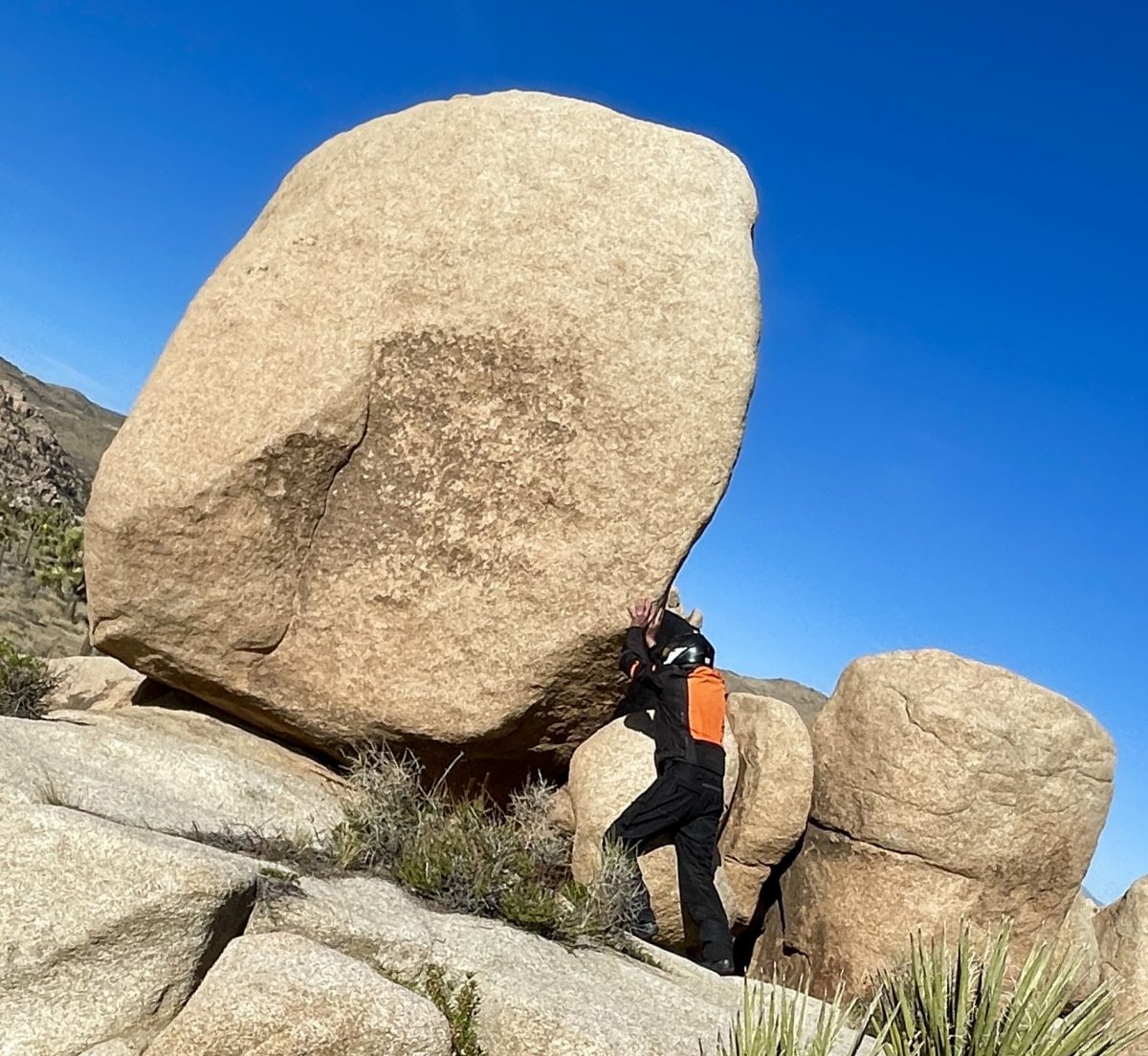
Hail to Euler!

Beauty, As In the Eye of This Beholder

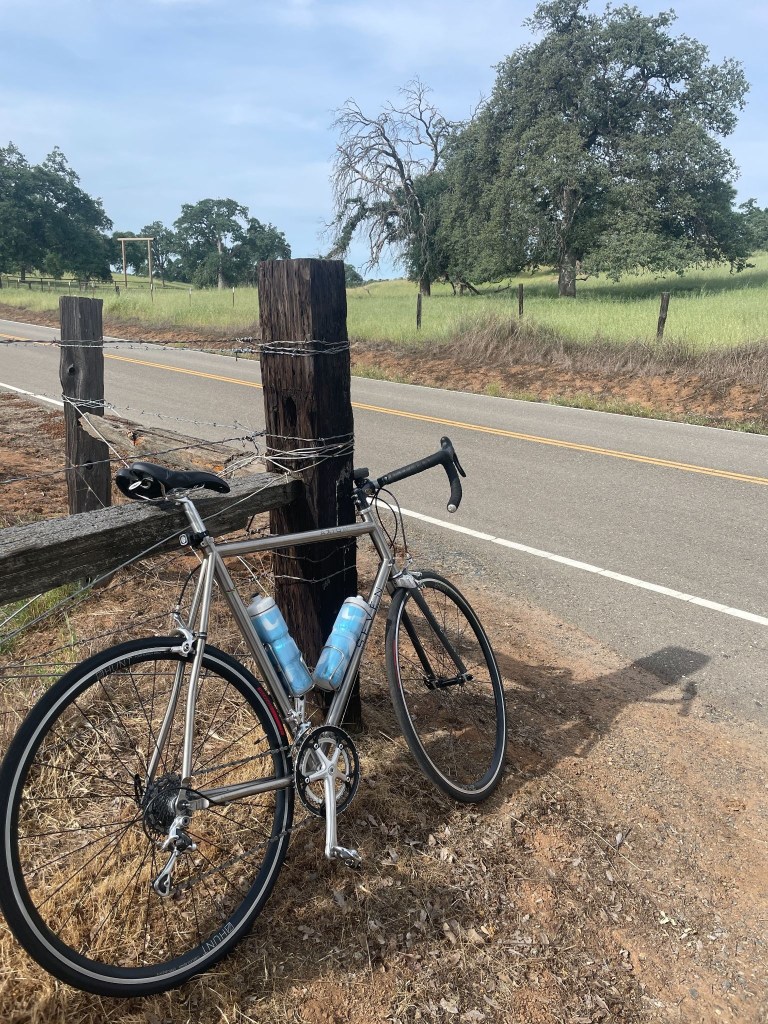
If you’re likely to jump on a bicycle to go for a ride in the country, then today would have been a great day to do just that.  With all  of the uncertainty as the world seems to be wobbling these days, neither a precession nor Chandler wobble, it’s nice to get out, get the heart pumping, and flush the confusion from the noggin.  But where to go?   
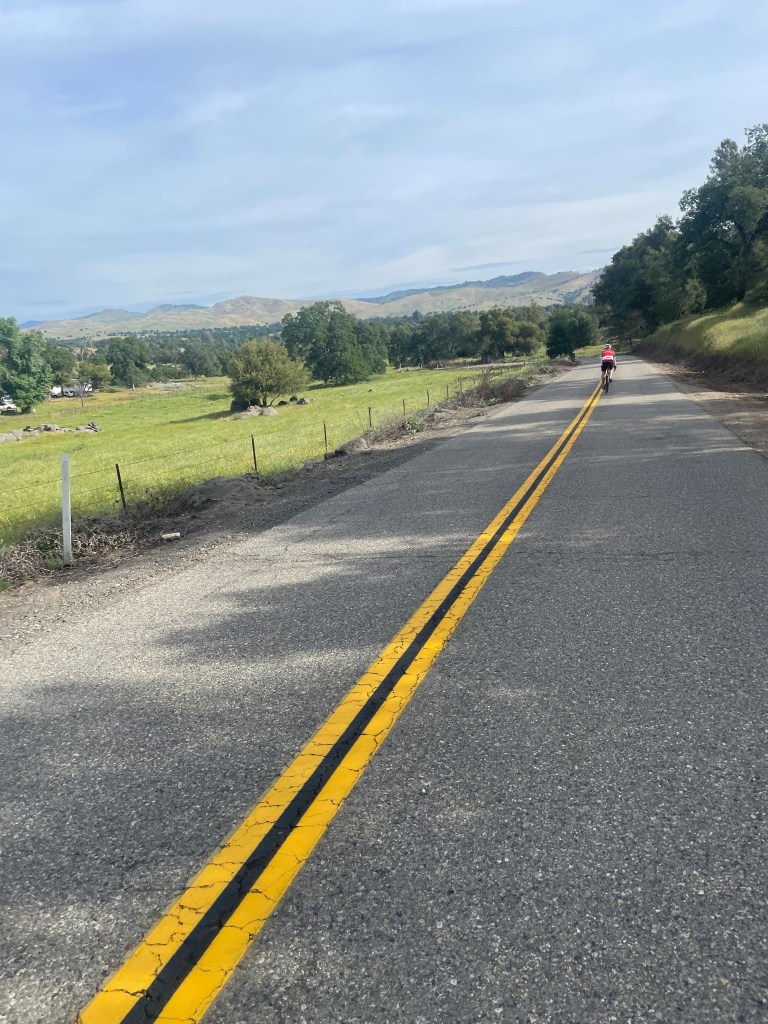
How about Mariposa County?   

Ben Hur Road is a great stretch through that golden foothill country — oak savanna, old ranches, Chinese stone fences, the kind of place where you might round a bend and find a cow, a red winged blackbird, a covey of quail, or apparently a roadside meditation on the nature of the universe.   
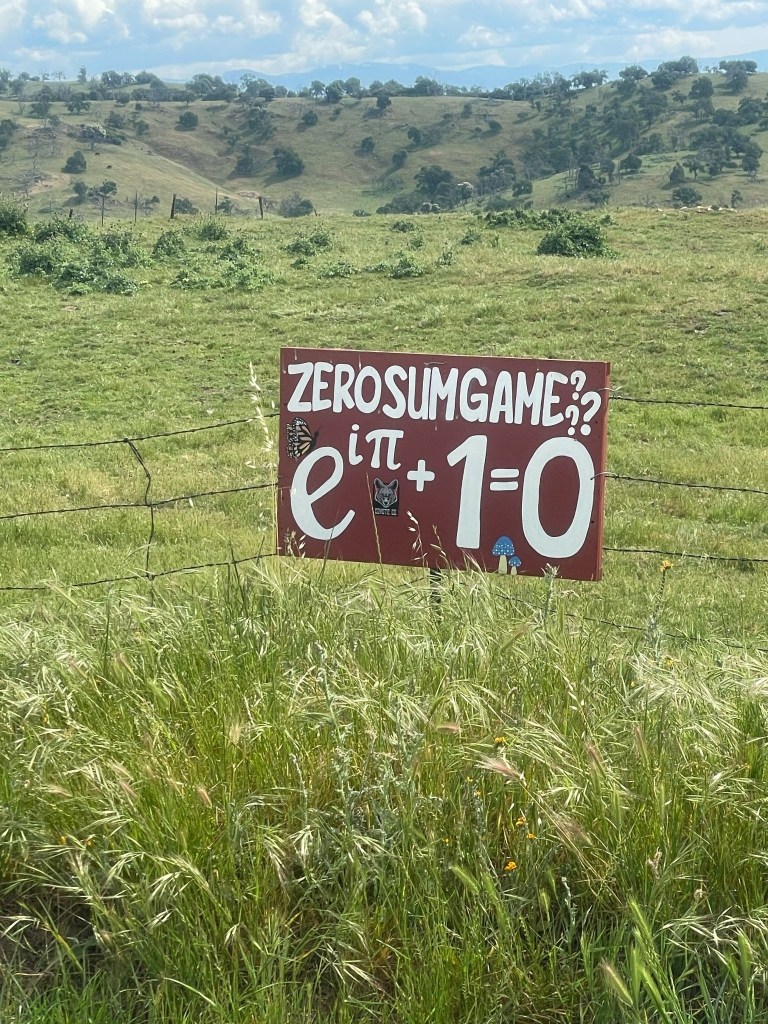
The full foothill ecosystem we observed included upland birds (turkeys, quail, woodpeckers), raptors, songbirds, a jack rabbit and some coyote scat.   There were Fiddlenecks (Amsinckia) — those coiled orange-yellow clusters that carpet entire hillsides, Lupine in both blue and white — gorgeous against that green grass and some  yellow/orange small flowers that were likely goldfields (Lasthenia) — or butter-and-eggs (Triphysaria).  Buckeye (Aesculus californica) and deer brush (Ceanothus integerrimus) were in full bloom before the summer heat and lack of moisture will force them into dormancy.  

Indeed, I got to dust off the California Naturalist credentials that lie dormant in my CV.  But, there’s something more in that zero-sum question sign in the midst of the verdant rolling hills that resonates with Sisyphus.  Was it a witty philosophical cowpoke or some clever mathematician on a Sunday drive in the country wanting to challenge those passing by?

In case you’re not familiar with this equation, Euler’s identity is celebrated for its beauty as it elegantly links five fundamental mathematical constants:  e, i, π, 1, and 0 in a single, surprisingly simple relationship.  I taught sixth grade math for a quarter century.  Before that, ten years in an elementary classroom or a classroom of teachers as a staff developer and curriculum guy.  Mostly arithmetic with a smattering of probability, algebra, and geometry.  Oh, and measures of central tendency.  You might know that as the mean, median, and mode that  are used to summarize data sets, AKA statistics.  So don’t count on me to explain Euler’s identity beyond how my buddy Claude explained it to me. 

 I do have a Euler’s disk that was a gift from a student.  For those who don’t know — a Euler disk is that mesmerizing spinning disk that precesses faster and faster as it loses energy, the spinning becoming almost frantic right before it suddenly… stops. Silence.  Zero.  It’s a beautiful physical demonstration of a system summing to nothing, but the journey to that zero is hypnotic and spectacular.… Kind of like when Sisyphus reaches the summit and the heave-ho cedes to wheeeee…

The question ‘ZERO SUM GAME ??? is the clever bit.  A zero-sum game is an economic/game theory concept where one party’s gain equals another’s loss — the total always nets to zero. The sign is asking: is life a zero-sum game?  Then it answers with Euler’s Identity, which literally equals zero — but gets there through an extraordinarily rich, interconnected web of mathematics spanning complex numbers, exponential functions, and geometry.  At least that’s how it was explained to me.

Like I said, nothing I taught in sixth grade, but I hope I at least approximated the beauty in the math I did teach to sixth graders to that of Euler’s interconnected math.  So, the implication of the sign being: yes, it sums to zero, but the journey there is anything but zero is what resonatesNow Sisyphus gets it!

 It’s a genuinely witty piece of roadside philosophy — the universe might net out to nothing, but the structure and beauty along the way is staggering.  Just like today’s ride.  Spending three hours huffing and puffing uphill, and zooming down hill is the Sisyphusian bike ride.  It’s the structure and beauty along the way that makes so much more than zero.  Besides, once the atoms reach the summit, they just jam down the opposite slope.  Have I stumbled upon Sisyphus’s new and improved motto?

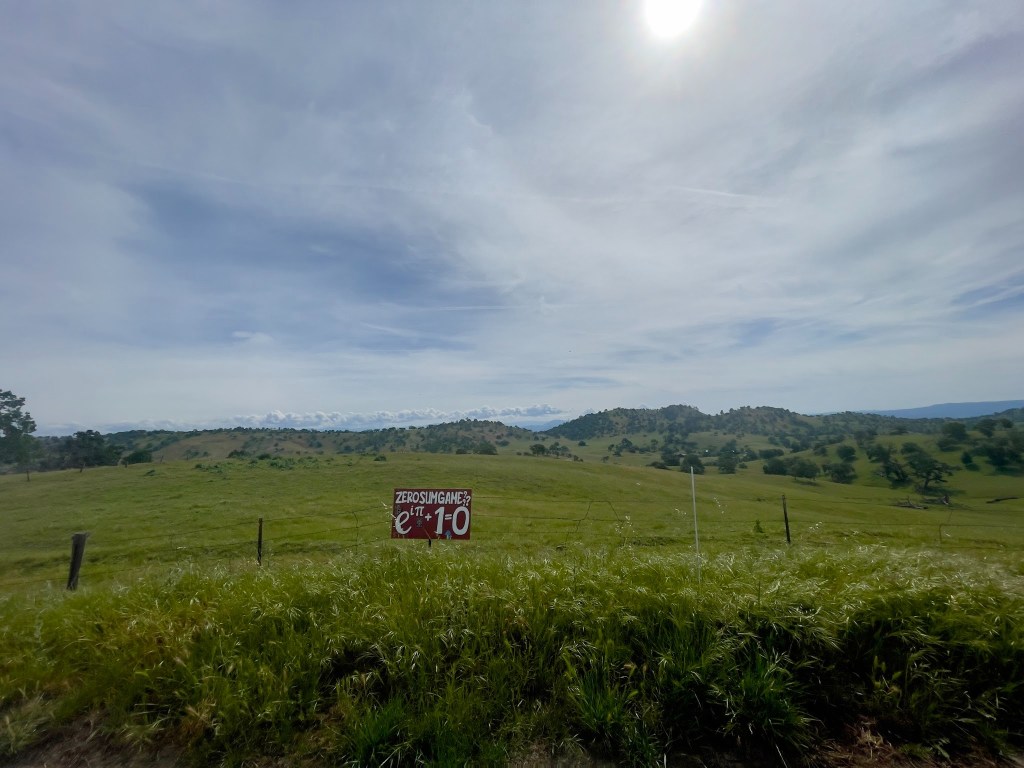
Someone out there on that road has clearly got both a mathematical mind and a philosophical one. The setting makes it even better — that sweeping green hillside backdrop, barbed wire fence, wild grass in the foreground, coyote scat on the road.  Euler’s Identity stenciled on a barn-red board feels completely at home among the Mariposa foothills in a way it never would on a city wall. Especially in Merced.

It’s the kind of thing that makes you slow down (literally and mentally) on what might otherwise just be a ride through the county.  We whizzed by descending that section of Ben Hur Rd.  It was on the uphill return I stopped to consider the sign, so slowing down wasn’t a problem.  The sign was near a ranch, with a gate that had another sign,”What do you call a cow that is laying down?  Ground beef…”  

The “howdy neighbor” groan worthy dad joke followed by Euler’s Identity questioning the zero-sum nature of existence was, let’s say, unexpected.  From the lowest form of wit to one of the deepest ideas in all of mathematics, all within probably a hundred feet of each other.  And not far from the Pea Ridge Pioneer Cemetery where profound ideas go to die (Ugh, a failed attempt to out-wit ground beef).  

It’s that kind of discovery that makes road cycling special over driving.  At bike pace you actually see things, smell things, feel things — you would have blown right past that sign at 60mph in a car, or maybe just glimpsed it without being able to read it as we did on the descent. On a bike you can slow down, stop, pull out your phone, snap a pic,  and really take it in. The dad joke on the gate got a groan from SMAP, which was right there with my commentary on the 12%-er as we climbed. That had something to do with inertia, another of my middle school topics.

Is the boulder rolling uphill a zero-sum game? The equation says it nets to zero, but the experience — the green hills, the lupine, the turkeys, whizzing down the hills or wheezing up the climbs — is anything but. It captures both the physical reality of hill riding and something existentially honest about why we keep going back. Not futility, but meaning found in the repetition itself.  Spice up the familiar routes with what is inevitable, some heretofore unobserved glimpse of life affirming detail, and there you have it.  

The wobble seems to be a little less worrisome. 
Say Hey to the Painted Ladies

We missed the super bloom but have caught the super migration…

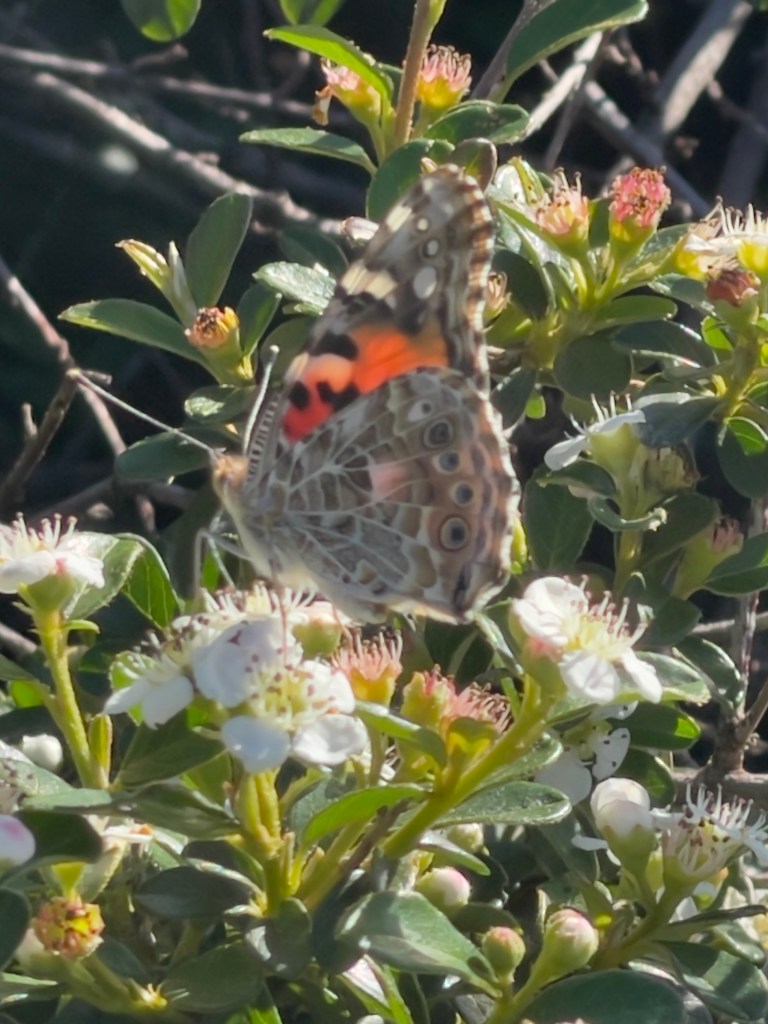
“Vanessa”enjoying a Cotoneaster blossom in our garden. 

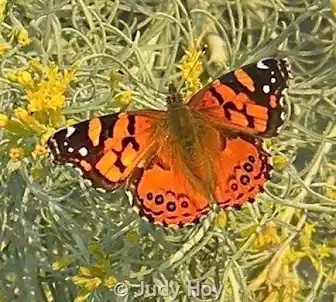
Painted Lady (Vanessa cardui)

Reports from March and April 2026 confirm high volumes of Painted Ladies moving northward through areas like San Diego and Orange County.

2026 migration, now reaching Merced County, is noted as being larger than normal. In peak “irruption” years, which often follow wet winters, their numbers can reach into the hundreds of millions or even a billion.

These butterflies are known for flying “like a bat out of hell,” reaching speeds of 20–30 miles per hour. They typically fly at eye level, making them very easy for people to spot. But equally difficult to photograph.

They are traveling from their wintering grounds in the Mojave and Colorado deserts toward the Pacific Northwest(Oregon, Washington) and as far north as Canada.

I began noticing them on our Moto ramble to Anza-Borrego around the first of March.  On bicycle rides through the month we spotted them increasingly, noting how infrequently we see these large winged pollinators, like monarchs or swallowtails these days. 

Today, Easter Sunday, I kept seeing them“flying like hell”across our backyard, a few pausing to visit blossoming flowers.  It takes a fair amount of energy to make this lengthy migration.

So, Godspeed Vanessa and all of your family on this wonderful journey!  

Why I Write

Sometimes there’s a story. Sometimes there’s reflection on a process that yields a story. Here’s my process in three parts.

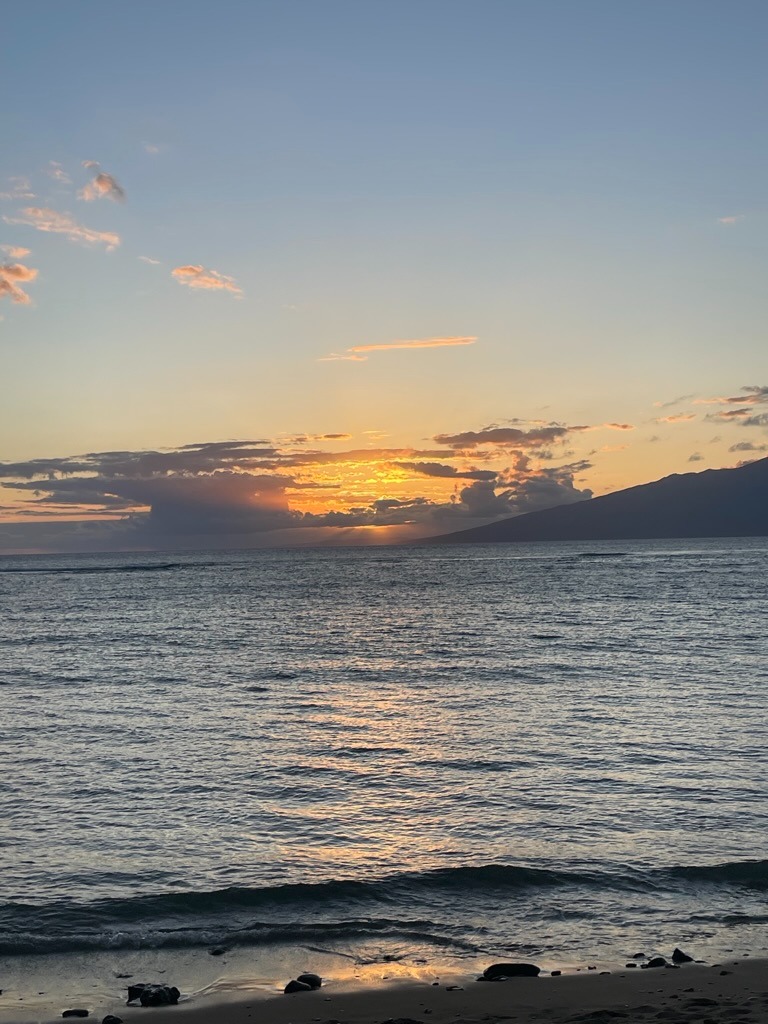
From Kāʻanapali, Hawaii May 12, 2023 
Where does the a snowflake begin and where does it end?

Why I Write, Part I

I write because I have thoughts, and thoughts, left unattended, become a problem. They pile up like unread emails, each one flagging itself as urgent, none of them quite making sense until I’ve forced them into a sentence and made them sit still.  Deleting emails may unclutter your inbox, but deleting your thoughts is not a solution.

This is not, I should say, an efficient system. A therapist would be faster. A long bike ride works too. But neither of those produces a well-turned paragraph, and that — embarrassingly, joyfully — is half the point.  Maybe it takes a motorcycle ramble to make the point whole.

I love the thing of writing. The way a sentence can be technically correct and still completely wrong. The way you swap one word for another and suddenly the whole room changes temperature. It’s a craft with no ceiling, which is either inspiring or maddening depending on the day and how long I’ve been staring at the same clause.  That’s something I didn’t understand as I do now when I began writing in earnest upon retirement.

And then there’s the other reason, the one that feels almost too earnest to say out loud: I write to find you. Whoever you are, reading this. Writing is a slightly ridiculous act of faith — that the particular shape of your inner life, wrestled into words, will land in someone else and they’ll think, yes, exactly, that’s the thing I couldn’t say. It doesn’t always work. But when it does, it’s the best feeling there is.  Even though my work doesn’t seem to have garnered much of an audience, the feedback I get has landed squarely in, here I am and you’re welcome into my world.  

So. I write to think. I write for the love of the sentence. And I write because somewhere out there, you’re reading. That seems like enough.

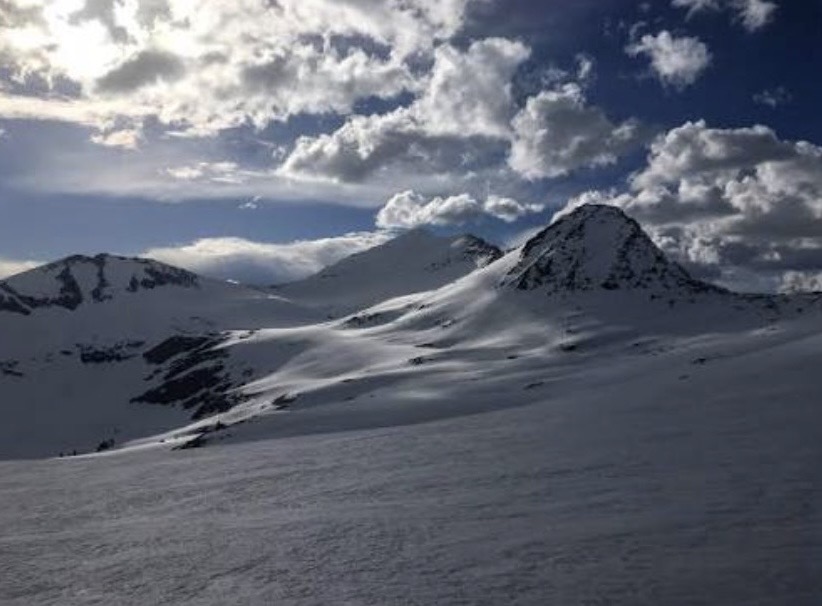
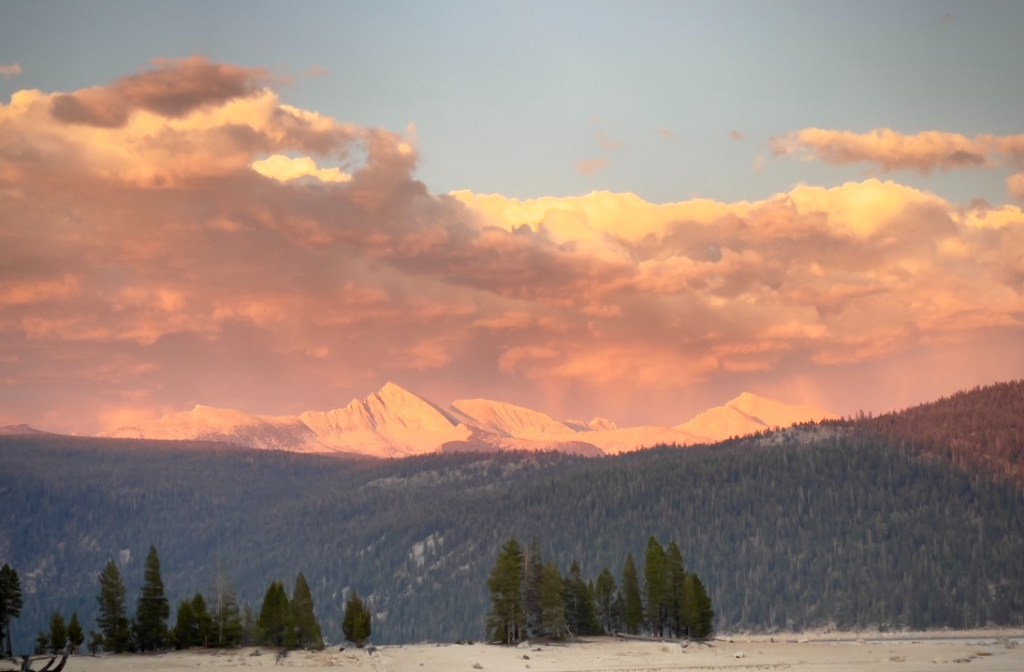
Mt. Hilgard and the Silver Divide from Lake Thomas A. Edison, August 12, 2025 
As the snowflake’s journey continues

Why I Write, Part 2

I write to figure out what I think. This sounds simple until you try it, at which point you discover that your thoughts are not, in fact, a tidy list waiting to be transcribed. They are a pile. A lively, argumentative, occasionally contradictory pile. Writing is how I sort them — how I find the thread and follow it until something true shows up at the end.  Here is what I’ve learned after 37 years in a classroom: the thread is almost always a story.

I taught public school for nearly four decades, and whatever I was supposed to be teaching — history, math, science, the proper use of a semicolon — I was really teaching through narrative. Every lesson had a beginning, a middle, and an end that opened, if I did it right, into the next beginning. Because that’s how learning actually works. Not as information transferred, but as experience built. One story stacking on another until a student looks up one day and realizes they’ve been constructing a worldview all along.

Writing, for me, is the same thing. It’s how I reflect on what’s happened — to me, around me, through me — and give it enough shape, like sculpting a clump of clay, that it means something. A story has edges. It holds like the carefully carved contours that give that clay form.

And the part that still moves me: everyone has them. Students who thought they had nothing to say. People who believe their lives are too ordinary to be interesting. They’re wrong, and I’ve spent a long time trying to convince them of that.  I humbly submit sisyphusdw7.com as my effort to share stories, mostly ordinary, but gently, persistently, and sometimes with a well-timed anecdote. 

That’s why I write. To make sense of things. To love the language that makes sense-making possible. And to keep saying, to anyone who’ll read it: your stories are in there. Go find them. They’re worth telling.  Especially if the story can bring a smile to the reader’s face or provide a glimpse into what’s possible.

Anyone who reads probably thinks they’ve got a book in them.  The book I’ve always thought was in me has a title, Journey of a Snowflake.  In its vague outline the story is based on the water cycle, a topic I have shared with somewhere in the neighborhood of some 2,700 students in the course of those nearly four decades in the classroom. 

Cycles are my jam.  I look for them and ride them.  I’m amused that my quest for finding patterns in the natural world and virtually any manipulated form of the natural world by humans, is the essence of AI.  We are all responsible for Artificial Intelligence insofar as the technology we seem not to be able to live without has gobbled up pretty much the sum total of what we’ve identified as the known and scours all of that data searching for patterns upon which predictive models can act with this artificial form of claimed intelligence.  It seems that AI has also gobbled up the unknown. Not always do those scoured patterns result in something true.  At least that’s how I understand it.   

I’m hoping my journey with this snowflake can make sense to my grandchildren as the spectre of their encounter with language is undergoing such profound upheaval.  Language is ceding ground. The images that flood my grandchildren’s world can inspire, certainly — but inspiration is not imagination. A picture gives you something to see.  I’ve included a few in this piece.  A word gives you something to build. And what gets built in the private interior of a reader’s mind, assembled from nothing but black marks on a page, is a thing no algorithm can generate and no screen can replicate. That is what I am afraid we are losing. That is why I write. To me, a picture is no substitute for a thousand words.

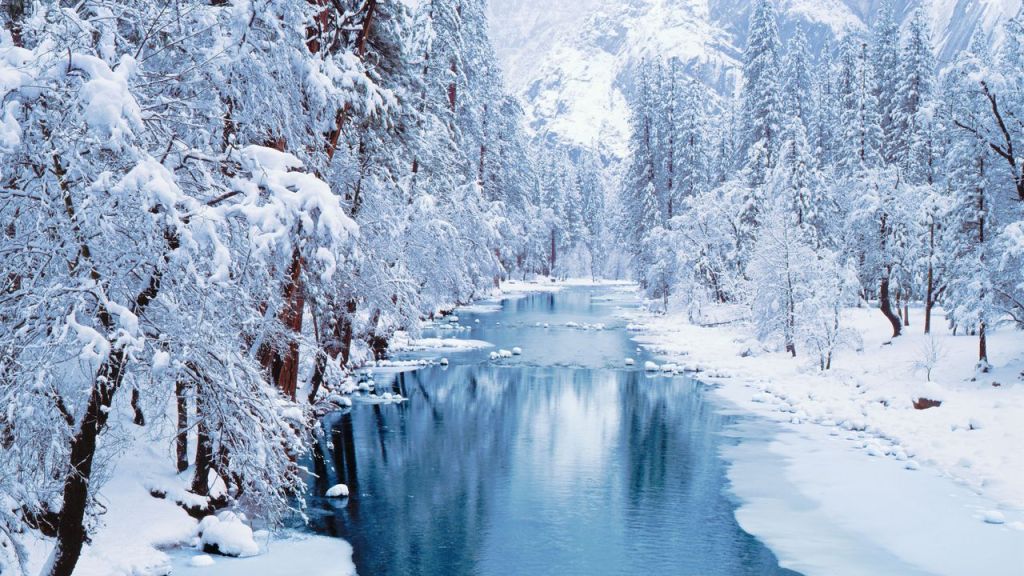
Merced River, Yosemite Valley, December 13, 2025
The snowflake is on the move

Why I Write, Part 3

Every snowflake begins as a speck of dust, a condensation nuclei. 

Not very glamorous, I know. But that tiny particle of nothing-much floats up into a cloud, and water vapor wraps around it, crystal by crystal, and something intricate and unrepeatable takes shape. Then it falls. It lands on a mountain, melts into a stream, travels to the ocean, rises again as vapor, and begins the whole extraordinary journey once more — different each time, carrying something of everywhere it’s been. 

I write to figure out what I think. Thoughts, left to themselves, are just specks of dust — vague, restless, bumping around without form. Writing is what pulls them into a shape. A sentence. A paragraph. A beginning, a middle, and an end that opens, if you’re lucky, into the next beginning. The crystal builds slowly, and then all at once you have something that didn’t exist before. Something no one else could have made in quite that way.

Our stories are like that. Each one starts small — a moment, a question, a thing that happened on an otherwise ordinary Tuesday. But stories don’t stay small. They gather. They transform. A story that begins as a local bicycle ride becomes a multiple day ramble over fascinating terrain encountering by chance ordinary people with extraordinary stories. That’s a story just like those stories depicted in my motorcycle rambles. And that’s why I write.

A story that began in a classroom finds its way into a grandchild’s imagination. A story whispered at bedtime floats up and becomes part of how a child sees the whole world. You never quite know where it will travel or what it will become by the time it arrives.

The snowflake doesn’t choose its path. It goes where the wind and the water take it — from cloud to mountain to river to sea to sky again. But here’s the quiet miracle: it was never lost. It was always becoming the next thing.

That’s what reflecting on our experiences does. It catches the journey mid-flight and says: look at this. Look at where you’ve been. Look at the shape of it. A story gives experience its edges. It makes the invisible visible, the fleeting permanent, the personal somehow universal. You write down what happened to you, and a stranger reads it and thinks — yes. That happened to me too. I just didn’t have the words.

So I write for the craft of it — for the love of finding exactly the right word, the sentence that finally holds the weight I needed it to hold. I write to make sense of things. And I write because I believe, with the quiet stubbornness of someone who has spent a long time watching people discover this for themselves, that everyone has stories worth the telling. That’s what all of the authors I admire have done for me.  They’ve given me the courage to listen, consider, and tell the story.

You can too. Your stories are in there — in the ordinary Tuesdays, the small moments, the things you’ve carried so long you’ve forgotten they’re remarkable. Find them. Write them down. Give them a beginning, a middle, and an end.

And then let them go, the way a snowflake lets go of the mountain — trusting that the journey, and whatever it touches along the way, is exactly the point.

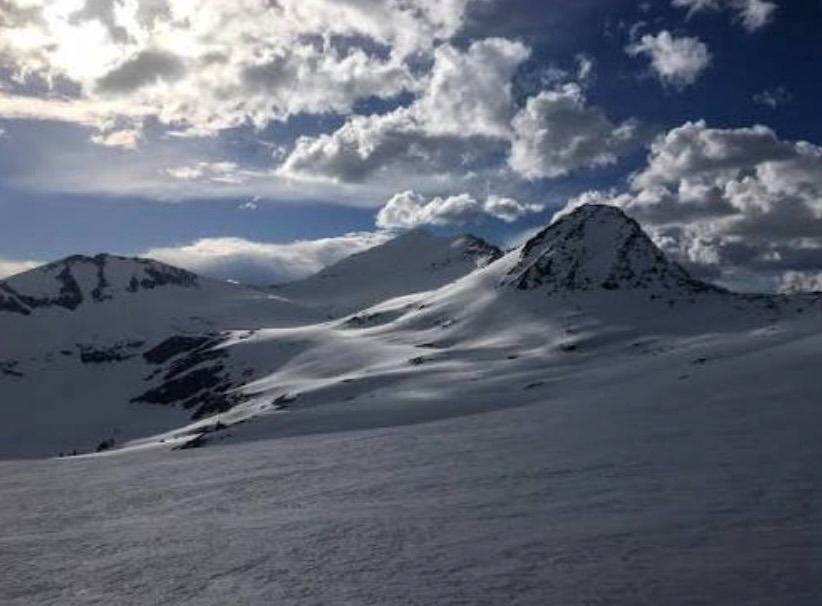
Yosemite National Park, Merced Peak on April 19, 2019 
Perhaps this is where the snowflake’s journey begins and ends, in that moment

sisyphusdw7.com