
No Italics Necessary

It’s been two weeks of fog and I don’t know what to write about. The holiday season is pressing in with its expectations. The motorcycle has been quiet and to ride the bicycle is a challenge in enduring the cold. The blog is waiting. All of it creates this particular kind of hollow that needs filling. As I gaze out the window I see a redbud that has retreated into dormancy, stripped of its life affirming leaves. An acer holds fast to its red-orange leaves drained of chlorophyll. The redwood towers over all of this drabness, ironically, taking succor from the moisture that flattens the light.
The last of the citrus, Persian limes and Meyer lemons, have been harvested. The annuals and perennials that provided exuberant blush to the landscape just a few weeks ago have collapsed into a damp, dreary withering beneath leaves shed by the crepe myrtle, now barren. The last gasp white flowering begonias and lantana with enduring lavender or orange, yellow, and red sepals and leaves of deep green await a chilling frost to join its flowerbed mates. The azalea, ferns, and hearty primroses whose blossoms are only now awakening, give some relief to an otherwise fading landscape.
Living in an area surrounded by almonds, pistachios, walnuts, and other assorted deciduous fruit bearing orchards, dormancy is overwhelmingly apparent. Ornamental trees both native and cultivated non-natives, are taking on their winter semblance, stripped of energy producing leaves as well. Only the conifers that we barely keep alive during the brutally hot summers by inundating with the remnants of the previous winter’s snowfall that comes from their native Sierra Nevada appear to thrive.
Gardners revving leaf blowers and leaf collection machinery dispatched by the city to harvest their efforts break the muted neighborhood sounds. Dog walkers are shuttered in their warm homes, rather than brace the cold dampness. Even the playful cries of children at recess attending neighborhood elementary schools is vague, only occasionally do the high pitched squeals of little girls, likely chased by little boys, break through.
Crows squawk on their morning journey northeast and again on their return flight southwest before sunset. Flickers peck for insects on the dead birch branches. Sparrow hawks dispatch cedar waxwings down from the mountains – the waxwings drunk on fermented pyracantha berries, excreting everywhere. Squirrels from Rascal Creek scamper about storing the last of wild pecans in flowerbeds that become deeply rooted nuisances as they forget their larder and I try to extract them come spring.
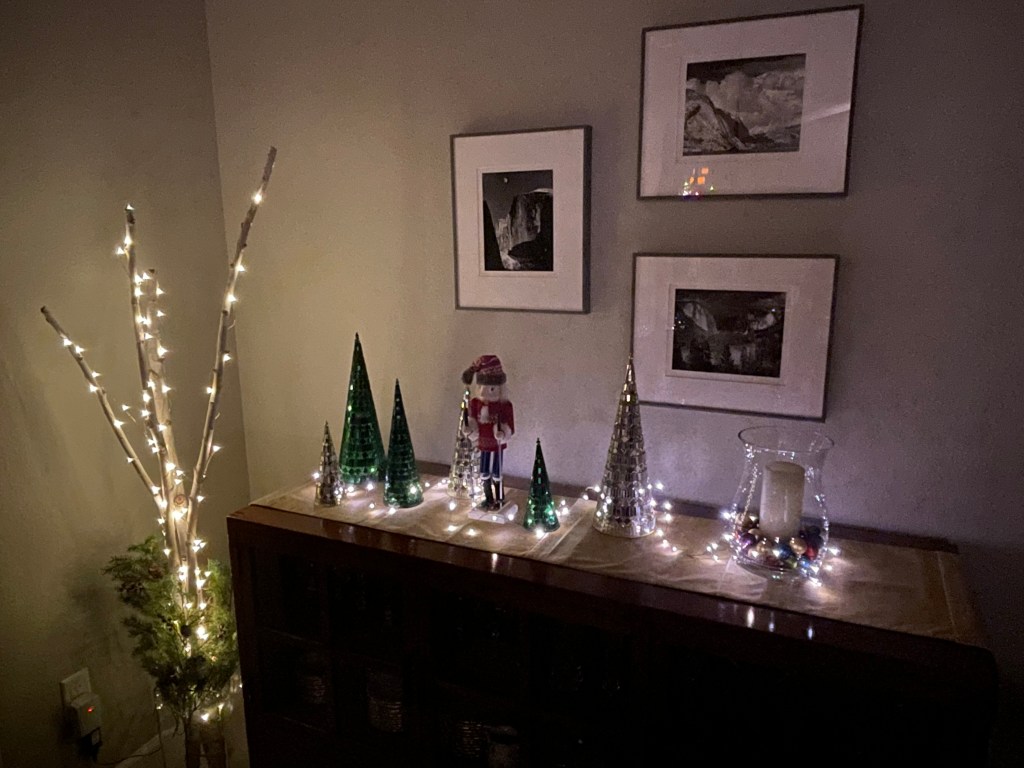
Birds getting drunk, squirrels being squirrels, nature carrying on messily despite everything. Yet for all this dormancy and dampness, something else is happening. Even in the gray stillness, there’s an impulse to create light and warmth and community when nature withdraws. It shows up at Christmas, and exists across cultures. It’s what humans do when it’s dark and cold. It punctures the fog. People have been doing this for thousands of years. When it’s cold and dark, we light fires, we gather, we feast, we make noise and music. Decorating, celebrating, gathering is a kind of gentle rebellion against the dreariness. We refuse to just hunker down like dormant trees and wait it out.
Familiar carols and seasonal music create a soundtrack that the fog can’t quite muffle. Christmas has absorbed and carries forward these older winter traditions of light-making and gathering. Squawking crows, orchards of naked trees, bone chilling cold that penetrates, and those forgetful squirrels cannot stifle a spirit that the Christmas season evokes. I may find myself toasting the cedar waxwings, acknowledging that my spirit can be warmed by a yule log from without and a cup of eggnog from within.
Cheers and season’s greetings!
Sisyphus 12/5/2025
 Sisyphus and Associates